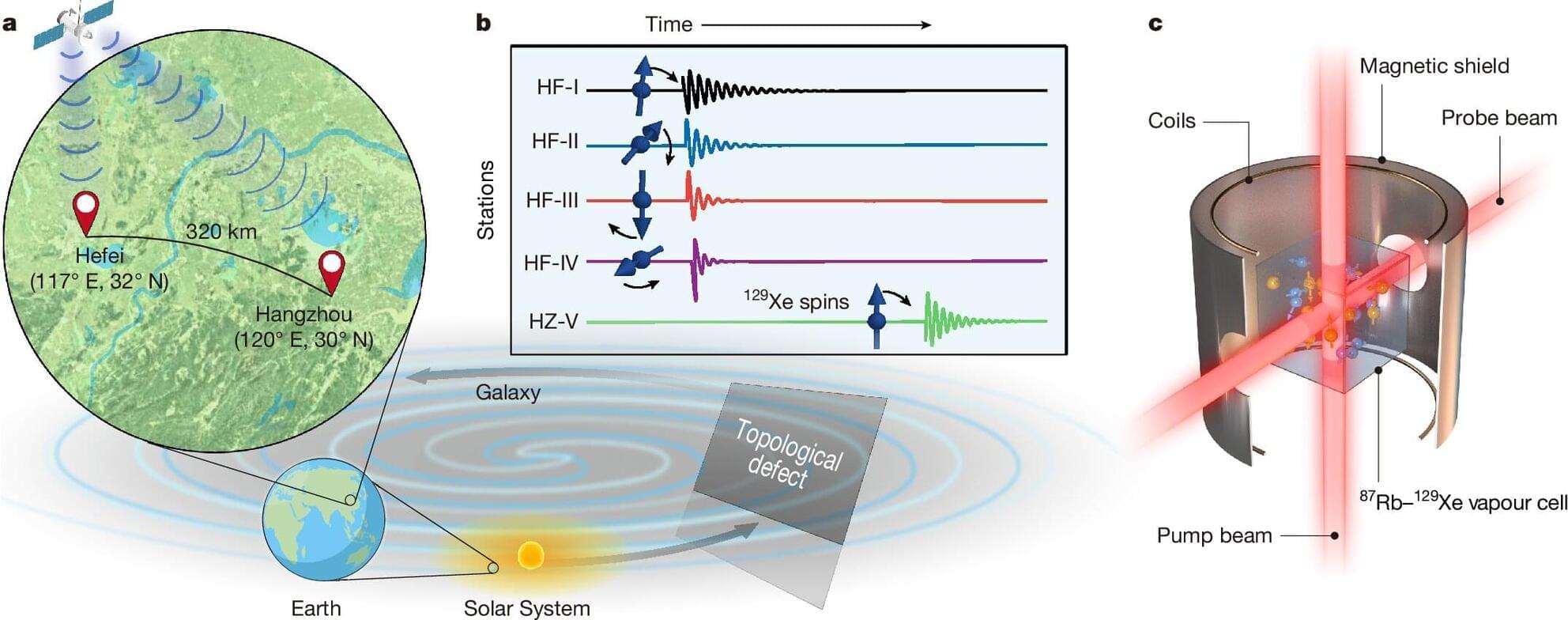
Recently, scientists from institutions including the University of Science and Technology of China made a fundamental breakthrough in nuclear-spin quantum precision measurement. They developed the first intercity nuclear-spin-based quantum sensor network, which experimentally constrains the axion topological-defect dark matter and surpasses the astrophysical limits. The study is published in the journal Nature.
Current studies indicate that ordinary visible matter accounts for only about 4.9% of the universe, while dark matter makes up about 26.8%. Axions are among the best-motivated dark matter candidates, and axion fields can form topological defects during phase transitions in the early universe. As Earth crosses topological defects, the defects are expected to interact with nuclear spins and induce signals. However, detection remains a formidable challenge because signals are extremely weak and short-duration.
To overcome the detection challenge, the research team innovatively developed a nuclear-spin quantum precision measurement that “stores” microsecond-scale axion-induced signals in a long-lived nuclear-spin coherent state, enabling a minute-scale readout signal. At the same time, the team used nuclear spin as a quantum spin amplification to further enhance the weak dark-matter signal by at least 100-fold, increasing the sensitivity of spin rotation to about 1 μrad, representing an improvement of more than four orders of magnitude over previous techniques.