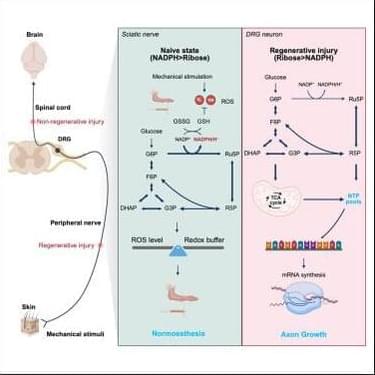
Pentose phosphate pathway in axonal regeneration.
Various signaling pathways play an important role in neuronal homeostasis and regeneration.
The researchers in this study determine that the pentose phosphate pathway (PPP) plays a dual role in enabling homeostatic and regenerative adaptations to environmental stimuli and injuries.
They show that sciatic nerve axoplasms are enriched PPP and maintains redox balance via NADPH production but following sciatic nerve injury, the PPP is required for regeneration by fueling ribonucleotide synthesis through ribose-5-phosphate.
However, after spinal cord injury (SCI), PPP remain inactive and neuronal transketolase overexpression or oral ribose supplementation, promotes metabolic reprogramming, restores sensory and motor axonal growth. sciencenewshighlights ScienceMission https://sciencemission.com/pentose-phosphate-pathway-is-a-metabolic-checkpoint
The pentose phosphate pathway plays a dual role in enabling homeostatic and regenerative adaptations to environmental stimuli and injuries and can be leveraged to promote regeneration and recovery after spinal cord injury.