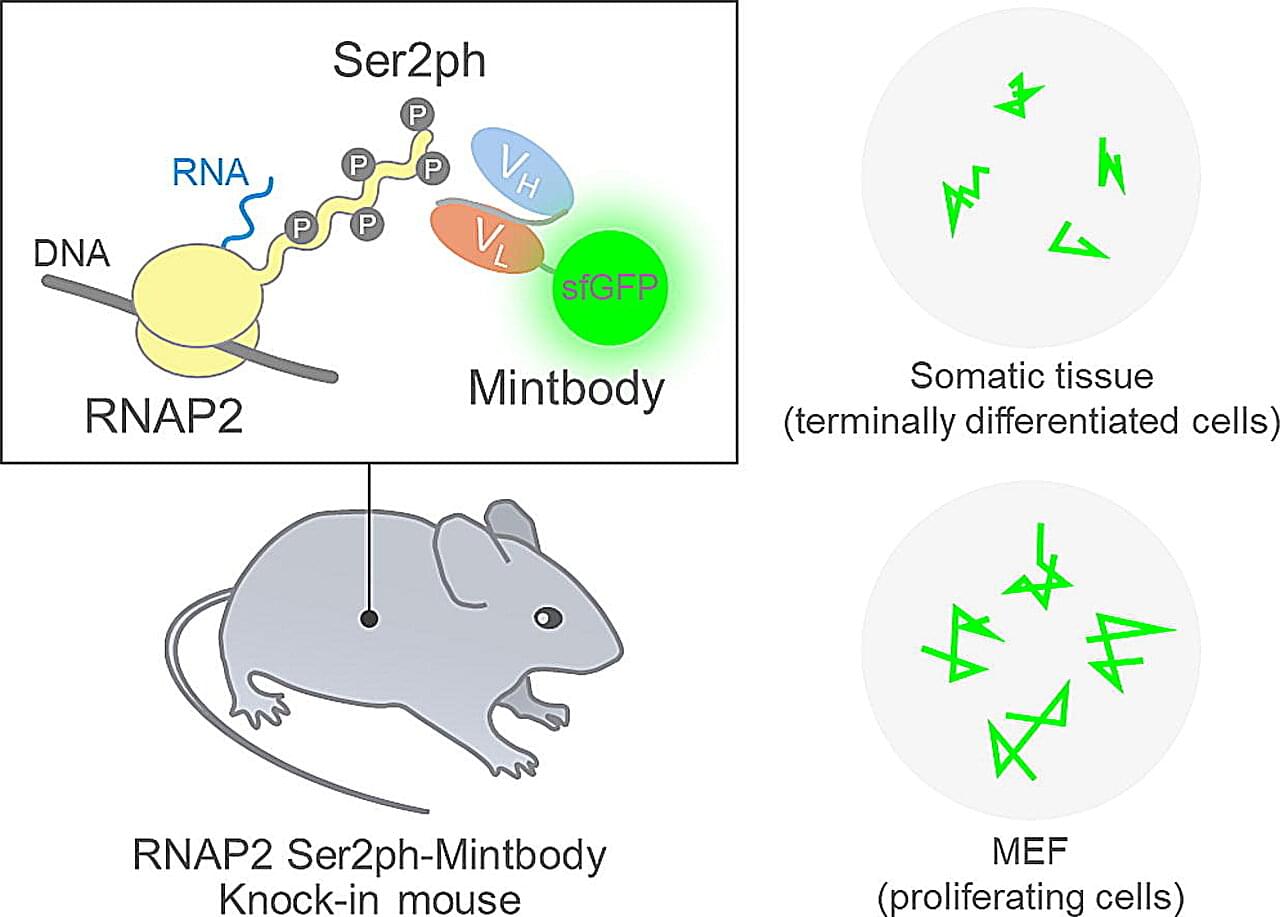
DNA can be thought of as a vast library that stores all genetic information. Cells do not use this information all at once. Instead, they copy only the necessary parts into RNA, which is then used to produce proteins—the essential building blocks of life. This copying process is called transcription, and it is carried out by a molecule known as RNA polymerase II.
When RNA polymerase II begins actively transcribing DNA, a specific site called Ser2 on its tail region is marked with a small chemical group known as a phosphate. This phosphate acts as a sign that transcription is in progress. Until now, observing this sign required stopping cellular activity and chemically treating the cells to visualize the phosphate. As a result, it was impossible to see how transcription changes dynamically in living cells.
To overcome this limitation, a research team led by Professor Hiroshi Kimura at Institute of Science Tokyo (Science Tokyo) chose a different approach. Instead of freezing cells at a single moment, they aimed to track transcription continuously without stopping cellular activity.