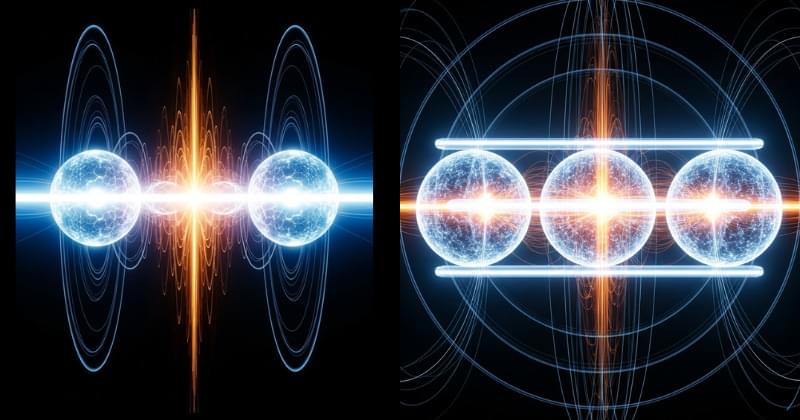
Gravity is the most familiar force in human experience, yet it remains the least understood at a fundamental level. Despite centuries of study—from Newton’s law of universal gravitation to Einstein’s general theory of relativity—gravity stubbornly resists unification with quantum mechanics. In recent decades, this tension has led some physicists to propose a radical rethinking of gravity’s nature. According to these ideas, gravity may not be a fundamental force at all, but instead an emergent effect arising from quantum entanglement and the flow of information in spacetime.
This perspective represents a profound conceptual shift. Rather than treating gravity as something particles “exert” on one another, these theories suggest it emerges statistically, much like temperature arises from the collective motion of atoms. This article examines the scientific foundations of this idea, the key theoretical frameworks supporting it, and the evidence—both suggestive and incomplete—that motivates such claims. By analyzing gravity through quantum, thermodynamic, and informational lenses, we gain insight into one of the most ambitious research directions in modern theoretical physics.
The Standard Model of particle physics successfully describes three of the four fundamental interactions: electromagnetism, the weak force, and the strong force. Gravity, however, remains outside this framework. Attempts to quantize gravity using the same methods applied to other forces lead to mathematical infinities that cannot be renormalized.