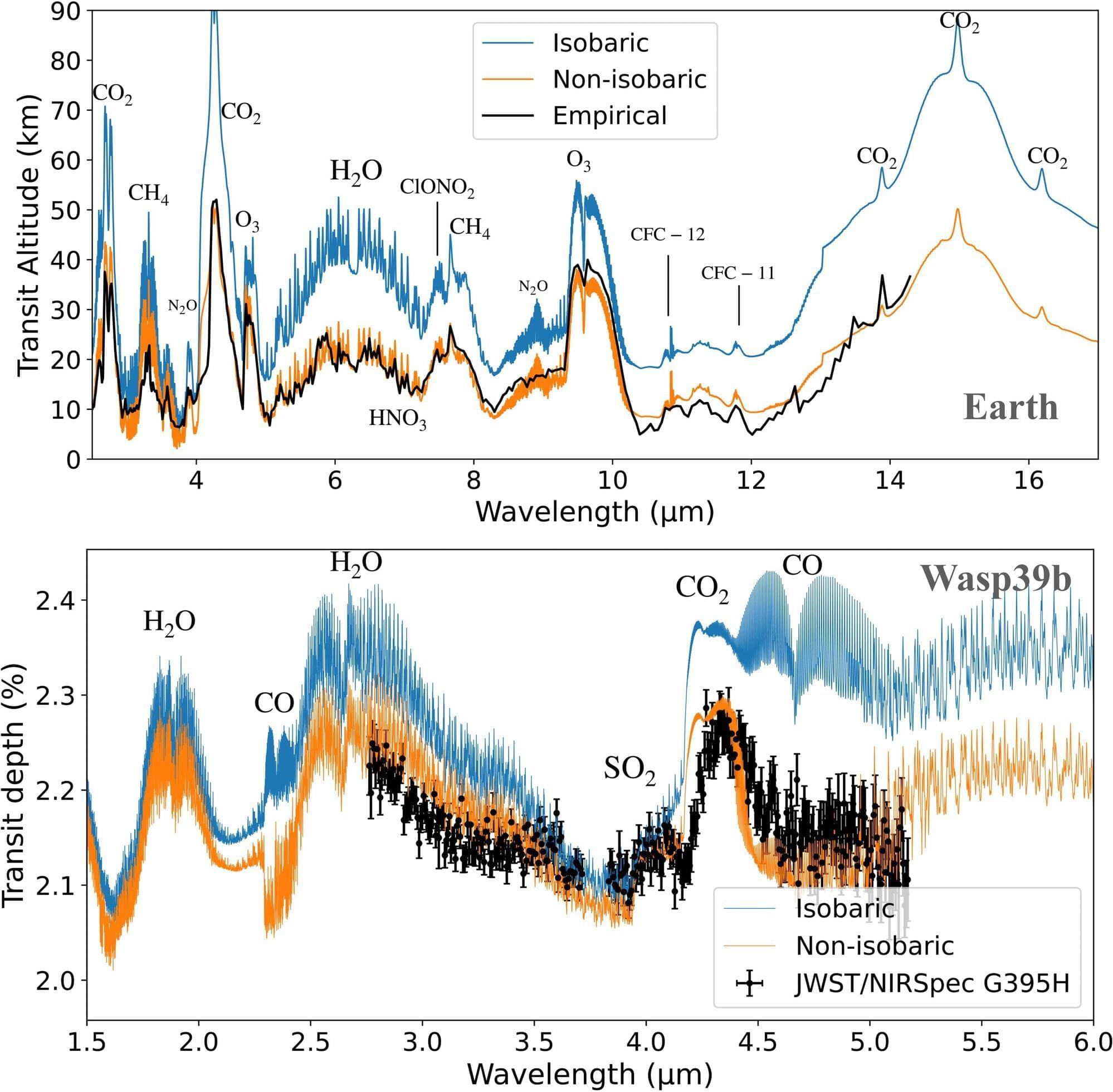
Dr. Leonardos Gkouvelis, researcher at LMU’s University Observatory Munich and member of the ORIGINS Excellence Cluster, has solved a fundamental mathematical problem that had obstructed the interpretation of exoplanet atmospheres for decades. In a paper published in The Astrophysical Journal, Gkouvelis presents the first closed-form analytical theory of transmission spectroscopy that accounts for how atmospheric opacity varies with pressure—an effect that is crucial in the scientific exploration of real atmospheres but had until now been considered mathematically intractable.
For more than 30 years, analytical models were based on a “simplified” atmosphere, as the full mathematical treatment requires solving a complex geometric integral in the presence of altitude-dependent opacity—a problem that could only be tackled using expensive numerical simulations. However, this limitation concealed how the true vertical structure of an atmosphere alters the signals observed by telescopes.
The new model provides key insights into why many exoplanet atmospheres display “muted” spectral features, directly links laboratory molecular-physics data with astronomical observations, and significantly improves agreement with real data—both for Earth’s atmosphere and for high-precision observations of exoplanets.