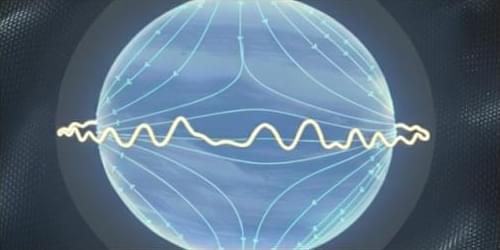
One candidate for dark matter is a subatomic particle carrying a tiny electric charge many times smaller than that of the electron. This so-called millicharged dark matter would presumably interact with Earth’s magnetic field, generating potentially observable time variations in the magnetic field on Earth’s surface. A new study of archived data looked for this signal but came up empty [1]. The research has thus placed strict limits on the properties that a millicharged dark-matter particle could have if it has a small mass (in the range of 10–18 to 10–15 eV/c2).
Dark matter can’t have a typical electric charge, as it would interact too strongly with normal matter. But a small charge is possible and could produce features in-line with dark-matter models. Astrophysicists have looked for evidence of millicharged dark matter in stellar evolution data, as such particles could cause stars to cool faster than expected. No such signal has been seen, ruling out a large portion of millicharged-dark-matter parameter space.
Lei Wu from Nanjing Normal University in China and colleagues have explored another potential signal in the geomagnetic field. According to the team’s calculations, low-mass millicharged particles could annihilate each other in the presence of the planet’s magnetic-field background, producing an effective electric current that would generate its own magnetic field. This dark-matter-induced field would be small (roughly a million times less than Earth’s field), but it might be detectable owing to its peculiar time variation (at frequencies less than 1 Hz). The researchers failed to find such a signal in previously collected geomagnetic observations. The absence rules out low-mass dark-matter charges in a large range down to 10−30 times the electron charge. Such a small charge may seem implausible, but “nature sometimes surprises us,” Wu says.