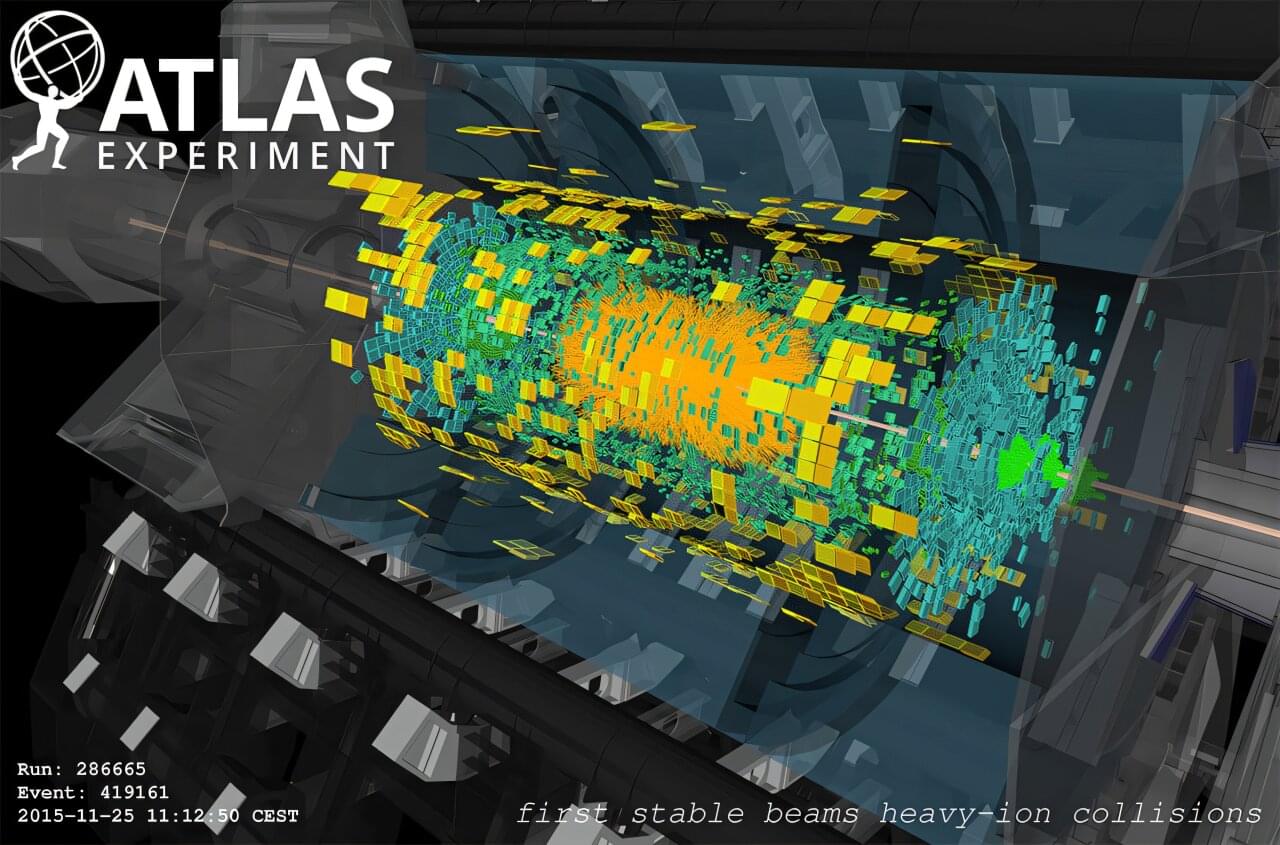
Scientists analyzing data from heavy ion collisions at the Large Hadron Collider (LHC)—the world’s most powerful particle collider, located at CERN, the European Organization for Nuclear Research—have new evidence that a pattern of “flow” observed in particles streaming from these collisions reflects those particles’ collective behavior. The measurements reveal how the distribution of particles is driven by pressure gradients generated by the extreme conditions in these collisions, which mimic what the universe was like just after the Big Bang.
The research is described in a paper published in Physical Review Letters by the ATLAS Collaboration at the LHC. Scientists from the U.S. Department of Energy’s (DOE) Brookhaven National Laboratory and Stony Brook University played leading roles in the analysis.
The international team used data from the LHC’s ATLAS experiment to analyze how particles flow outward in radial directions when two beams of lead ions—lead atoms stripped of their electrons—collide after circulating around the 17-mile circumference of the LHC at close to the speed of light. The findings offer new insight into the nature of the hot, dense matter generated in these collisions—with temperatures more than 250,000 times hotter than the sun’s core. These extreme conditions essentially melt the protons and neutrons that make up the colliding ions, setting free their innermost building blocks, quarks and gluons, to create a quark-gluon plasma (QGP).