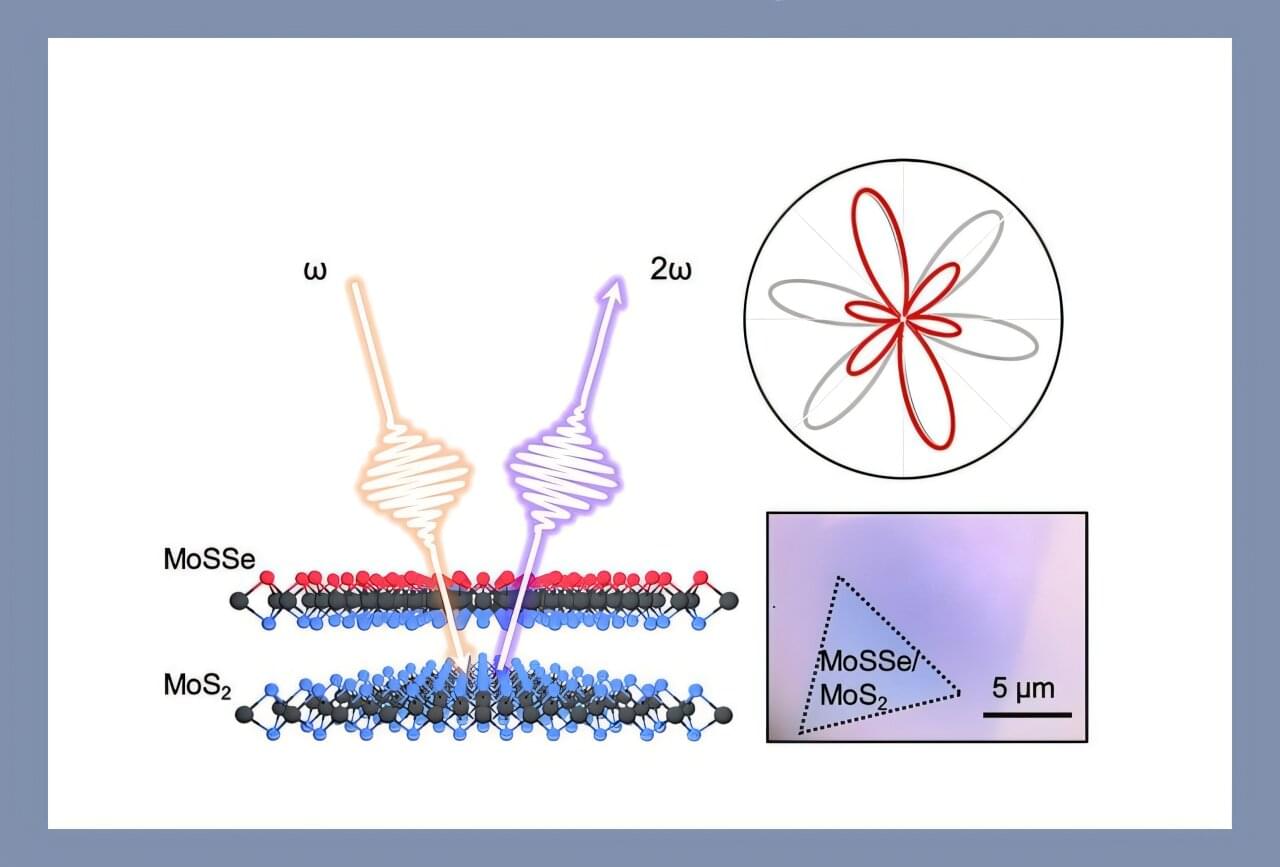
Rice University researchers studying a class of atom-thin semiconductors known as transition metal dichalcogenides (TMDs) have discovered that light can trigger a physical shift in their atomic lattice, creating a tunable way to adjust the materials’ behavior and properties.
The effect, observed in a TMD subtype named after the two-faced Roman god of transitions, Janus, could advance technologies that use light instead of electricity, from faster and cooler computer chips to ultrasensitive sensors and flexible optoelectronic devices.
“In nonlinear optics, light can be reshaped to create new colors, faster pulses or optical switches that turn signals on and off,” said Kunyan Zhang, a Rice doctoral alumna who is a first author on a study documenting the effect. “Two-dimensional materials, which are only a few atoms thick, make it possible to build these optical tools on a very small scale.”