People with Down syndrome (DS) show reduced saliva flow and high periodontal disease burden. In Dp16 mice, a model of DS, Son et al. show that deficient calcium signaling in salivary glands underlies hyposalivation and is associated with oral and gut microbial dysbiosis and altered succinate levels.
Dr. jeff jones, MD — chief medical officer cullinan therapeutics.
For decades we’ve treated autoimmune diseases by suppressing the immune system — but what if we’ve been approaching the problem all wrong? What if, instead of lifelong immunosuppression, we could selectively eliminate the immune cells causing disease and allow the immune system to rebuild itself? Today we’re exploring one of the hottest areas in biotechnology: T-cell engagers and the possibility of an \.
Mark Ciotola, CEO and Co-Founder of Sustain Space.
Everyone talks about getting humans to Mars. But almost nobody talks about the harder question — how do you keep them alive once they get there? My guest today says the answer isn’t bigger rockets — it’s plants.
Mark Ciotola is CEO and Co-Founder of Sustain Space (https://www.sustainspace.com/), a company focused on developing regenerative life-support technologies for future space missions while translating those innovations to improve agriculture and sustainability on Earth. Through Sustain Space’s Orbital Genomics initiative, he is helping advance research into growing plants in space environments — an essential capability for long-duration missions to the Moon, Mars, and beyond.
Mark’s career spans entrepreneurship, academia, industry, and government, including work with NASA, Genentech, Applied Biosystems, Intuit, Carnegie Mellon University, Monash University, San Francisco State University, and Singularity University, where he served as Entrepreneur-in-Residence and faculty member in Space and Physical Sciences.
A physicist, entrepreneur, educator, and sustainability advocate, Mark is particularly interested in regenerative ecosystems, closed-loop life-support systems, space agriculture, and the broader question of how humanity can build a sustainable future both on Earth and beyond it.
Different analyses of gravitational-wave observations are converging on evidence for a distinct population of massive black hole binaries produced through repeated mergers.
Throughout the Universe, pairs of orbiting black holes emit ripples in spacetime that propagate across the cosmos. These gravitational waves carry away orbital energy, causing the black holes to slowly spiral closer together. This process is extremely slow, but, in a minority of cases, it leads to a cataclysmic merger within the age of the Universe. Since the historic detection of gravitational waves in 2015 (see Viewpoint: The First Sounds of Merging Black Holes), the LIGO, Virgo, and KAGRA gravitational-wave detectors have advanced to the point of recording a signal from merging black holes every few days of operation, yielding a cumulative catalog of hundreds [1]. Understanding how, when, and where the Universe produces these extreme astrophysical collisions remains an open question, with implications spanning physical scales from the subatomic to the cosmological.
Now, two teams led, respectively, by Cailin Plunkett at MIT [2] and Sharan Banagiri at Monash University in Australia [3] present evidence that a subset of binary black hole observations can be connected to a particular origin story: that of hierarchical mergers, in which at least one member of the pair is not the remnant of a dead star but instead the product of an earlier black hole merger (Fig. 1). The fact that these and other analyses [4– 10], based on markedly different assumptions, converge on a similar conclusion strengthens the case that hierarchical mergers constitute an important contribution to the binary black hole population.
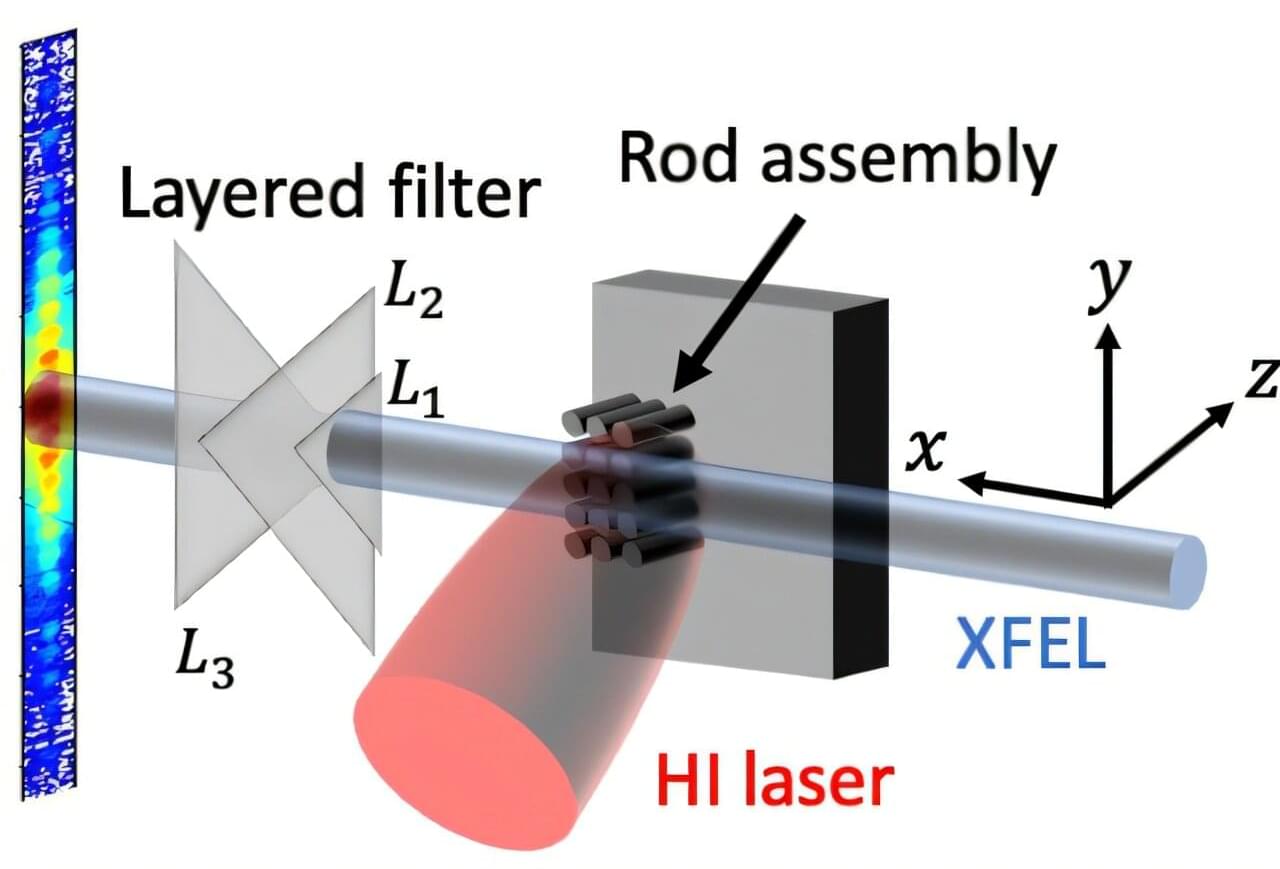
A German-Japanese research team involving the University of Augsburg has made a significant breakthrough in the use of antiferromagnets. For the first time, the team has succeeded in writing magnetic information using only ultrashort laser pulses—without the need for electric currents or magnetic fields.
Antiferromagnetic materials are considered promising for the next generation of data storage devices because they react particularly quickly and are insensitive to external disturbances. Until now, however, their application has been limited because their magnetic states are difficult to control precisely.
The research team led by experimental physicist Prof. Dr. István Kézsmárki has now developed a new method in which it is not the polarization of the light, but its direction of propagation (“pulse”), that is used for control. Through targeted irradiation, it is possible to switch between different magnetic states and write information. Furthermore, this information can also be read out using purely optical means. The paper is published in the journal Nature Materials.
The research group of Professor Kotohiro Nomura, Tokyo Metropolitan University, in cooperation with the research groups of Senior Researcher Hiroshi Hirano and Director Seiji Higashi of the Osaka Research Institute of Industrial Science and Technology, and Associate Professor Hiroki Takeshita of The University of Shiga Prefecture, has developed biobased poly(ester amide)s from inedible biorenewables that can be easily chemically recycled and exhibit better mechanical (tensile) properties in film than commodity plastics.
The work has been published in JACS Au.
The development of biobased polymers that are readily chemically recyclable and derived from nonedible renewable resources has been recognized as a promising sustainable material in the circular economy. However, there have been few examples of materials with mechanical properties (e.g. tensile strength and elongation at break) that exceed those of conventional polymers such as polyethylene and polypropylene.
In a paper published in Proceedings of the National Academy of Sciences, researchers from Technion and Tel Aviv University present BetaDescribe, an AI system that translates protein sequences into natural-language descriptions, opening a new path toward understanding protein functions and accelerating drug development and material design.
Protein analysis is essential in medicine and biotechnology, as demonstrated by breakthroughs such as Ozempic, a drug whose development was inspired by a peptide found in the saliva of a rare desert lizard and is used to treat obesity, diabetes and other conditions. However, experimental protein characterization remains a lengthy and expensive process, and even large language models (LLMs) have had limited success in performing this task.
This challenge inspired the development of BetaDescribe, an AI system that converts protein sequences into detailed textual descriptions of their functions and other characteristics. In doing so, the system helps bridge the vast gap between the hundreds of thousands of proteins characterized in the lab and the billions or even trillions that actually exist in nature.
Developers are increasingly relying on large language models (LLMs) for everyday computing tasks such as fixing bugs, explaining code and automating text-processing tasks like filtering logs.
However, it’s not as simple as entering or submitting a question and relying on the model to give you the answer. While humans easily understand these tasks and know exactly what they want, it is difficult to translate them into rigid computer code.
Phase transformations—in which a material changes from one crystal structure to another, thereby acquiring dramatically different properties—are ubiquitous in nature. Understanding the microscopic mechanisms of these transformations is essential for controlling material properties and designing functional devices.
A research team led by Profs. Chen Xingqiu and Sun Yan from the Institute of Metal Research (IMR) of the Chinese Academy of Sciences, in collaboration with Prof. Niu Haiyang from Northwestern Polytechnical University, has uncovered a previously unknown phase transformation mechanism in monolayer molybdenum telluride (MoTe2).
The study, published in Proceedings of the National Academy of Sciences on June 29, reveals a phase transformation pathway that is fundamentally distinct from the conventional martensitic model, in which many atoms move together through concerted shear displacements.
Because video games are a regular part of many people’s everyday lives, researchers have spent a lot of time trying to determine whether they are beneficial or detrimental to brain health. A new study, published in Acta Psychologica, has compiled 20 years of research on how video games affect cognitive abilities into a single systematic review and meta-analysis. This comprehensive study indicates that video games may provide some helpful cognitive benefits to gamers.
On the face of it, it might seem like video games fall into the “brain rot” category of entertainment, similar to endless social media scrolling or watching television. Yet most gamers would agree that video games involve at least some degree of skill, and many researchers would agree, too.
In fact, the interactive nature of video games has positioned them as a potential tool for cognitive training, helping to exercise core mental skills like memory, attention, self-control, spatial reasoning and broader problem-solving.