“Appearances have always played a much more important part than reality in history, where the unreal is always of greater moment than the real.“
–Gustav LeBon, The Crowd (1895)
I’ve gotten no substantive response to my last post on vaccine safety– neither in the comments, nor the TruthSift diagram, nor anywhere else, nor have the papers I submitted to two medical journals… but I have gotten emails telling me I’m delusional and suggesting I seek psychiatric attention. And this of course is integral to the explanation of how such delusions as vaccine safety persist so widely when it is so demonstrably a delusion: the majority who believe the majority must be right because its the majority are emotionally unwilling to confront the evidence. They assume the experts have done that, and they rely on the experts. But the experts assume other experts have been there. Ask your Pediatrician if he’s personally read Bishop et al and formulated an opinion on vaccine aluminum. Neither has the National Academy, except perhaps their members have and decided, perhaps tacitly, not to review the subject. Their decision not to review the animal literature was not tacit, they said they explicitly decided to omit it, although elsewhere they say they couldn’t find human evidence that addressed the issues. So everybody is trusting somebody else, and nobody has picked up the ball. And can you blame them? Because when I pick up the ball, what I receive in return is hate mail and people’s scorn. The emotional response cuts off any possible inspection of the logic.
On most questions where a majority with authority is facing a minority of dissenters or skeptics, the majority is delusional.
In other words, you are living in the matrix; much of what you and people believe is fundamentlaly wrong.
Reason 1, as above, is that the majority forms its view by circular reasoning, and rejects any attempt at logical discussion without considering it seriously, so it is prone to delusion.
Once the crowd concluded vaccines are safe and effective, for example, the question of whether the aluminum is damaging can apparently no longer be raised (even as more gets added to vaccines). And when I or others try to raise it, we are scorned and hated, and ineffectual in changing the opinion supported by circular reasoning. When new research papers appear that call it into question, they are ignored, neither cited in the safety surveys nor influencing medical practice in any way. This paragraph is all simple reporting of what has repeatedly happened.
Reason 2 is a minority wouldn’t be holding out without a good reason, because they are punished for their opposition with scorn and hatred at least. Except perhaps for explicitly religious issues, the usual reason they are so stubborn is they are defending rational truth.
Reason 3 is there’s often big money to be made or political power to be gained by influencing the majority opinion, and experts given good budgets appear to be pretty good at influencing majority opinion, especially with the aid of mass media, covertly staged stunts, and in many areas time enough to have long ago started from kids and education. On the other hand, rationality and reality don’t usually have press agents or forward looking media strategies, and there’s little or no money in swaying the minority position.
Show me a question with a majority with authority facing a minority where the majority isn’t delusional, and I’ll show you a minority that’s being paid under the table or planted to discredit rationalists in other controversial areas. At least I’ll suggest you strongly consider that as an alternative theory of what you see. The only one I can think of off hand are flat-earthers.
Mass Delusions were famously studied in 19th century first by Charles Mackay in
Popular Mass Delusions and the Madness of Crowds (1852) but more interestingly IMO in Gustave Le Bon, (1895) The Crowd. This latter was arguably the single book that had the most influence on the shape of the twentieth century. By their own accounts “The Crowd” was on Theodore Roosevelt’s bedside table, and dogeared by Mussolini. Lenin and Stalin took from it, and “Hitler’s indebtedness to Le Bon bordered on plagiarism” in the words of historian and Hitler-biographer Robert G. L. Waite. Sigmund Freud wrote a book discussing Le Bon, and Freud’s nephew Edward Bernays, acknowledged his deep debt, as Goebbels did of Bernays’ reflected insights.
Bernays equally isn’t as widely known as he should be. He invented the field of public relations, the “panel of doctors”, the slogan “making the world safe for democracy”, the diamond engagement ring, broke the taboo on women’s smoking and practically doubled sales by recruiting protesters smoking “torches of freedom”, bacon and eggs, and flouridated water, among many other things. There weren’t any decent safety studies on fluoridated water, and some modern studies say its taking multiple IQ points off the population, and nations and regions that don’t fluoridate have just as good teeth today as nations and regions that do, and putting fluoride in mouthwash and toothpaste rather than the drinking water would plainly have made a lot more sense from the point of view of public safety and health, but one thing you can count on: once he put it in the water supply and convinced everybody it was a health measure, you couldn’t sue for damage from fluoride runoff any more, and potentially multi-asbestos scale class action suits against the Government and aluminum manufacturers disappeared. Since Bernays got done, just raising the issue of fluoride gets you branded fruitcake and shunned to this day.
They are also still “making the world safe for democracy”, which he coined for WW1. But is this what they are doing, or is that another widely held delusion?
Bernays also wrote the book Propaganda which begins: “The conscious and intelligent manipulation of the organized habits and opinions of the masses is an important element in democratic society. Those who manipulate this unseen mechanism of society constitute an invisible government which is the true ruling power of our country.”
I’ve quoted from and summarized and discussed Le Bon extensively before so I will give only a brief flavor here.
“It is not necessary that a crowd should be numerous for the faculty of seeing what is taking place before its eyes to be destroyed and for the real facts to be replaced with hallucinations unrelated to them….
“To return to the faculty of observation possessed by crowds, our conclusion is that their collective observations are as erroneous as possible, and that most often they merely represent the illusion of an individual who, by a process of contagion, has suggestioned his fellows.”
“The events with regard to which there exists the most doubt are certainly those which have been observed by the greatest number of persons. To say that a fact has been simultaneously verified by thousands of witnesses is to say, as a rule, that the real fact is very different from the accepted account of it.”…
“By the mere fact that an individual forms part of a crowd, his intellectual standard is immediately and considerably lowered….
“The inferior reasoning of crowds is based, just as is the reasoning of a high order, on the association of ideas, but between the ideas associated by crowds there are only apparent bonds of analogy or succession. The mode of reasoning of crowds resembles that of the Esquimaux who, knowing from experience that ice, a transparent body, melts in the mouth, concludes that glass, also a transparent body, should also melt in the mouth…
The characteristics of the reasoning of crowds are the association of dissimilar things possessing a merely apparent connection between each other, and the immediate generalization of particular cases. It is arguments of this kind that are always presented to crowds by those who know how to manage them. They are the only arguments by which crowds are to be influenced. A chain of logical argumentation is totally incomprehensible to crowds…”
“When these convictions [of crowds] are closely examined,…, it is apparent that they always assume a particular form which I can not better define than giving it the name of a religious sentiment…
Intolerance and fanatacism are the necessary accompaniments of the religious sentiment. They are inevitably displayed by those who believe themselves in the possession of the secret of earthly or eternal happiness. These two characteristics are to be found in all men grouped together when they are inspired by a conviction of any kind. The Jacobins of the Reign of Terror were at bottom as religious as the Catholics of the Inquisition, and their cruel ardour proceeded from the same source. The convictions of crowds assume those characteristics of blind submission, fierce intolerance, and the need of violent propaganda which are inherent in the religious sentiment, and it is for this reason that it may be said that all their beliefs have a religous form.
Whether the feelings exhibited by a crowd be good or bad, they present the double character of being very simple and very exaggerated… a throng knows neither doubt nor uncertainty.”
The Red pill
So, now what’s in the red pill? Why, its a placebo. You can use any old red jelly bean. But if you swallow it and believe that the majority may be totally delusional about anything, and start looking into practically any subject with dissenters with an open mind, then I predict if you are skilled at critical thinking, you will shortways find the majority is in fact delusional, that is, you are indeed living in the matrix.
Much more widely than you are likely to imagine. For example, the news is basically propaganda, in lockstep among all the mainstream media, who accept whatever the government and political correctness tells them to believe uncritically. Was the passenger plane over Ukraine brought down by missile or strafing? Did the CDC conspire to hide a vaccine autism connection? Is the congress being run behind the scenes by a uniparty? You won’t find any of those subjects discussed unless to whitewash in the US mainstream media. What you want in a media system is ostensible diversity that conceals an actual uniformity. –Joseph Goebbels The history books are no better, as Le Bon observed. The banking system is all based on smoke and mirrors and a healthy skim. Etc.
I don’t expect TruthSift.com to convince the masses they are delusional, because Le Bon assures me logic will never sway a crowd, but I offer it as a tool to shortcut a lot of work for those who swallow the red pill. Rather than having to study a field in detail for years as I have with vaccines and needing to be able to supply PhD level understanding of what you are reading and needing the confidence of your convictions against the many, you can much more rapidly peruse a diagram and find what the real situation is, assuming the diagram has been created and debated.
So I beg readers here to create such diagrams on TruthSift for any topic you are interested in.
Of course, they are fun and interesting too.
I also commend TruthSift to corporations and others wanting to escape the kind of crowd think delusions so well characterized by Le Bon, and achieve actual rationality in your decisions. Use it on Private Diagrams. Everybody in your organization will be able to contribute to the document, if you invite them, exactly where its pertinent. It will naturally divide and conquer your problems in ways where different people can address different problems, achieving true collaboration. Nobody will be able to get confused or pursue some other agenda without being transparently refereed. The answer will be far more rationally derived and argued for than what you are doing now. You can allow people to contribute under pseudonyms if you want. http://TruthSift.com
Find my first blog post describing TruthSift here.


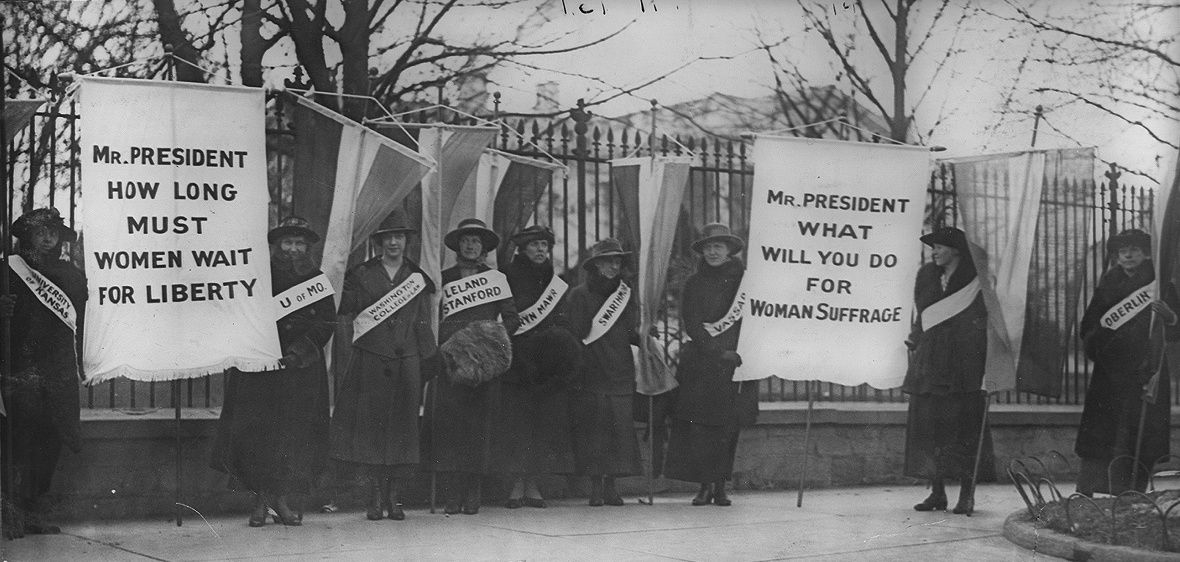
 Women were also becoming increasingly influential in politics. Such milestones included the first woman to run for president on a major-party ticket in 1972 to landmark Supreme Court cases asserting that a right to privacy does include guaranteed legal accessibility to abortion and contraceptives. Title 9, the amendment to the Education Amendments Act of 1972, enabled girls in schools across the country to receive the same benefits as their male peers. All of these milestones reshaped a woman’s role in society throughout the 20th century onwards, but they did not come without drawbacks. The ’20s was an intense era of sexist and classist attitudes. Female sexual liberation resulted in extreme objectification. After WWI was over and soldiers came home, women were whisked back into the households to resume their roles as obedient housewives. Male dominance made running for public office harder for a woman, despite having the opportunity. And let us not forget the controversy surrounding a woman’s right to privacy. A significant factor involves religious morals and/or other ethical reasoning that are not related to gender equality, but it is impossible to ignore the misogynistic rationale that many pro-lifers exhibit. All of the achievements we’ve had have seemingly been countered by just as much dissent as support, a persistent reality since Abigail Adams urged her husband to support gender equality.
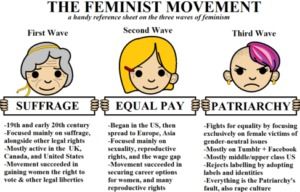 wave feminism’s goal? Is there even a goal, or are its advocates serving as the world’s determinators of what is PC
  “Dear Daughter: Here’s Why I Didn’t March For You”: “…we are biologically and physically and emotionally different from men, but that doesn’t mean we’re less. It means we’re special.”
 We live in a world where raising people up has turned into knocking others down. Vulgarity and impertinence has turned into the ideal image of a “strong” woman, and has become more and more acceptable. The idea of a feminist who respects others’ opinions has seemingly been swapped with one that thrives off of the idea of being regarded as “bitchy,” angry, or disrespectful. We’ve come a long way since our feminist founding mothers marched down Pennsylvania Avenue fighting for suffrage, and unfortunately, it’s not for the best.
 Envisioning myself in the world of politics five or ten years down the road…I won’t pretend it doesn’t worry me at times.Influential female politicians over the years have found

 They state that doing this fulfills Jihad and prophecy and is sanctioned by the Holy Qur’an. With this in mind, I the choice of poll responses is political, selfish and offensive. It assumes that readers are idiots…


 Please don’t make me translate your Indian Standard Time. I will get it wrong. I always do.