Watch our new Lifeboat Foundation YouTube channel!
Asteroids
Discovery Channel — Miracle Planet — Large Asteroid Impact Simulation.
Biotech/Medical
DNA molecular biology visualizations – wrapping and replication.
The inner life of the cell.
RNA interference in action. Low resolution above or available as a high resolution movie.
Educational Videos
- The AI Physician by our Kim Solez.
- Cryonics Fundamentals by our Edgar W. Swank and Charles Tandy.
- The End of the World: Are We Doomed? by our David Brin.
- Existential Risks by our Kim Solez.
- Mixed and Virtual Reality by our Kim Solez.
Existential Risks
Futurism
Did you know?
I am the very model of a Singularitarian by Charlie Kam.
TEDx Brussels 2010 – David Orban – Every Thing.
A visual trip through the 21st Century.
Life Extension
The Immortalists: A Short Film
Nanotechnology
Nanotechnology – Age of Convergence. Visualizes how nanotechnology will be used to repair and upgrade our bodies. Charles Ostman was the “Nanotech Visionary” behind this.
Nanotechnology Takes Off — KQED QUEST
Nokia Morph Concept. Morph is a concept demonstrating some of the possibilities nanotechnologies might enable in future communication devices. Morph can sense its environment, is energy harvesting, and self cleaning. Morph is a flexible two-piece device that can adapt its shape to different use modes. Nanotechnology enables us to have adaptive materials yet rigid forms on demand.
It is also featured in the MoMA online exhibition “Design and the Elastic Mind”. It has been a collaboration project of the Nokia Research Center and Cambridge Nanoscience Center.
Productive Nanosystems: From molecules to superproducts. An 86.1 MB high resolution version is also available.
The Dermal display. Special feature with author’s narration.
The Z450 Full Color 3D Printer made by Z Corp. (Real product that makes three dimensional objects.)
Nuclear
First hydrogen bomb test.
Particle Accelerator
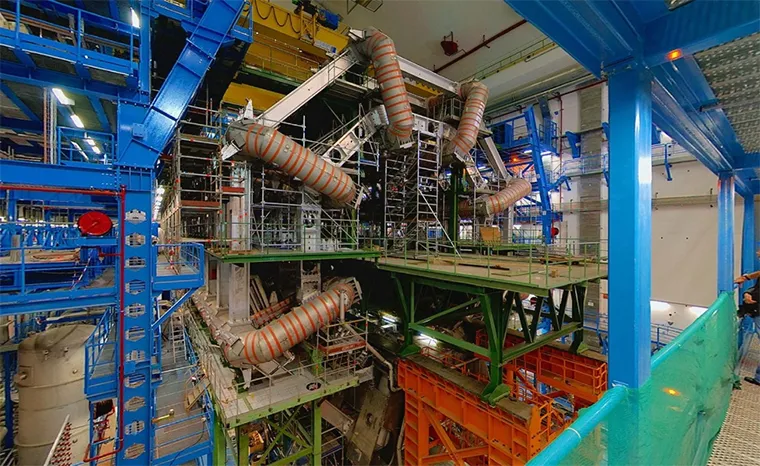
The ATLAS detector of the Large Hadron Collider (LHC) under construction. The LHC is 27 kilometers (16.7 miles) long and spans two countries.
Enter 3D panoramas with sound!
ATLAS – Episode I: A New Hope
ATLAS – Episode II: The Particles Strike Back: Part I
ATLAS – Episode II: The Particles Strike Back: Part II
Large Hadron Rap: Rappin’ about CERN’s Large Hadron Collider!
Robotics/AI
Actroid DER2 fembot released by Japan’s Kokoro.
Dancing robots (worth about $4 million in total).
High-speed robot hand demonstrates dexterity and skillful manipulation.
LittleDog Robot
RoboCup 2007 Final, Humanoid League. (Watch those amazing robot dive saves!)
Robot Quadrotors Perform James Bond Theme
The Turing Test
Space Settlement
Blue Beauty: Our Beautiful Earth.
Space compilation.
Transparency and Privacy
An old Star Trek episode comes to life with the Panoptic Systems C-Thru 3D Video Surveillance System , a way for Big Brother to get a “god’s-eye view” of everything going on inside a building or plane. Taking input from numerous 360-degree cameras placed throughout any location, the system combines all those images into one “auto-stereoscopic” display.