Understanding nanoparticles is important in astrophysics and atmospheric physics and for applications like catalysts. These particles are tough to characterize, but now Vitaly Kresin of the University of Southern California and his colleagues have determined one elusive property with high accuracy. They inferred the melting point of sodium and potassium nanoparticles 7–9 nm in diameter with an accuracy of 1% [1]. They found that the melting point is about 100 K lower than in bulk samples, in agreement with less-precise data on other types of nanoparticles of this size and with theoretical predictions. The technique could potentially provide a new way to probe other properties of nanoparticles having a wide range of sizes.
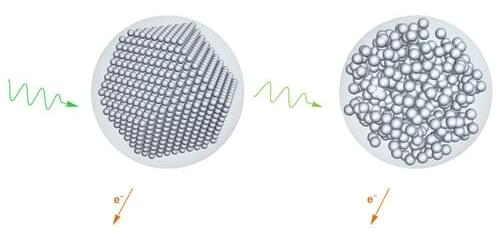
Metal nanoparticles are known to melt at lower temperatures than bulk samples, but the theory needed to predict the melting point has significant uncertainties. Experiments also face various challenges, such as the tendency of electron microscopes to melt nanoparticles. Kresin and his colleagues suspected that the work function—the energy required to remove an electron from a surface or a nanoparticle—might show some notable changes when a nanoparticle melts, given the major structural rearrangements involved.
Their recently developed setup [2] uses a beam of temperature-controlled nanoparticles targeted by an adjustable-wavelength, monochromatic light source. When the photons eject electrons, the team detects the charged particles. For both sodium and potassium, the work function-versus-temperature data show a clear discontinuity and change in slope at the melting point.