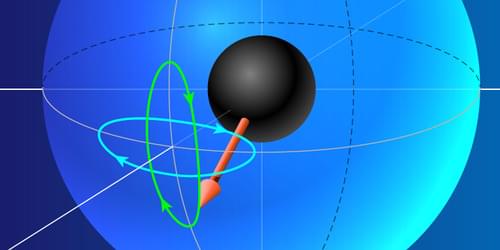
An isolated magnet’s intrinsic angular momentum induces gyroscopic motion, an observation that could lead to ultrasensitive magnetometers.
In 1861, physicist James Clerk Maxwell proposed that a magnet behaves to some extent like a spinning gyroscope [1], but his experiments never managed to demonstrate the effect. Since then, researchers have observed various manifestations of so-called gyromagnetism, mostly in specialized magnetic materials or with spinning magnets, but now a research team has detected signatures of gyroscopic motion corresponding to Maxwell’s original ideas [2]. The team used a microscopic magnetic sphere in a technique that, with improvements, could be employed for ultrasensitive magnetic-field detection, which could be useful for research on biological magnetism.
If you try to tilt a gyroscope spinning around a vertical axis, it will respond by tilting at 90° from the push direction, an effect that leads to precession in response to gravity—such as the slow loop executed by the axis of a spinning top. An electron in a magnetic field behaves like a gyroscope in a gravitational field because the electron has a magnetic moment, which is associated with intrinsic angular momentum, or spin. So you might expect that a material whose microscopic spins align—such as an ordinary ferromagnet—would have a macroscopic angular momentum and behave like a gyroscope.