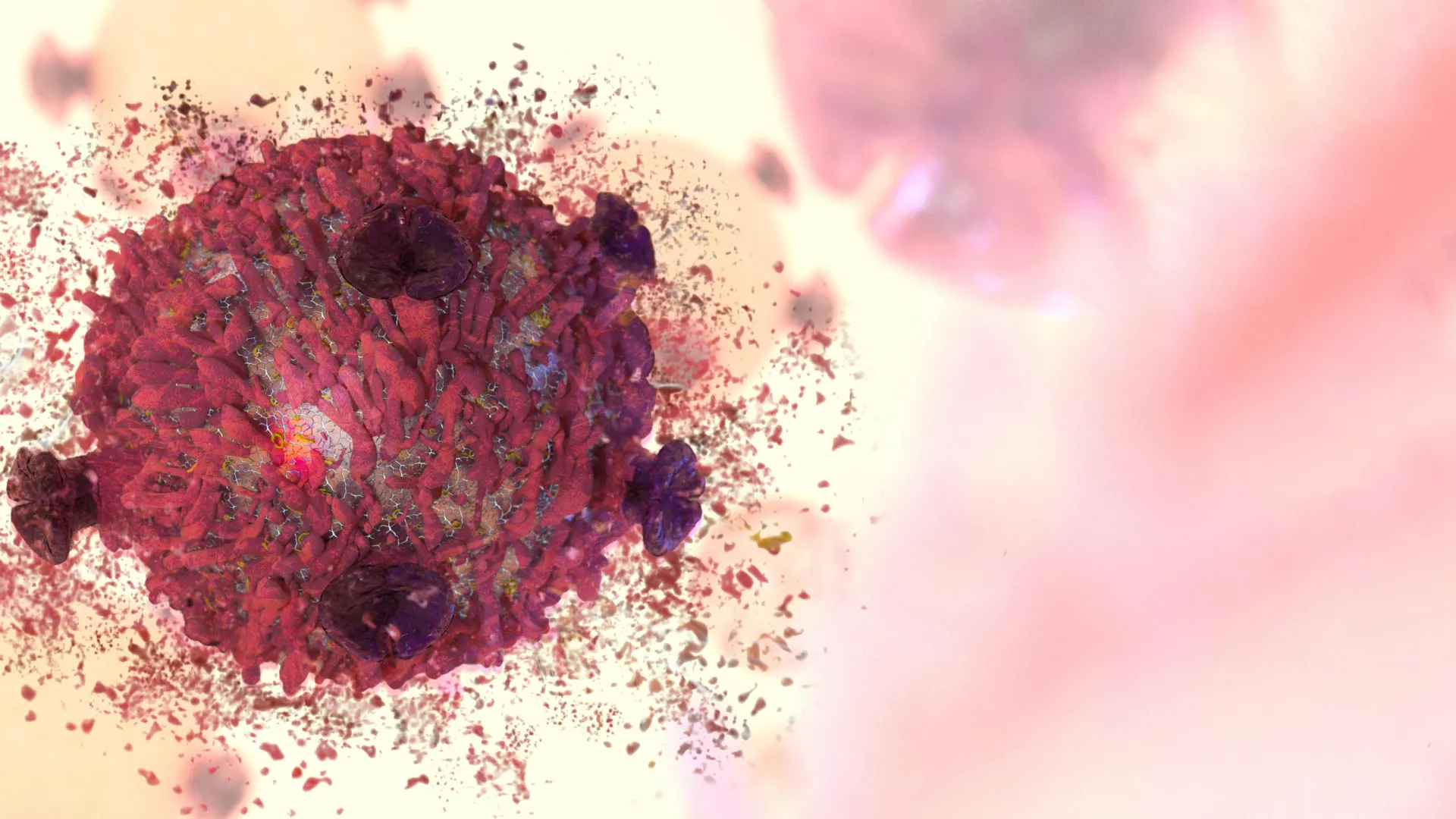
Scientists at Oregon State University have engineered a powerful new nanomaterial that zeroes in on cancer cells and destroys them from the inside out. Designed to exploit cancer’s unique chemistry—its acidity and high hydrogen peroxide levels—the tiny iron-based structure sparks not one but two intense chemical reactions, flooding tumors with cell-damaging oxygen molecules. This dual attack overwhelms cancer cells with oxidative stress while sparing healthy tissue.
An insect-scale robot that jumps using only light has completed 188 continuous leaps without a single electronic component.
The soft machine bends, snaps and resets itself automatically, powered entirely by material physics instead of chips or wires.
The robot is built mainly from liquid crystal elastomers, a rubber-like material that changes shape when exposed to light. When illuminated, the material bends and stores elastic energy in a curved beam structure.
Something once thought too delicate for real cities just survived them. A quiet test in Germany hints that the next internet may be both unbreakable and already under our feet.
On a 30-kilometer loop of commercial fiber in Berlin, researchers just teleported data while ordinary internet traffic flowed on the same line without a hiccup. The feat, executed by T-Labs with Qunnect’s Carina platform, kept delicate quantum states steady against city vibrations and temperature swings, hitting 95 percent fidelity in real time. It shows that today’s networks can carry tomorrow’s quantum links, with stakes that range from unbreakable cryptography to connected quantum computers. For Deutsche Telekom’s Abdu Mudesir, it also signals a path to European technological sovereignty as the system scales to longer distances and more nodes.
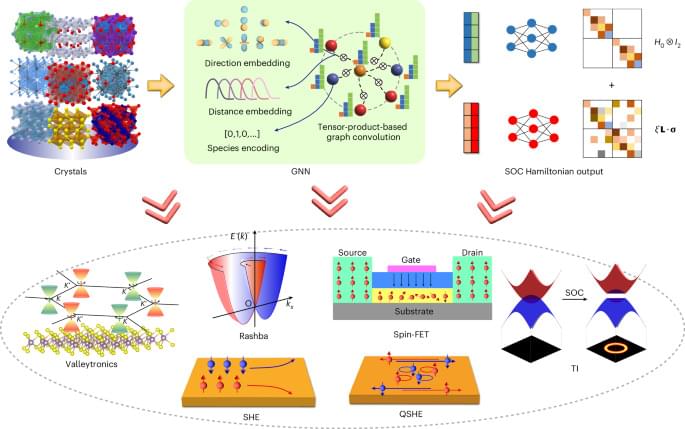
Zhong et al. introduce Uni-HamGNN, a graph neural network model that predicts spin–orbit-coupled electronic structures quickly and accurately, enabling fast screening and the discovery of advanced quantum materials across the periodic table.
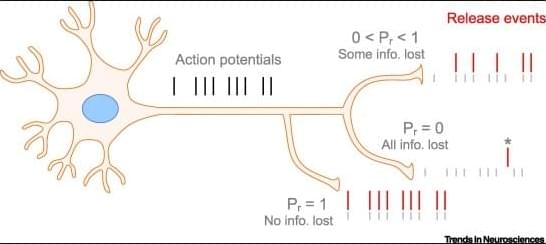
More often than not, action potentials fail to trigger neurotransmitter release. And even when neurotransmitter is released, the resulting change in synaptic conductance is highly variable. Given the energetic cost of generating and propagating action potentials, and the importance of information transmission across synapses, this seems both wasteful and inefficient. However, synaptic noise arising from variable transmission can improve, in certain restricted conditions, information transmission.
And exploration of what may be the The Coming Age of Alien Communications, and how quantum computers and AI might alter the course of how that might unfold.
⚠️⚠️⚠️Please note: The narration in this documentary is produced using advanced AI voice technology and is not voiced by a human narrator.⚠️⚠️⚠️ Sir David Attenborough: Have We Finally Solved the Fermi Paradox?
The universe contains hundreds of billions of galaxies. Each galaxy holds hundreds of billions of stars. Around many of those stars orbit planets — some potentially similar to Earth.
So where is everybody?
In 1950, physicist Enrico Fermi posed a simple yet unsettling question: if intelligent life is common in the cosmos, why have we found no evidence of it? This contradiction became known as the Fermi Paradox — one of the greatest mysteries in modern science.
In this immersive documentary, we explore whether recent discoveries in astronomy, astrobiology, and cosmology may finally offer an answer. From the staggering scale of the Milky Way to the discovery of thousands of exoplanets by missions like James Webb Space Telescope and Kepler Space Telescope, our understanding of the universe has transformed dramatically in just a few decades.
We examine the leading explanations: the Rare Earth hypothesis, the Great Filter theory, cosmic distance barriers, self-destruction scenarios, and the possibility that advanced civilizations may exist beyond our ability to detect them.