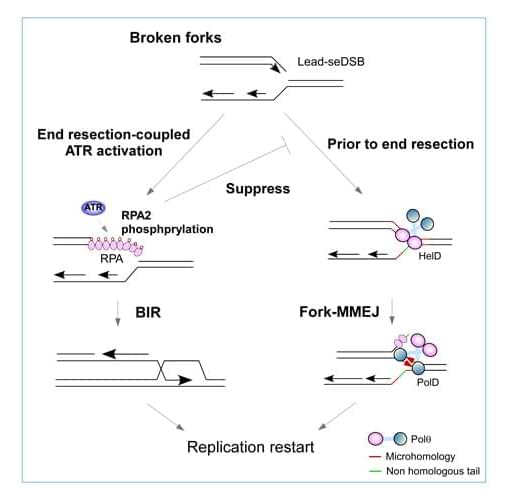
LA JOLLA, CA— A cancer drug target already being investigated in clinical trials turns out to be doing something even more consequential than researchers realized. Scientists at Scripps Research have discovered that the enzyme Pol theta (Polθ) drives a DNA repair mechanism directly at broken replication forks—one of the most frequent forms of DNA damage in cancer cells. The findings, published in Molecular Cell on March 16, 2026, help explain how tumors survive relentless replication stress and clarify why Pol theta inhibitors may be an effective strategy to selectively target cancer.
“We’ve uncovered a whole new dimension of how cancer cells cope with DNA damage at replication forks,” says Xiaohua Wu, professor at Scripps Research and senior author of the study.
Every time a cell divides, it must make an exact copy of its entire genome, a process carried out by molecular machinery that unzips the DNA double helix and reads each strand to build a new one. The point where this unzipping and copying actively happens is called a replication fork. But when this replication machinery encounters damage, forks can stall or collapse, leaving behind dangerous one-ended DNA breaks that are particularly difficult to repair and, if left unresolved, can kill the cell. This is particularly true in cancer cells, where replication stress is constant.