Toggle light / dark theme

RNA-binding proteins and ribonucleoproteins as determinants of immunity

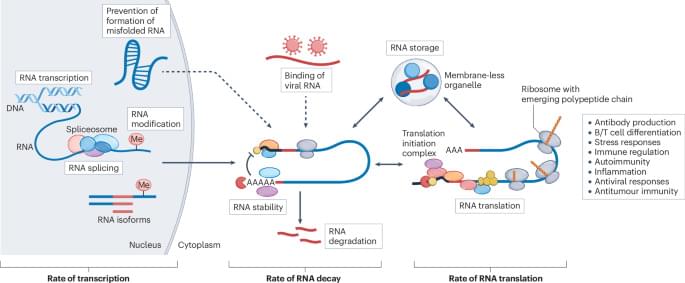
RNA-binding proteins (RBPs) considerably expand the information content of the genome and can determine the lifespan, localization and function of RNA, thereby controlling when, where and how much protein is produced. There is a growing body of evidence that links RBPs to specialized functions of immune cells and they can also mediate cell-autonomous immunity to foreign RNA and to misfolded self-RNAs. This Review examines how RBPs regulate the biogenesis and fate of mRNAs to mediate immune cell function and cell-autonomous immunity and their roles in immunodeficiency, autoimmunity and chronic inflammation.

Securing the Cyber Supply Chain in an AI Era

Supply chain attacks are now a top cyber threat—SolarWinds and Colonial Pipeline showed how one weak link can cascade across entire sectors.

In my latest article, I examine how AI, 5G, IoT, and quantum computing are expanding both risks and defenses, and share practical steps: zero trust, SBOMs, supplier audits, public-private collaboration, and board-level ownership.

Cyber supply chain security is no longer optional—it’s essential for resilience, innovation, and national security.

Read the full piece: The Cybersecurity Challenges of the Supply Chain https://www.govconwire.com/articles/chuck-brooks-govcon-expe…hain-risks.

#cybersecurity #technology #supplychain


By Chuck Brooks, president of Brooks Consulting International and one of Executive Mosaic’s GovCon Experts

Researchers pioneer next-generation AI semiconductors with ‘thermal constraining’ technique

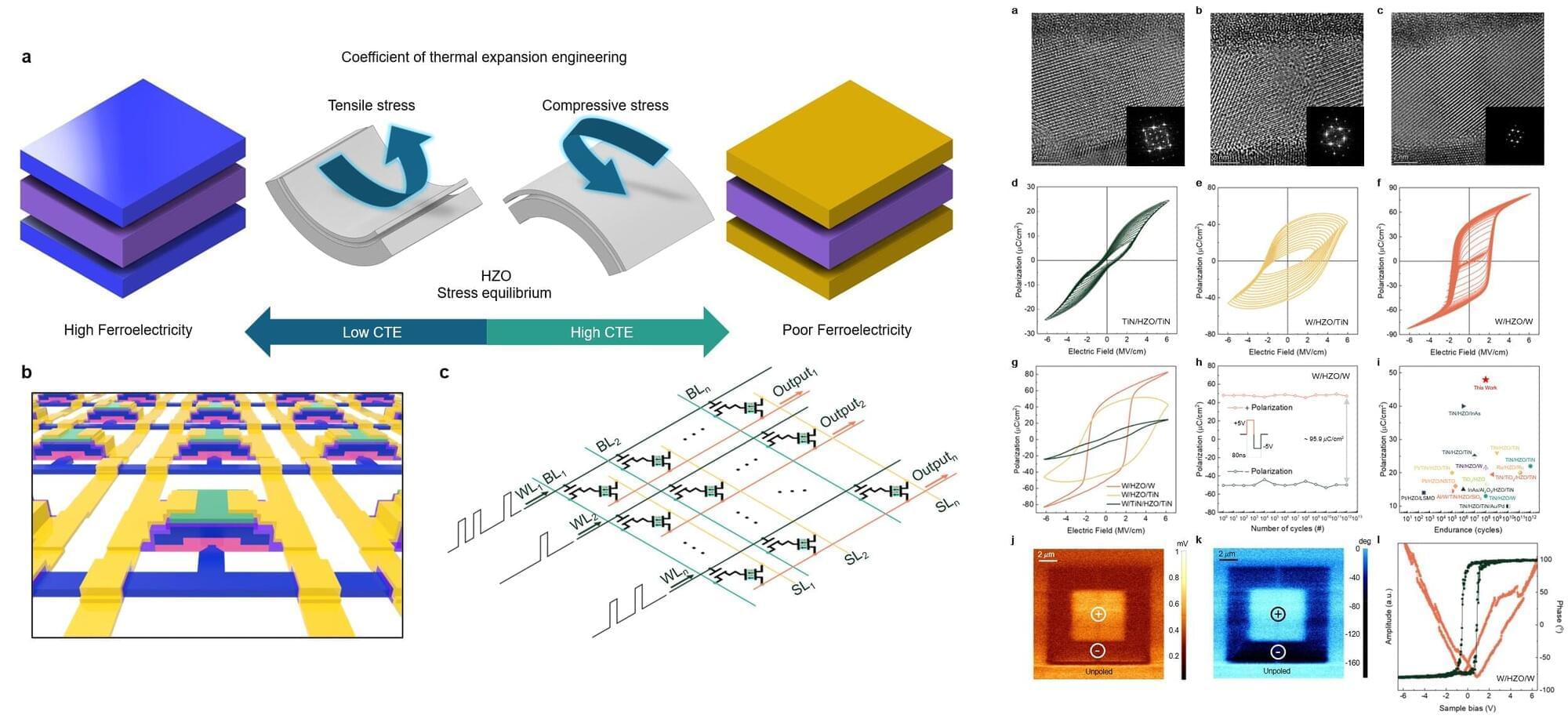
A research team led by Professor Taesung Kim from the School of Mechanical Engineering at Sungkyunkwan University has developed a technology that precisely controls the internal structure of semiconductors using heat, much like stamping out “bungeoppang” (fish-shaped pastry) in a mold. The team report that this approach improves the performance of next-generation artificial intelligence (AI) hardware. With this technology, complex AI computations can be processed more quickly using significantly less electricity than before. The findings are published in the journal ACS Nano.

Most computers and smartphones we use today operate based on the “von Neumann architecture.” This structure is similar to having a desk (the processor) and a bookshelf (the memory) placed far apart.

Each time you study, you have to go back and forth to get a book, which takes time and effort. To solve this problem, a method called “in-memory computing” has been proposed, in which computation is carried out directly inside the memory. The key component that enables this approach is the “ferroelectric transistor,” which is the focus of this study.

Diamond owl swoops in with new method to keep electronics cool

At Rice University, a research lab’s signature keepsake has helped perfect a method for growing patterned diamond surfaces that could help decrease operating temperatures in electronics by 23 degrees Celsius. The paper is published in the journal Applied Physics Letters.

“In the world of electronics, heat is the enemy,” said Xiang Zhang, assistant research professor of materials science and nanoengineering at Rice and a first author on the study. “A reduction of 23 C is significant—it can extend the lifespan of a device and allow it to run faster without overheating.”

Heat management is one of the major challenges facing today’s high-power technologies, from the gallium nitride transistors used in radar and 5G devices to the processing units powering the data center infrastructure that supports artificial intelligence. Diamond outshines most other materials when it comes to handling heat, but its hardness makes it difficult to work with. Growing diamond in technology-relevant forms is particularly challenging.

Can a chatbot be a co-author? AI helps crack a long-stalled gluon amplitude proof

Like many scientists, theoretical physicist Andrew Strominger was unimpressed with early attempts at probing ChatGPT, receiving clever-sounding answers that didn’t stand up to scrutiny. So he was skeptical when a talented former graduate student paused a promising academic career to take a job with OpenAI. Strominger told him physics needed him more than Silicon Valley.

Still, Strominger, the Gwill E. York Professor of Physics, was intrigued enough by AI that he agreed when the former student, Alex Lupsasca, Ph.D., invited him to visit OpenAI last month to pose a thorny problem to the firm’s powerful in-house version of ChatGPT.

Strominger came away with much more than he expected—and the field of theoretical physics appears to have gained a little something too.

Malicious npm Packages Harvest Crypto Keys, CI Secrets, and API Tokens

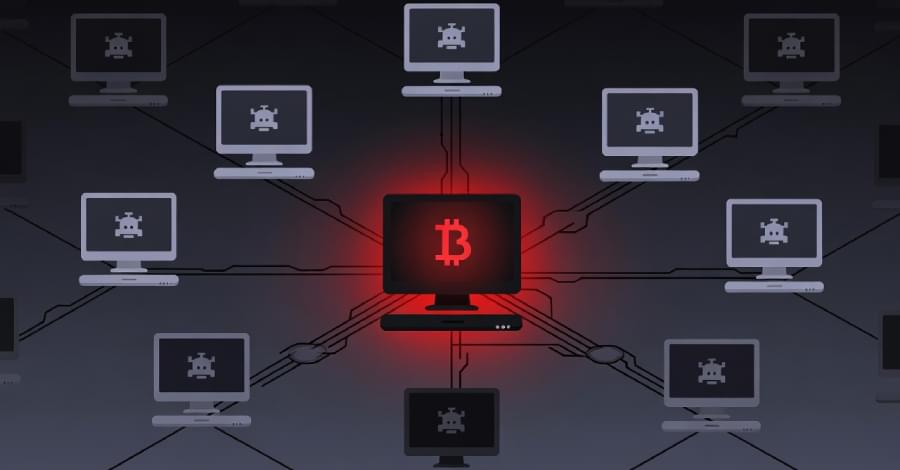
Cybersecurity researchers have disclosed what they say is an active “Shai-Hulud-like” supply chain worm campaign that has leveraged a cluster of at least 19 malicious npm packages to enable credential harvesting and cryptocurrency key theft.

The campaign has been codenamed SANDWORM_MODE by supply chain security company Socket. As with prior Shai-Hulud attack waves, the malicious code embedded into the packages comes with capabilities to siphon system information, access tokens, environment secrets, and API keys from developer environments and automatically propagate by abusing stolen npm and GitHub identities to extend its reach.

“The sample retains Shai-Hulud hallmarks and adds GitHub API exfiltration with DNS fallback, hook-based persistence, SSH propagation fallback, MCP server injection with embedded prompt injection targeting AI coding assistants, and LLM API Key harvesting,” the company said.

AI-Assisted Threat Actor Compromises 600+ FortiGate Devices in 55 Countries

With Fortinet appliances becoming an attractive target for threat actors, it’s essential that organizations ensure management interfaces are not exposed to the internet, change default and common credentials, rotate SSL-VPN user credentials, implement multi-factor authentication for administrative and VPN access, and audit for unauthorized administrative accounts or connections.

It’s also recommended to isolate backup servers from general network access, ensure all software programs are up-to-date, and monitor for unintended network exposure.

“As we expect this trend to continue in 2026, organizations should anticipate that AI-augmented threat activity will continue to grow in volume from both skilled and unskilled adversaries,” Moses said. “Strong defensive fundamentals remain the most effective countermeasure: patch management for perimeter devices, credential hygiene, network segmentation, and robust detection for post-exploitation indicators.”

/* */