Toggle light / dark theme

How “Empty Space” Is Supercharging Atomically Thin Semiconductors

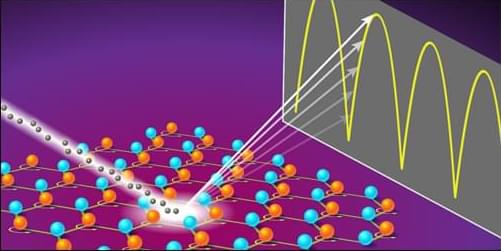
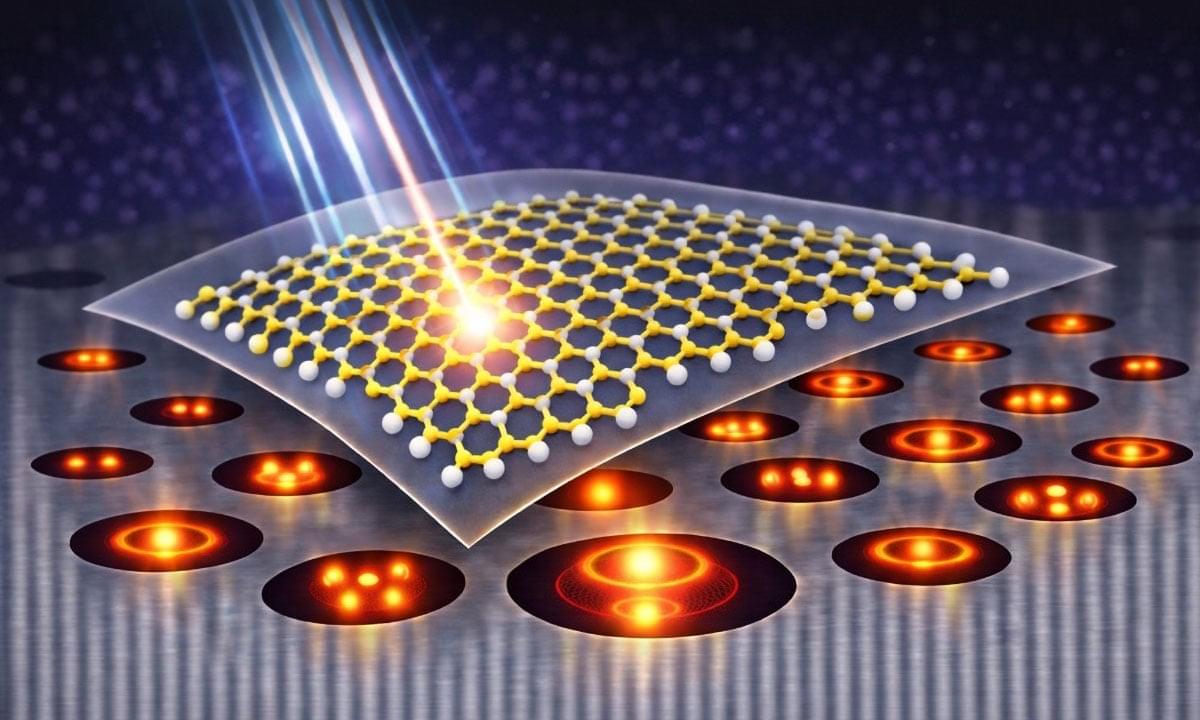
A single layer of atoms may seem too thin to meaningfully interact with light, yet materials like tungsten disulfide are reshaping what is possible in nanophotonics. Researchers have now found a way to dramatically strengthen these interactions. Atomically thin semiconductors such as tungsten dis

On the number of digital pictures Let’s switch from Go positions to digital pictures

There is an art project to display every possible picture. The project admits this will take a long time, because there are many possible pictures. But how many? We will assume the very common color model known as True Color, in which each pixel can be one of 224 ≅ 17 million distinct colors. The digital camera shown below left has 12 million pixels. We’ll also consider much smaller pictures: the array below middle, with 300 pixels, and the array below right with just 12 pixels. Shown are some of the possible pictures:

12,000,000 pixels 300 pixels 12 pixels.

Quiz: Which of these produces a number of pictures similar to the number of atoms in the universe?

Answer: An array of n pixels produces (17 million)n different pictures. (17 million)12 ≅ 1,086, so the tiny 12-pixel array produces a million times more pictures than the number of atoms in the universe!

How about the 300 pixel array? It can produce 102,167 pictures. You may think the number of atoms in the universe is big, but that’s just peanuts to the number of pictures in a 300-pixel array. And 12M pixels? 1,086,696,638 pictures. Fuggedaboutit!

So the number of possible pictures is really, really, really big. And the number of atoms in the universe is looking relatively small, at least as a number of combinations.

On counting combinations People often underestimate the number of combinations of things. I think there are two main reasons: Combinations of things are multiplicative, while collections of things are additive. If you see a line of 6 people, it is easy to visualize a line of 60 people—it is ten times longer. But even if you know that there are 720 different orderings (permutations) in which those 6 people can line up, there is no way you can visualize the number of orderings for 60 people, because it is—you guessed it—larger than the number of atoms in the universe. Big numbers are hard. Even with simple collections of things, it takes practice to get a real intuition for the difference between 6 million and 6 billion people. When it comes to combinations, growth is faster and therefore intuition fails earlier. Authors are sloppy. Doug Smith reports that the New York Times confused “million” and “billion” over a dozen times per year; other sources also make similar mistakes. See the book by Unix co-creator Brian Kernighan for more on this. So beware, and be sure to use some simple math to augment your intuition when dealing with combinations.

Scientists just turned light into a remote control for crystals

NYU researchers have found a way to use light to control how microscopic particles assemble into crystals, effectively turning illumination into a tool for shaping matter. By adding light-sensitive molecules to a liquid filled with tiny particles, they can adjust how strongly the particles attract or repel one another simply by changing the light’s intensity or pattern. This allows them to trigger crystals to form, dissolve, or even be reshaped in real time.

Nanoparticle-Single-Atom Tandem Catalyst within a Metal–Organic Framework for Efficient Ethylene Electrosynthesis

Copper nanoparticles (Cu NPs) are effective catalysts for the electroreduction of CO2 (ECO2R) to multicarbon products but suffer from insufficient selectivity, aggregation, and deactivation. To address these challenges, we developed an in situ encapsulation strategy that engineers Cu NPs in a metal–organic framework (MOF) host from a simple one-pot hydrothermal synthesis, creating a selective and robust CO2R catalyst. The key design is the introduction of Sn additives during synthesis, which later evolve into single atoms (SAs) that serve a dual function: modulating the growth of Cu NPs from 3.35 to 9 nm and acting as active sites for the conversion of CO2 to CO. The locally generated CO then feeds adjacent Cu NPs, promoting subsequent C–C coupling via a tandem mechanism. The optimal catalyst, with a balanced Cu/Sn ratio, achieves a CO2-to-C2H4 Faradaic efficiency (FE) of 64%. Combined theoretical simulations and in situ infrared spectroscopy further reveal that Sn SAs promote Cu NPs electron transfer, enriching the electron density at active sites. This stabilizes *CO intermediates and reduces the energy barriers for CO2 activation and ensuing C–C coupling steps. This work presents a novel atomic- and nanoscale design strategy for advanced CO2RR catalysts.

Neutrons Illuminate the Magnetic Dance of Chiral Phonons

Neutron scattering has provided a new and broader view of the twirling collective atomic vibrations in a magnetic crystal.

Phonons—quantized conveyors of sound and heat in solids—are usually visualized as collective vibrations in which atoms simply bounce back and forth, almost as if they were weights on springs. However, atoms can sometimes form “chiral phonons” that twirl and swivel clockwise or counterclockwise, in a way that resembles a coordinated dance [1]. When these circular, chiral motions entrain ionic charge, they generate a magnetic moment, which suggests that there might be a way to control sound and heat using magnetic fields. Until recently, this magnetic dance was primarily observed using optical techniques, granting access to only one corner of the “stage”—the point in the phonon’s momentum space where the momentum is nearly zero. Song Bao of Nanjing University in China and his collaborators have now broadened the view of momentum space by using inelastic neutron spectroscopy.

Superfluids emerge in 2D moiré crystal formed from time, study predicts

Conventional crystals are materials in which atoms arrange themselves in repeating spatial patterns. Time crystals, on the other hand, are phases of matter characterized by repeating motions over time without constantly heating up, breaking a physical rule known as time-translation symmetry.

Researchers at East China Normal University and Shanghai Jiao Tong University recently predicted the formation of a new type of time crystal, dubbed a two-dimensional (2D) moiré time crystal. This crystal was theorized to emerge when periodic perturbations (i.e., regular, repeated disturbances) are applied to ultracold atoms held in a smooth, continuous trap, as opposed to an optical lattice trap. The paper is published in the journal Physical Review Letters.

“We were inspired by two exciting concepts in physics,” Keye Zhang, professor at East China Normal University and co-senior author of the paper, told Phys.org. “The first is the concept of ‘twistronics,’ where twisting atom-thin layers creates moiré patterns with exotic material properties. While the second is that of ‘time crystals’ (a new phase of matter with persistent rhythmic motion). We wondered: could we combine these ideas by treating time itself as a dimension that can be ‘twisted’?”

Physicists discover long-predicted ‘clock magnetism’ in an atomically thin crystal

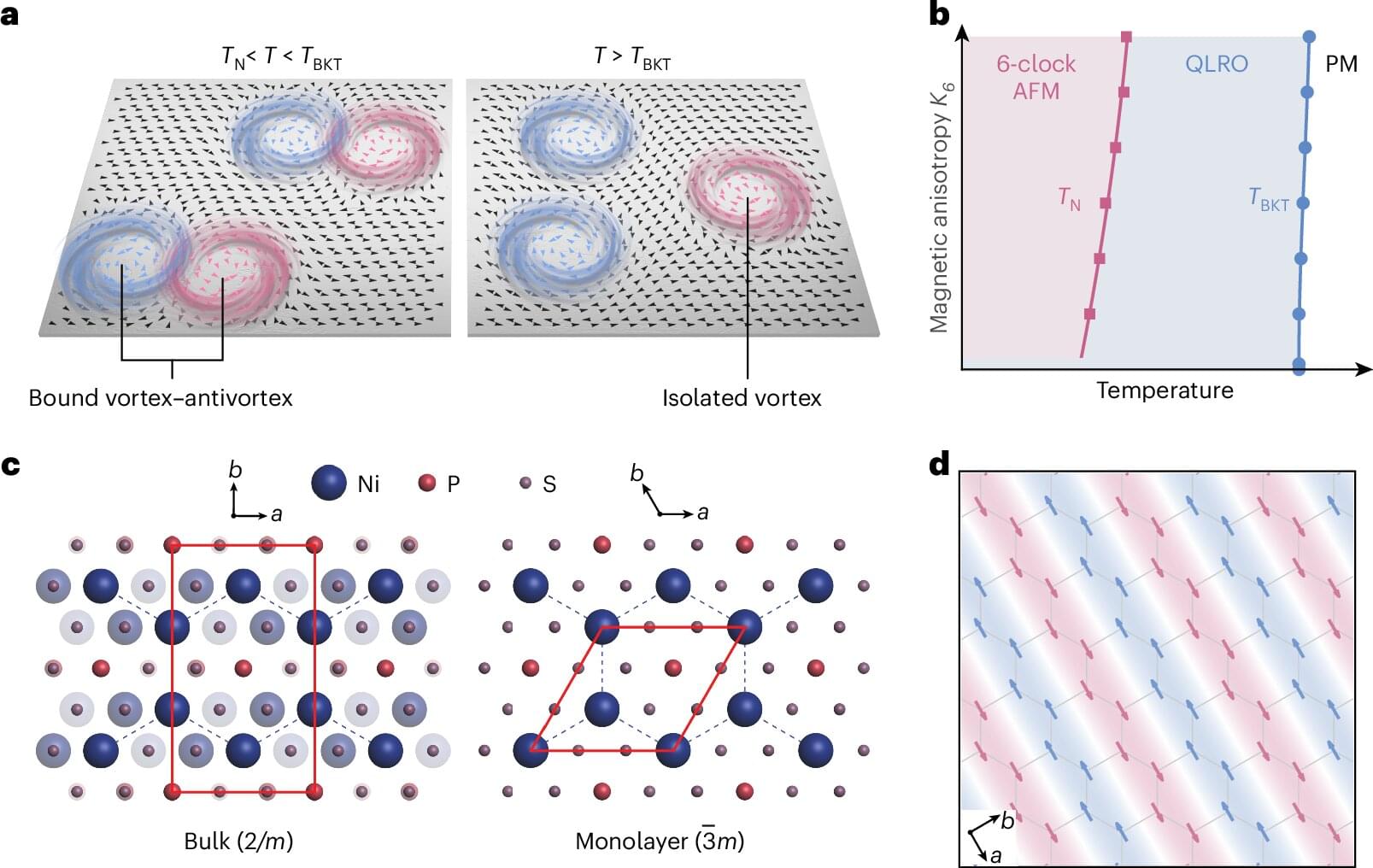
Strange things happen to materials when you peel them down, layer by layer, from thick chunks all the way to sheets just an atom thick. Reporting in the journal Nature Materials, a team led by physicists at The University of Texas at Austin has experimentally demonstrated a sequence of exotic magnetic phases in an ultrathin material that fully realizes, for the first time, a theoretical model of two-dimensional magnetism first proposed in the 1970s. The researchers say the advance might inspire new ultracompact technologies.

The sequence of exotic magnetic phases involves two key transitions that occur as certain materials cool down towards absolute zero. Both transitions have been observed experimentally on their own before, but never together in a complete sequence.

When the researchers cooled an atomically thin sheet of nickel phosphorus trisulfide (NiPS3) to temperatures between −150 and −130° C, the material entered the first special magnetic phase, called a Berezinskii–Kosterlitz–Thouless (BKT) phase. In this regime, the magnetic orientations associated with individual atoms in the material—known as magnetic moments—form swirling patterns called vortices. Pairs of these vortices wind in opposite directions, one clockwise and the other counterclockwise, and remain tightly bound together.

/* */