Toggle light / dark theme

Pnictogen-bonding-crosslinked polymer networks: constructing self-healing materials

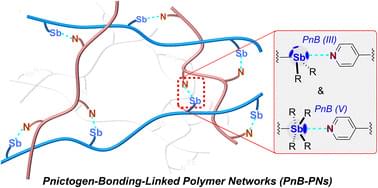
Herein, we introduce pnictogen bonding interaction into polymer networks for the design and modulation of dynamic macromolecular materials. Several types of polymeric pnictogen-bonding networks with graded interaction strengths were constructed to explore the structure–property relationship. Comprehensive investigations revealed that strengthening the pnictogen bonding significantly enhances the topological stability of the resulting materials. In contrast, analogous hydrogen-bonded networks did not exhibit comparable mechanical reinforcement. Moreover, the pnictogen-bonding networks endow the materials with tunable self-healing capability, allowing not only spontaneous healing at room temperature and thermally triggered healing on demand, but also effective healing in aqueous environments. This represents the first exploration of self-healing behavior driven by pnictogen bonding in polymeric materials. Mechanistic insights into the role of pnictogen bonding in polymer networks were elucidated through NMR titration of donor–acceptor polymer pairs, comparative self-assembly behavior, and cocrystal structures of small-molecule analogues. The incorporation of pnictogen bonding interaction into polymer networks provides a robust and versatile platform for engineering high-performance dynamic polymeric materials.
Superfluids emerge in 2D moiré crystal formed from time, study predicts

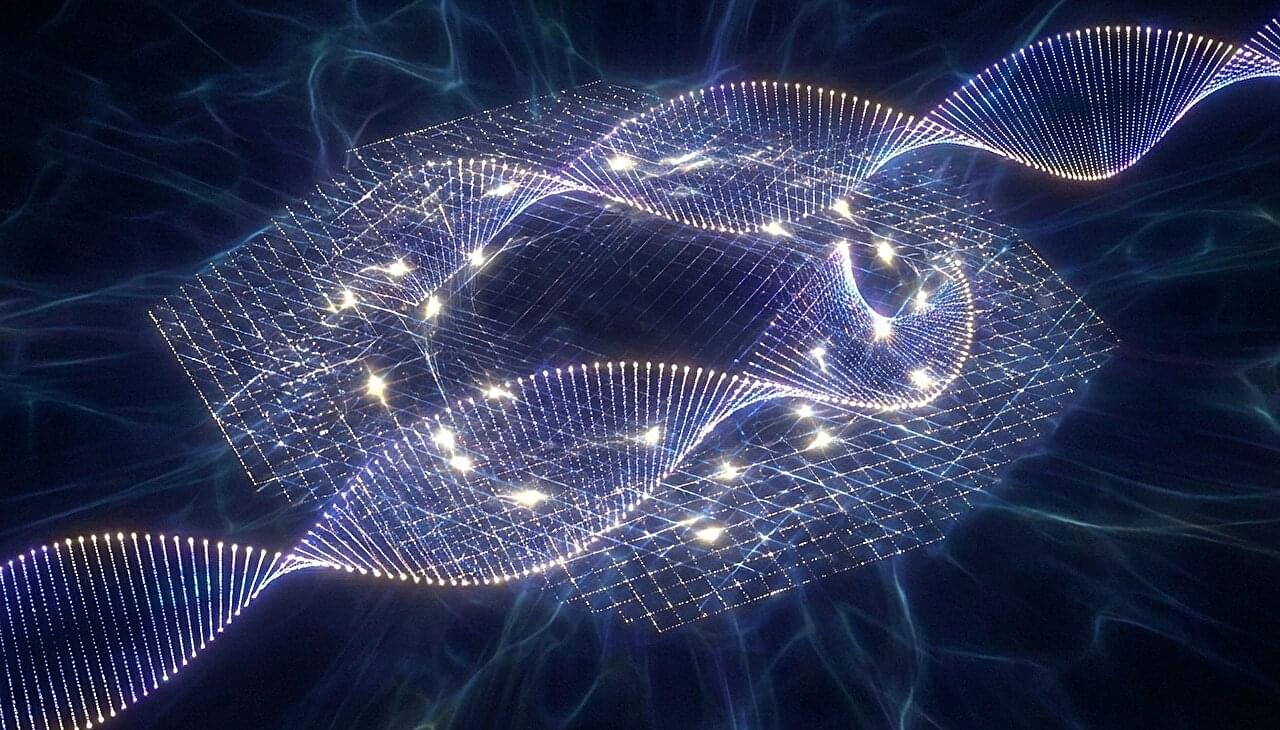
Conventional crystals are materials in which atoms arrange themselves in repeating spatial patterns. Time crystals, on the other hand, are phases of matter characterized by repeating motions over time without constantly heating up, breaking a physical rule known as time-translation symmetry.

Researchers at East China Normal University and Shanghai Jiao Tong University recently predicted the formation of a new type of time crystal, dubbed a two-dimensional (2D) moiré time crystal. This crystal was theorized to emerge when periodic perturbations (i.e., regular, repeated disturbances) are applied to ultracold atoms held in a smooth, continuous trap, as opposed to an optical lattice trap. The paper is published in the journal Physical Review Letters.

“We were inspired by two exciting concepts in physics,” Keye Zhang, professor at East China Normal University and co-senior author of the paper, told Phys.org. “The first is the concept of ‘twistronics,’ where twisting atom-thin layers creates moiré patterns with exotic material properties. While the second is that of ‘time crystals’ (a new phase of matter with persistent rhythmic motion). We wondered: could we combine these ideas by treating time itself as a dimension that can be ‘twisted’?”

Physicists discover long-predicted ‘clock magnetism’ in an atomically thin crystal

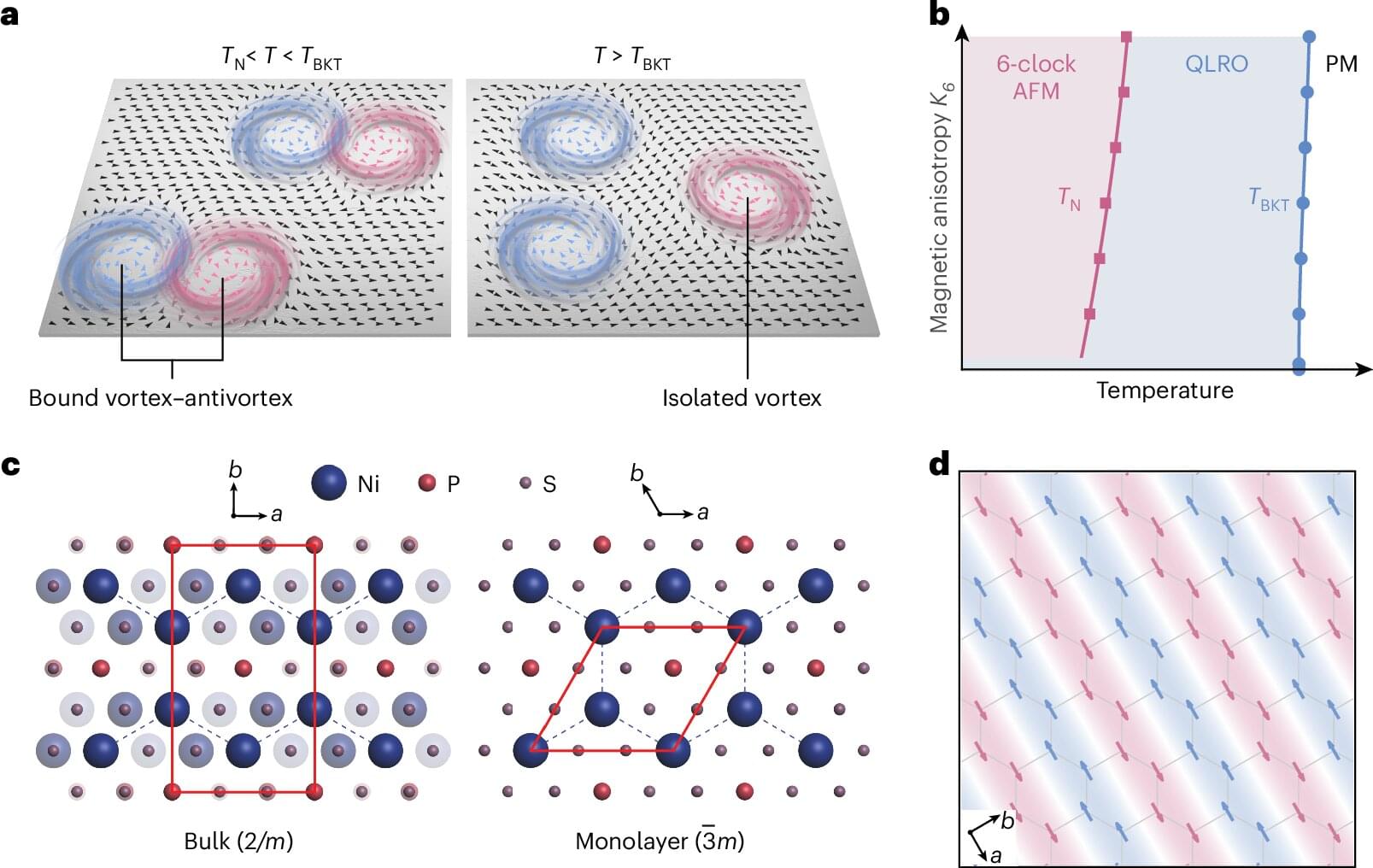
Strange things happen to materials when you peel them down, layer by layer, from thick chunks all the way to sheets just an atom thick. Reporting in the journal Nature Materials, a team led by physicists at The University of Texas at Austin has experimentally demonstrated a sequence of exotic magnetic phases in an ultrathin material that fully realizes, for the first time, a theoretical model of two-dimensional magnetism first proposed in the 1970s. The researchers say the advance might inspire new ultracompact technologies.

The sequence of exotic magnetic phases involves two key transitions that occur as certain materials cool down towards absolute zero. Both transitions have been observed experimentally on their own before, but never together in a complete sequence.

When the researchers cooled an atomically thin sheet of nickel phosphorus trisulfide (NiPS3) to temperatures between −150 and −130° C, the material entered the first special magnetic phase, called a Berezinskii–Kosterlitz–Thouless (BKT) phase. In this regime, the magnetic orientations associated with individual atoms in the material—known as magnetic moments—form swirling patterns called vortices. Pairs of these vortices wind in opposite directions, one clockwise and the other counterclockwise, and remain tightly bound together.

Cooling without gases: Molecular design brings solid-state cooling closer to reality

Some solid materials can cool down or heat up when pressure is applied or released. This behavior enables cooling and heating technologies that do not rely on climate-damaging refrigerant gases. In practice, however, a major obstacle remains: many materials behave differently during heating and cooling, which makes their response difficult to use reliably in real devices. In a study published in the journal Communications Materials, researchers investigate a solid material known for its exceptionally large cooling/heating response (thermal response) under pressure and ask a simple question: can this response be made more reliable? They show that a very small change in composition leads to a clear improvement and use neutron experiments to explain why this improvement occurs.

InN thin films show transient Pauli blocking for broadband ultrafast optical switching

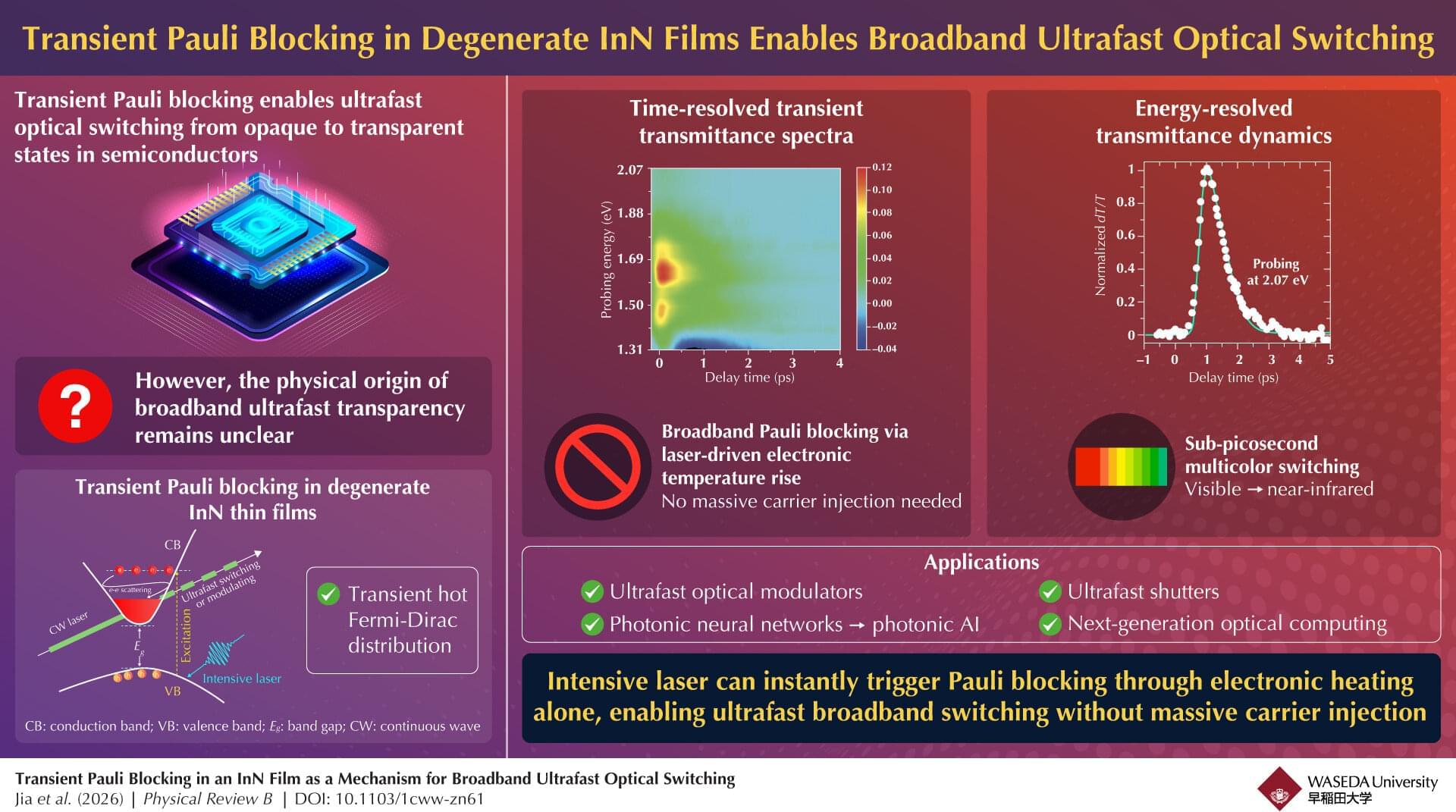
Recent decades have witnessed rapid advancements in high-intensity laser technology. The combination of laser irradiation and novel materials is opening exciting avenues for the design of functional materials and devices. Semiconductors are ideal platforms for generating laser-driven functionalities because they can exhibit novel features such as ultrafast optical transparency. This effect arises from electronic occupation redistribution driven by ultrafast excitation, which manifests as a phenomenon called transient Pauli blocking.

In a new development, a team of researchers in Japan, led by Professor Junjun Jia from the Global Center for Science and Engineering and the Graduate School of Advanced Science and Engineering at Waseda University, has examined the transient Pauli blocking effect in an InN film.

The study utilized pump-probe transient transmittance measurements with multicolor probe lasers, alongside first-principles electronic band-structure calculations. Their findings are published in Physical Review B.

Using high-energy sparks to degrade pollutants without generating waste

A study published in the Chemical Engineering Journal proposes a new approach to environmental remediation of pharmaceutical pollutants in water flows. This approach is based on a phenomenon known as “sparks,” which refers to the sparks that appear on the surface of a metal when it is subjected to plasma electrolytic oxidation (PEO).

During PEO, a metal part (in this case, aluminum) is immersed in a liquid to which an electrical voltage is applied. This results in the growth of an oxide coating. During the process, micro-electrical discharges, or sparks, appear. These sparks last for fractions of a second and cover a small area. However, they lead to very high temperatures, which is why they are nicknamed the “second sun.” This treatment is used on aluminum, magnesium, titanium, and other metal parts in the aerospace, automotive, medical, and electronics industries to create an oxide coating that improves the resistance of the material to corrosion and heat.

🔬Searching the Space of All Possible Materials — Prof. Max Welling, CuspAI

Editor’s note: raised a $100m Series A in September and is rumored to have reached a unicorn valuation. They have all-star advisors from Geoff Hinton to Yann Lecun and team of deep domain experts to tackle this next frontier in AI applications.

2D memristors could help solve AI’s energy problem

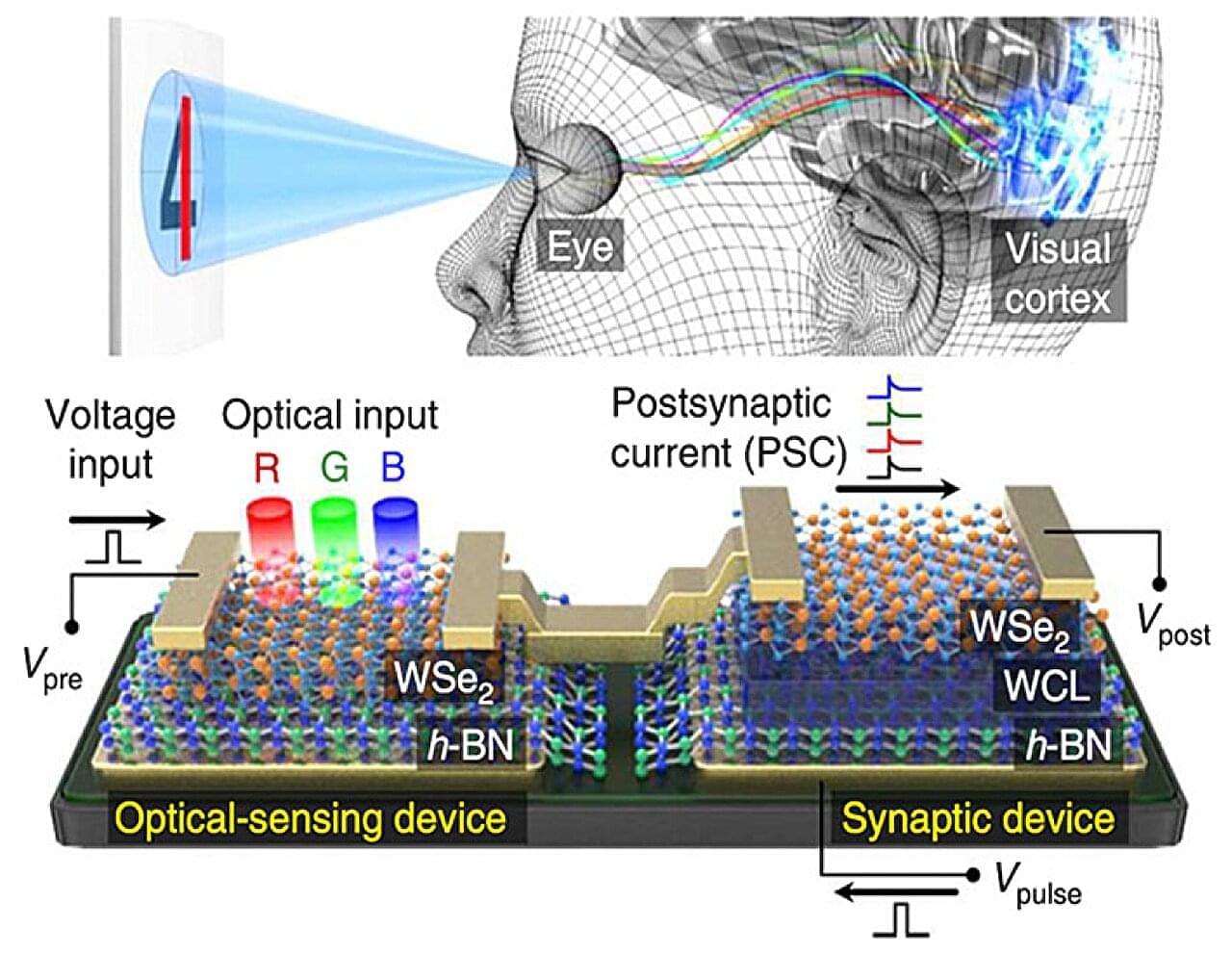
New generations of memristors could reliably store information directly within the molecular structures of graphene-like materials. In a new review published in Nanoenergy Advances, Gennady Panin of the Russian Academy of Sciences shows how these atomically thin materials are ideally suited for electrical circuits that mimic the function of our own brains—and could help address the vast power requirements of emerging AI technologies.

A memristor is a cutting-edge electrical component whose resistance depends on the amount of current that previously passed through it. Because it “remembers” this history even after charge is no longer flowing, it can store data when the power is switched off. In this way, memristors operate in a way remarkably similar to the neurons in our brains and the synapses connecting them.

With their fast response times, combined with simple, two-electrode structures that allow them to be packed into dense arrays, memristors are increasingly forming the building blocks of modern circuits—especially those designed for AI.

The Man Who Stole Infinity

In 1874, German mathematician Georg Cantor published a groundbreaking paper showing that there are different sizes of infinity — a result that fundamentally changed mathematics by treating infinity as a concrete mathematical concept rather than a mere philosophical idea.

That paper became the foundation of set theory, a central pillar of modern mathematics.

Newly discovered letters from Cantor’s correspondence with fellow mathematician Richard Dedekind, believed lost until recently, suggest that a crucial part of the proof Cantor published came directly from Dedekind’s work.

Historian and journalist Demian Goos uncovered these letters while researching Cantor’s life. He found a key letter from November 30, 1873 that shows Dedekind’s proof of the countability of algebraic numbers — the same result Cantor would publish later under his own name.

Earlier histories had portrayed Cantor as a lone genius, but the new evidence reveals he relied heavily on Dedekind’s ideas and published them without proper credit, effectively erasing Dedekind’s role in the discovery.

Cantor’s strategy was partly tactical: because influential mathematician Leopold Kronecker vehemently opposed actual infinity, Cantor framed the paper under a less controversial title (about algebraic numbers), using Dedekind’s simplified methods to “sneak” in the revolutionary idea of comparing infinities.

The result was not just a new theorem but a new way of thinking about infinity, setting the stage for set theory and reshaping mathematics — even though the true story of its origins was more collaborative and ethically complicated than commonly told.

/* */