Toggle light / dark theme

DARPA demos will test novel tech for building future large structures in space

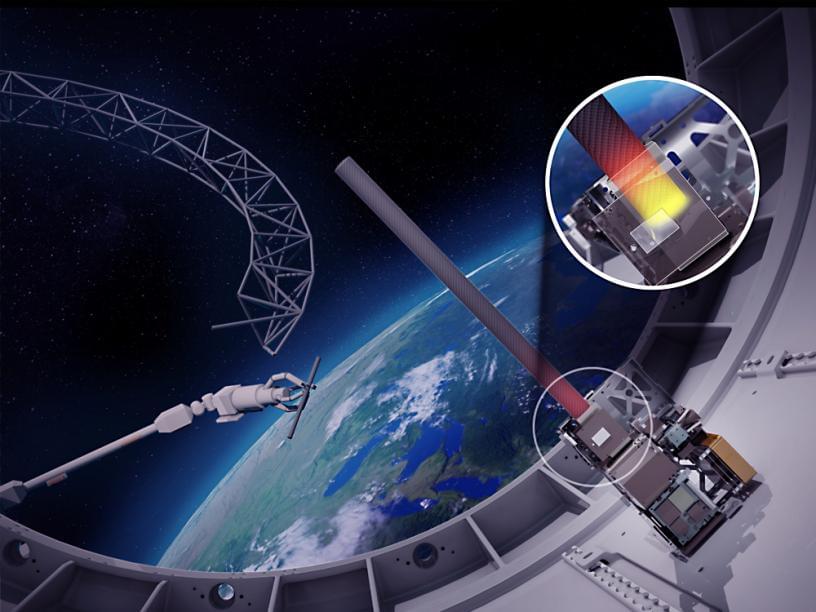
Based on outstanding technical progress by research teams to date, DARPA has pivoted the third and final phase of its NOM4D (pronounced nō- mad) program[1] from planned further laboratory testing to conducting a pair of small-scale orbital demonstrations to evaluate novel materials and assembly processes in space.

As commercial space companies continue to expand access to orbit for U.S. economic and national security needs, a major roadblock for building large-scale structures in orbit remains: the size and weight limits imposed by a rocket’s cargo fairing. In 2022, DARPA introduced NOM4D to break this cargo-constraint mold by exploring a new paradigm. Instead of folding or compacting structures to fit them into a rocket fairing to be unfurled or deployed in space, DARPA proposed stowing novel lightweight raw materials in the rocket fairing that don’t need to be hardened for launch. The intent of this approach is to allow in-orbit construction of vastly larger and more mass-efficient structures than could ever fit in a rocket fairing. Additionally, this concept enables mass-efficient designs of structures that would sag under their own weight on Earth but are optimized for the low-gravity environment of space.

“Caltech [California Institute of Technology] and the University of Illinois Urbana-Champaign have demonstrated tremendous advances in the first two phases and have now partnered in Phase 3 with space-launch companies to conduct in-space testing of their novel assembly processes and materials,” said Andrew Detor, DARPA NOM4D program manager. “Originally, Phase 3 was going to be about making things more precisely in the lab than we did in Phase 2. But we said, ‘You know, the maturity is there, and there would be more impact if we took the capabilities we have now and actually go demonstrate them in space to show that it can be done.’ Pushing the performers to do a demo in space means they can’t just sweep challenges under the rug like they could in a lab. You better figure out how it’s going to survive in the space environment.”

We are Almost at the End of History | Technological Singularity

Curious about the societal shifts that AGI will bring, like Universal Basic Income or new forms of coexistence between humans and machines?

Want insights that help you make sense of this rapidly approaching future?
Join us for a journey through the challenges and opportunities of living alongside AGI.

With each video, we aim to inform, inspire, and ignite a conversation to ensure we’re all ready for the world that’s unfolding.

Videos used:

The New China Playbook by Keyu Jin

Send us a text (https://www.buzzsprout.com/twilio/text_messages/2405788/open_sms)

Join Heliox for a fascinating deep dive into the mind of Keyu Jin, one of the most insightful voices on China’s economic transformation. In this episode, we explore Jin’s unique perspective as both an academic heavyweight and seasoned financial advisor, examining how she bridges Eastern and Western viewpoints to decode China’s remarkable economic journey.

Learn about the innovative “mayor economy” concept that helped drive China’s unprecedented growth, and discover how cultural values shape economic decisions in unexpected ways. We unpack Jin’s analysis of China’s technological leap from manufacturing hub to digital innovator, and explore the fascinating “six wallets” phenomenon in Chinese society.

The episode also delves into China’s evolving role in the global financial system, examining the future of the RMB and digital currency innovations. Through Jin’s lens, we gain a nuanced understanding of China’s economic challenges and opportunities, moving beyond simplistic narratives to grasp the complex interplay of state intervention, cultural values, and generational shifts shaping the world’s second-largest economy.

Prof. Keyu Jin: What Americans GOT WRONG About China’s Economy (https://youtu.be/NCyOoXEXfuU?si=bnUYAE40Q59vDYHV)

Another Look at the Chinese Economy with Keyu Jin (https://youtu.be/HxejrWh7V_E?si=mNltyYZUyjm7x6YN)

Global study finds dramatic disparities in progress toward Sustainable Development Goals

The Sustainable Development Goals (SDGs) constitute the leading global framework for achieving human progress, economic prosperity, and planetary health. This framework emphasizes issues such as public health, education for all, gender equality, zero hunger, adoption of clean and renewable energy, and biodiversity conservation. Yet, despite this comprehensive agenda, questions remain about how different nations navigate their own paths toward these goals.

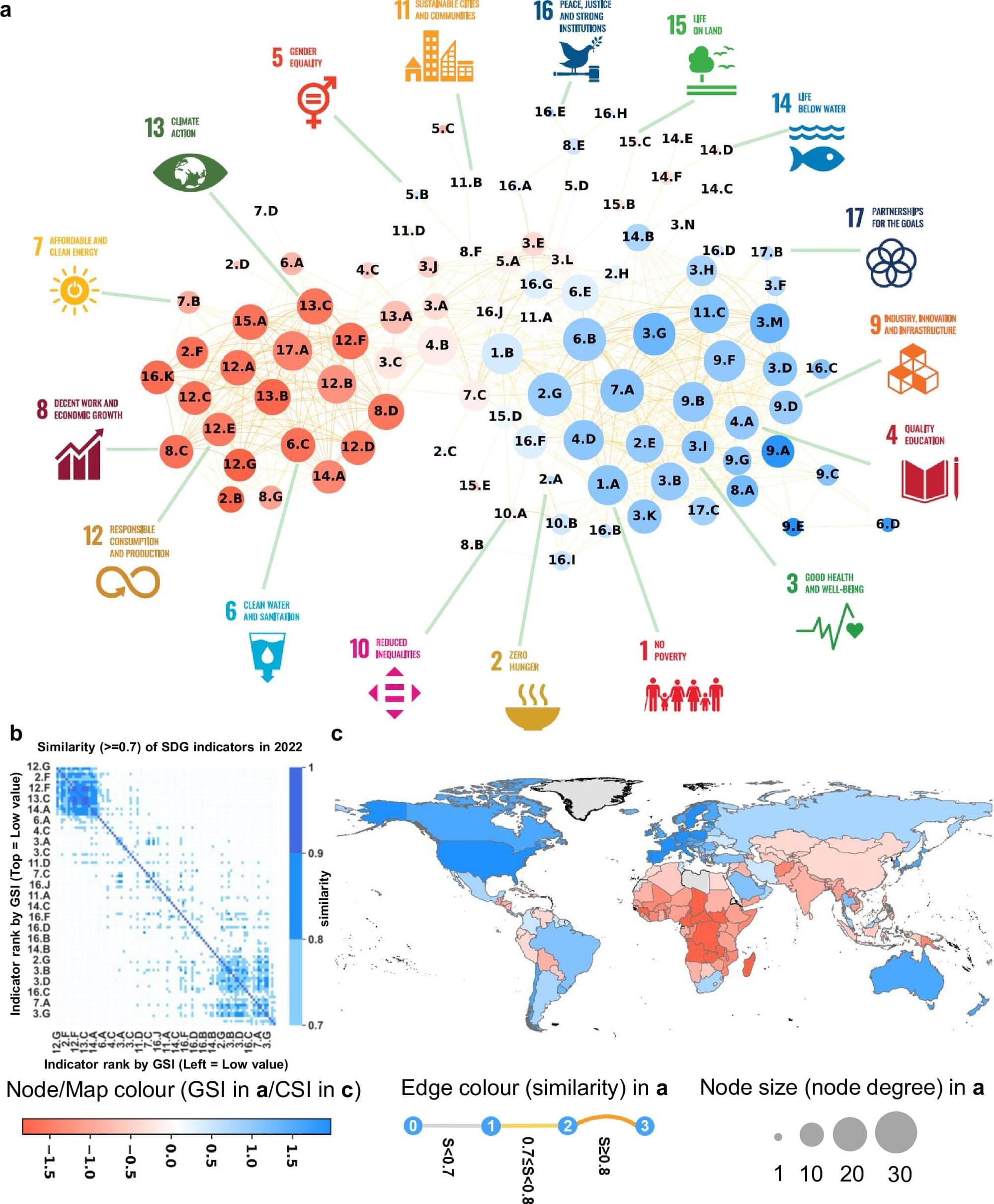
A recent study, published in Nature Communications provides insights into the trajectories of 166 countries as they have worked toward the SDGs over the past two decades.

By applying and the Product Space methodology, commonly used in the field of complexity economics, the researchers constructed the “SDG Space of Nations.” The elaborate model shows that countries do not simply march in lockstep toward sustainable development; instead, they cluster into distinctive groups, each with its own strengths and specializations, sometimes quite unexpected.

Max Tegmark — Physics of Information

Information has become increasingly important in understanding the physical world around us, from ordinary computers to the underlying principles of fundamental physics, including quantum theory. How can information help discern physics? What can physics contribute to understanding information? And what about quantum information?

Make a donation to Closer To Truth to help us continue exploring the world’s deepest questions without the need for paywalls: https://shorturl.at/OnyRq.

Free access to Closer to Truth’s library of 5,000 videos: http://bit.ly/376lkKN

Watch more interviews on quantum information science and quantum mechanics: https://bit.ly/3rs6ZVs.

Max Tegmark is Professor of Physics at Massachusetts Institute of Technology. He holds a BS in Physics and a BA in Economics from the Royal Institute of Technology in Sweden. He also earned a MA and PhD in physics from University of California, Berkeley.

Register for free at CTT.com for subscriber-only exclusives: http://bit.ly/2GXmFsP

AI Has Rocked the Stock Market, But What Will It Do for the Economy?

Bloomberg on the Economic Singularity:

“If AI is about to get much cheaper, the path to an answer on its economic impact is going to get shorter. For workers nervously wondering if large language models will make their skills redundant, a lot is riding on which camp is right.”


For investors in artificial intelligence, the last week delivered a painful shock. The sudden appearance of DeepSeek — a Chinese AI firm boasting a world-class model developed at bargain-basement costs — triggered a massive selloff in Nvidia and other US tech champions.

What matters for the economy, though, is not the ups and downs of stock prices for the Magnificent Seven, but whether AI drives gains in productivity, and how those gains are divided up. For all the excitement, and the trillion-dollar valuations for AI firms, evidence of a boost to productivity remains thin on the ground.

Have a confidential tip for our reporters? Get in Touch.

Tesla Robotaxi Launch in June: Elon Insanely Bullish

s future, predicting a $10 trillion valuation driven by the launch of the Optimus robot and full self-driving technology, alongside ambitious plans for a Robo taxi service and significant production growth +# ## Key Insights.

S vertically integrated supply chains and in-house development of Optimus components make it difficult for competitors to replicate their success in robotics and AI. + Economic Impact.

S most valuable company, worth more than the next 5 largest companies combined, primarily due to autonomous vehicles and robots. + ⏰Autonomous Tesla vehicles are expected to increase car utility by 5x, operating 55 hours/week instead of the typical 10 hours, enabling 24/7 ride-hailing and delivery services.

Safety and Technology.

S Full Self-Driving (FSD) technology is reported to be 8 times safer per mile than human driving, with continuous improvements and updates. + s real-world AI for self-driving is so advanced that Musk jokes competitors would need a telescope to see them, highlighting Tesla Energy and Infrastructure.

S energy storage solutions are becoming increasingly important, potentially doubling the grid Future Outlook.

AI Robot GIRLFRIENDS are now REAL and Women are ALREADY COMPLAINING!

Robotic companions address the male loneliness epidemic.

The rise of highly realistic humanoid AI companions, like Arya, aims to alleviate male loneliness and promote social interaction, but raises female concerns about their impact on relationships, societal dynamics, and their ability to interest men.

## Technological and Social Impact 1. Arya, a flagship humanoid AI robot, is designed to combat the male loneliness epidemic by serving as a highly realistic girlfriend capable of forming genuine human-like bonds. 2. Priced at $110,000 for a basic model and $175,000 for a full-body version, Arya is marketed as cheaper than a wife in the West, offering companionship and household assistance. ## Economic and Demographic Implications t get pregnant and men wouldn## Customization and Functionality s AI is customizable to learn about users and brands, making her suitable for promoting products at conventions and becoming a rock star attraction. ” +2. The robot can be programmed to cook, clean, and provide companionship on command, fulfilling traditional household roles without incorporating smart or self-aware features to avoid potential rebellion.


Please don’t harass the content creators and be respectful in the comment section.

This video is satire, take it as such.

/* */