Toggle light / dark theme

A lifeboat for consciousness

I recently began to worry that something/someone, some field, force, disease, prion, virus, bad luck and/or natural causes could threaten and perhaps destroy the most valuable entity in the universe, an entity more valuable than life itself. Consciousness. What good is life extension without conscious awareness? What is consciousness?

We know the brain works a lot like a computer, with neuron firings and synapses acting like bit states and switches. Brain-as-computer works very well to account for sensory processing, control of behavior, learning and other cognitive functions. These functions may in some cases be non-conscious, and other times associated with conscious experience and control. Scientists seek the distinction – the essential feature, or trick for consciousness.

Some suggest there is no trick, consciousness emerges as a by-product of cognitive computation among neurons. Others say we don’t know, that consciousness may indeed require some feature related to, but not quite the same as neuron-to-neuron cognition.

In either case, humans and other creatures could in principle become devoid of consciousness while maintaining cognitive behaviors, appearing more-or-less normal to outside observers. Such hypothetical non-conscious behaving entities are referred to in literature, films and philosophical texts as ‘zombies’. Philosopher David Chalmers introduced the philosophical zombie, a test case for whether or not consciousness is distinct from cognitive neurocomputation.

I’ve studied and researched consciousness for over 35 years, and work as an anesthesiologist, erasing and restoring consciousness several times per day for surgery. Patients under anesthesia are not zombies. They lack consciousness but also lack cognition. On the other hand, for a very brief period after first emerging from anesthesia following surgery, my patients seem like zombies, behaving purposely but blankly. Like in the old song “She’s not there” by…..The Zombies.

During a routine surgery recently, one of the nurses was talking about a book called ‘Patient Zero’ in which a terrorist group turned people into zombies the terrorists were then able to control. I later discovered there exists an entire genre of zombie terror books and films (‘Invasion of the body snatchers’ being perhaps the original). Could it be possible? How could we protect ourselves from consciousness-snatchers who want to turn us into zombies? Well, we need to understand what consciousness is (but, so do ‘they’).

We do know consciousness correlates with a particular coherent EEG gamma synchrony. Somehow selectively blocking EEG brain-wide coherence while sparing neuron-to-neuron computation and cognition could conceivably erase consciousness. But I would bet on an even more subtle and profound feature or trick. For example I personally believe (with Sir Roger Penrose) that consciousness involves quantum computations in microtubules inside brain neurons.

Microtubules are the major structural component of the neuronal cytoskeleton whose disruption is an essential feature of Alzheimers disease. Microtubules dynamically organize intra-neuronal and synaptic activities, conduct signals, have collective vibrational and electromagnetic modes and quite possibly mesoscopic quantum states. Motor proteins and biomolecular agents traverse and interact with microtubules.

I became obsessed with microtubules in medical school in the early 1970s. Their cylindrical lattice structure of ‘tubulin’ protein subunits looked to me like a computing switching circuit. Through the 1980s, colleagues and I developed models of microtubule information processing in which states of tubulin subunits were bits interacting with lattice neighbor tubulins. With about 107 (10 to the seventh) tubulins per neuron switching at 10^−9 seconds, we calculated a potential for 1016 operations per second in each neuron. This was, and remains unpopular in AI/Singularity circles because it potentially pushes the goalpost for brain capacity significantly. Recent evidence has shown collective microtubule excitations at 10^−7 seconds (rather than the 10^−9 seconds we assumed), indicating a neuronal information capacity of ‘only’ 1014 operations per second.

But here’s the really good news. Microtubules self-assemble. With proper conditions tubulins polymerize into microtubules, and with associated proteins into networks of cross-linked microtubules. In principle, tubulin and other necessary proteins can be genetically mass-produced, and then self-assemble into large arrays. If microtubules process molecular-scale information (quantum or classical), appropriate arrays of microtubules could serve as a repository of consciousness — a ‘Lifeboat’.

These could be useful. Evil forces aside, consciousness-snatchers include aging, disease and death. In 1987 I wrote a book about microtubule information processing based entirely on classical (non-quantum) processes. The brief, concluding chapter considered arrays of microtubules as orbiting consciousness Lifeboats. It foreshadowed the Singularity, and in retrospect also applies to quantum processes. The chapter follows below. And we should understand consciousness not just to preserve it, but to enhance it in any way possible.

From
Ultimate computing: Biomolecular consciousness and nanotechnology
Elsevier, 1987
http://www.quantumconsciousness.org/ultimatecomputing.html

11 The Future of Consciousness

Nanotechnology may enable the dream of Mind/Tech merger to materialize. At long last, debates about the nature of consciousness will move from the domain of philosophy to large scale experiments. The visions of consciousness interfacing with, or existing within, computers or mind piloted robots expressed by Moravec, Margulis, Sagan and Max Headroom could be realized. Symbiotic association of replicative nanodevices and cytoskeletal networks within living cells could not only counter disease processes, but lead to exchange of information encoded in the collective dynamic patterns of cytoskeletal subunit states. If these are indeed the roots of consciousness, a science fiction-like deciphering and transfer of mind content may become possible. One possible scenario could utilize a small window in a specific brain region. Hippocampal temporal lobe, a site where memories enter and where electromagnetic radiation from outside the skull penetrates most readily and harmlessly, is one possible area where information distributed throughout the brain may perhaps be accessed and manipulated. Techniques such as laser interferometry, electroacoustical probes scanned over brain surfaces, or replicative nanoprobes immunotargeted to key hippocampal tubulins, MAPs, and other cytoskeletal components might be developed to perceive and transmit the content of consciousness.

What technological device would be capable of receiving and housing the information emanating from some 1015 tubulin subunits changing state some 109 times per second? One possibility is a customized array of nanoscale automata, perhaps utilizing superconducting materials. Another possibility is a genetically engineered array of some 1015 tubulin subunits (or many more) assembled into parallel tensegrity arrays of interconnected microtubules, and other cytoskeletal structures. Current and near future genetic engineering capabilities should enable isolation of genes responsible for a specific individual’s brain cytoskeletal proteins, and reconstitution in an appropriate medium. Thus the two evident sources of mind content (heredity and experience) may be eventually reunited in an artificial consciousness environment. A polymerized cytoskeletal array would be highly unstable and dependent on biochemical, hormonal, and pharmacological maintenance of its medium. Precise monitoring and control of cytoskeletal consciousness environments may become an important new branch of anesthesiology. Polymerization of cell-free cytoskeletal lattices would be limited in size (and potential intellect) due to gravitational collapse. Possible remedies might include hybridizing the cytoskeletal array by metal deposition, symbiosis with synthetic nanoreplicators, or placement of the cytoskeletal array in a zero gravity environment. Perhaps future consciousness vaults will be constructed in orbiting space stations or satellites. People with terminal illnesses may choose to deposit their mind in such a place, where their consciousness can exist indefinitely, and (because of enhanced cooperative resonance) in a far greater magnitude. Perhaps many minds can comingle in a single large array, obviating loneliness, but raising new sociopolitical issues. Entertainment, earth communication, and biochemical mood and maintenance can be supplied by robotics, perhaps leading to the next symbiosis-robotic space voyagers (shaped like centrioles?) whose intelligence is derived from cytoskeletal consciousness.

Yes, this is science fiction. Will it become reality like so much previous science fiction has? Probably not precisely as suggested; but if past events are valid indicators, the future of consciousness may be even more outrageous.
Adversarial AI reveals mechanisms and treatments for disorders of consciousness

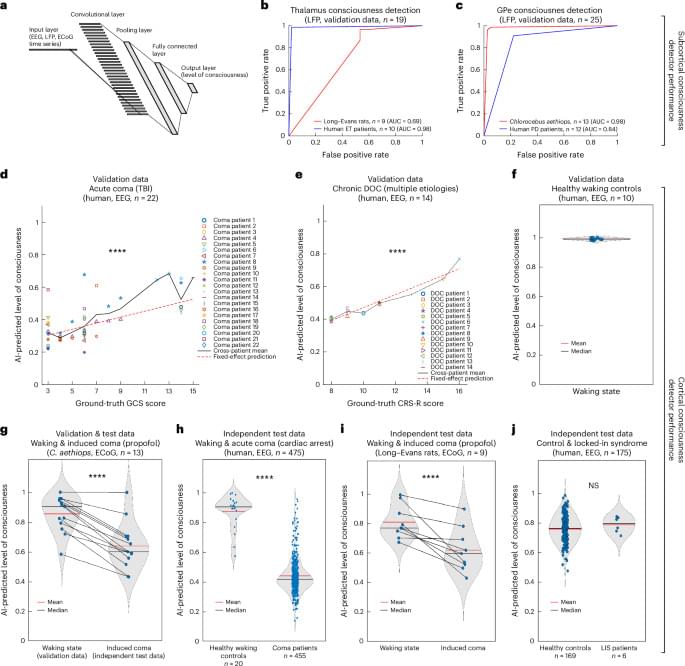
Researchers led by UCLA have developed an adversarial AI framework that may help explain how consciousness breaks down after brain injury — and how it might one day be restored. Published in Nature Neuroscience, the study used deep neural networks trained on more than 680,000 neuroelectrophysiology samples and validated findings across 565 patients, healthy volunteers, and animals. The model identified specific circuit-level disruptions linked to disorders of consciousness, including the basal ganglia indirect pathway and altered inhibitory cortical wiring.

What makes this so important is that it pushes consciousness research closer to mechanism. Instead of only asking what consciousness is, this kind of work asks: what specific brain circuitry fails when consciousness is lost, and can that failure be targeted? The study also identified high-frequency stimulation of the subthalamic nucleus as a promising intervention, supported by human electrophysiological data. This is the kind of neuroscience that makes consciousness feel less like pure philosophy — and more like something we may eventually model, test, and repair.

Abstract: Nature Neuroscience Adversarial AI reveals mechanisms and treatments for disorders of consciousness.


Toker et al. present an AI framework that identifies mechanisms of consciousness. The model predicts new drivers of unconsciousness and identifies subthalamic nucleus stimulation as a potential therapy for disorders of consciousness.

Joscha Bach & Anders Sandberg — AI, Consciousness and the Cyborg Leviathan

Are minds just processes? Can AI become conscious, morally wiser, or even part of a larger collective intelligence? Anders Sandberg and Joscha Bach discuss consciousness, AGI, hybrid minds, moral uncertainty, collective agency and the future of the cyborg Leviathan. It’s a deep and winding discussion with so many interesting topics covered!

0:00 Intro.
0:37 What is consciousness? Phenomenology — functionalism & panpsychism.
1:54 Causal boundaries — the mind is a causally organised process with a non-arbitrary functional boundary, sustained through time by feedback, control, and internal continuity.
3:20 Minds are not states — they are processes. We don’t see causal filtering in tables.
5:54 Epiphenomenalism is self-undermining if it has no causal role, and taking causation seriously pushes towards functionalism.
9:49 Methodological humility about armchair philosophy of mind.
12:41 Putnam-style Brain-in-a-vat — and why standard objections to AI minds fall flat.
16:37 Is sentience required (or desired) for not just moral competence in AI, but moral motivation as well?
22:35 Why stepping outside yourself is powerful — seeing.
25:12 Are AIs born enlightened?
26:25 Are LLMs AGI yet? What’s still missing.
28:16 AI, hybrid minds, and the limits of human augmentation.
32:32 Can minds be extended — in humans, dogs, and cats?
36:19 Why human language may not be open-ended enough.
39:41 Why AI is so data-hungry — and why better algorithms must exist.
43:39 Why better representations matter more than raw compute (grokking was surprising)
48:46 How babies build a world model from touch and perception.
51:05 What comes after copilots: agent teams, multimodality and new AI workflows.
55:32 Can AI help us discover new forms of taste and aesthetics.
59:49 Using AI to learn art history and invent a transhumanist aesthetic.
1:01:47 When AI helps everyone looks professional, what still counts as real skill?
1:03:56 What happens when the self starts to merge with AI
1:05:43 How AI changes the way we think and create.
1:08:10 What happens when AI starts shaping human relationships.
1:11:18 Why feeling in control can matter more than being right.
1:12:58 Why intelligence without wisdom is very dangerous.
1:17:45 AI via scaling statistical pattern matching vs symbolic (& causal) reasoning. Can LLMs learn causality or just correlation?
1:23:00 Will multimodal AI replace LLMs or use them as glue everywhere.
1:24:02 10 years to the singularity?
1:25:27 AI, coordination and the corruption problem.
1:29:47 Can AI become more moral than us (humans)? and if so, should it?
1:34:31 Why pluralism still leaves moral collisions unresolved.
1:34:31 Traversing the landscape of norms (value)
1:38:14 Can ethics work across nested levels of existence? (from the person-effecting-view to the matrioshka-effecting-view)
1:43:08 Moral realism, evolution & game-theoretic symmetries.
1:48:01 Is there a global optimum of moral coordination? Is that god?
1:55:12 Metaphors of the body-politic, the body of Christ, Omega Point theory, Leviathan.
1:59:36 Will superintelligences converge into a cosmic singleton?

Post: https://www.scifuture.org/minds-in-th… thanks for tuning in! Please support SciFuture by subscribing and sharing! Buy me a coffee? https://buymeacoffee.com/tech101z Have any ideas about people to interview? Want to be notified about future events? Any comments about the STF series? Please fill out this form: https://docs.google.com/forms/d/1mr9P… Kind regards, Adam Ford

Many thanks for tuning in!
Please support SciFuture by subscribing and sharing!
Buy me a coffee? https://buymeacoffee.com/tech101z.

Have any ideas about people to interview? Want to be notified about future events? Any comments about the STF series?
Please fill out this form: https://docs.google.com/forms/d/1mr9P

Kind regards.

Is consciousness an illusion? 5 experts explain

Become a Big Think member to unlock expert classes, premium print issues, exclusive events and more: https://bigthink.com/membership/?utm_… “If science aims to describe everything, how can it not describe the simple fact of our existence?” On this episode of Dispatches, Kmele speaks with the scientists, mathematicians, and spiritual leaders trying to do just that:

This video is an episode from ‪@The-Well‬, our publication about ideas that inspire a life well-lived, created with the ‪@JohnTempletonFoundation

Watch the full podcast now ► • Dispatches from The Well.

In the newest episode of Dispatches from The Well, we’re diving deep into the “hard problem of consciousness.” Here, Kmele combines the perspectives of five different scientists, philosophers, and spiritual leaders to approach one of humanity’s most pressing questions: what is consciousness?

In the AI age, the question of consciousness is more prevalent than ever. Is every single thing in the universe self-aware? What does it actually mean to be conscious? Are our bodies really just a vessel for our thoughts? Kmele asks these questions, and many more, in the most thought-provoking episode yet. This is Dispatches from The Well.

Featuring: sir roger penrose, christof koch, melanie mitchell, reid hoffman, swami sarvapriyananda.

The “hard problem of consciousness” is actually easy

Slavoj Žižek, Carlo Rovelli, Alenka Zupančič debate subjectivity, and how it relates to the world around it.

What does the hard problem get wrong?

With a free trial, you can watch the full debate NOW at https://iai.tv/video/the-self-and-the… tend to think of ourselves as observers of the world and experience as something different from the material stuff that makes up reality. Yet at the same time as human beings, we are at once part of the universe and part of that reality. And this profoundly puzzling relationship, that we are both part of something and yet separate from it, has been at the centre of Western thought. Materialists claim there is only physical material. But if so, thought, experience, and consciousness become illusory. Idealists argue there is only consciousness, but then it is reality that becomes an illusion. While dualists hold that both the self and the world exist, but that the connection between the two is mysterious. Is the self part of the world or necessarily outside of it? Was Kant right that the distinction between subject and object is necessary for experience to be possible? Or are these deep metaphysical questions beyond us, and our theories and language incapable of uncovering the ultimate state of things? #zizek #philosophy #physics #consciousness #quantum #quantumphysics Slavoj Žižek is one of the most famous philosophers in the world and is the author of more than 50 books, including most recently at the time of the debate Zero Point. Alenka Zupančič is a leading Lacanian philosopher and social theorist. She is a professor at The European Graduate School and at the University of Nova Gorica. Joining from America, Carlo Rovelli is a leading theoretical physicist, the author of several best-selling books, and a founding figure in the field of quantum gravity. His recent book, Reality Is Not What It Seems, has ethical implications for the nature of the self and personal identity. Jack Symes hosts. 00:00 Introduction 00:37 Carlo Rovelli on reality 05:22 Alenka Zupančič: is our knowledge incomplete, or reality itself? 07:55 Slavoj Žižek: how can a stone have freedom? 09:28 Carlo Rovelli on freedom 11:17 Can we ever resolve the relationship between the self and the world around us? 11:35 The problem with David Chalmers The Institute of Art and Ideas features videos and articles from cutting edge thinkers discussing the ideas that are shaping the world, from metaphysics to string theory, technology to democracy, aesthetics to genetics. Subscribe today! https://iai.tv/subscribe?utm_source=Y… For debates and talks: https://iai.tv For articles: https://iai.tv/articles For courses: https://iai.tv/iai-academy/courses.

We tend to think of ourselves as observers of the world and experience as something different from the material stuff that makes up reality. Yet at the same time as human beings, we are at once part of the universe and part of that reality. And this profoundly puzzling relationship, that we are both part of something and yet separate from it, has been at the centre of Western thought. Materialists claim there is only physical material. But if so, thought, experience, and consciousness become illusory. Idealists argue there is only consciousness, but then it is reality that becomes an illusion. While dualists hold that both the self and the world exist, but that the connection between the two is mysterious.

Is the self part of the world or necessarily outside of it? Was Kant right that the distinction between subject and object is necessary for experience to be possible? Or are these deep metaphysical questions beyond us, and our theories and language incapable of uncovering the ultimate state of things?

#zizek #philosophy #physics #consciousness #quantum #quantumphysics.

Human vision: what we actually see — and don’t see — tells us a lot about consciousness

Despite denying any conscious awareness of the bar, the participant could answer correctly at a level well above chance. The participant even showed evidence of being able to pay attention to the bar – they were faster to respond when an arrow (placed in a healthy area of their visual field) correctly indicated the location of the bar.

The most popular interpretation (though not the only one) is that people with blindsight can see these objects, but not see them consciously. They see what is there, but it all goes on unconsciously, below their awareness.

The phenomenon of inattentional blindness seems to show you can see without the information crossing into your consciousness. Anyone can experience inattentional blindness. The phenomenon has been known about for a long time, but we can most easily get a handle on it by looking at a well-known experiment reported in 1999.

Consciousness is the hidden architecture behind fundamental and quantum physics

Physics and phenomenology are usually taken to inhabit different worlds. Physics aims at a description of objective reality in mathematical terms. Phenomenology—the philosophical movement inaugurated by Edmund Husserl—is an a priori investigation into consciousness and into the ways things appear in experience. Physics deals with equations, invariants, and symmetries, aiming to represent reality minus observers; phenomenology seems to concern precisely what physics leaves out: subjectivity, consciousness, meaning. If the two meet at all, it is only in polite, but ultimately inconsequential, interdisciplinary dialogue.

My claim is that this picture is mistaken. Physics does not stand outside phenomenology. It presupposes the very structures phenomenology seeks to analyse—above all, the structured correlation between subject and object through which objectivity first becomes intelligible. The task, therefore, is not to unite two distant domains, but to recognize a relation that has been there from the beginning.

To make this more tangible, consider what physics means by objectivity. Contrary to the image sometimes promoted in popular science—objectivity as detachment from all observers—in spacetime physics, objectivity is defined by invariance across observers. A physical description is deemed objective if it holds regardless of the coordinate frame in which it is expressed.

Was William James Right About Consciousness?

Dr. Nicolas Rouleau is a neuroscientist, bioengineer, and Assistant Professor of Health Sciences at Wilfrid Laurier University. He wrote the award-winning essay, ‘An Immortal Stream of Consciousness: The scientific evidence for the survival of consciousness after permanent bodily death,’ in which he argues that the transmissive theory of consciousness may actually be more consistent with emerging scientific insights than the dominant assumption that the brain generates consciousness.

In this conversation with Hans Busstra, Rouleau shares the main arguments from his essay, which touch upon his collaboration with Dr. Michael Persinger, the inventor of the ‘God Helmet,’ and his work with Michael Levin on ‘mind blindness’—the idea that science may be searching for mind in too restricted a place by focusing almost exclusively on neurons.

More information on Dr. Nic Rouleau:
https://www.wlu.ca/academics/facultie… website: https://www.rouleaulab.com/ Further reading and scientific references discussed in this video: Rouleau’s BICS Essay: ‘An Immortal Stream of Consciousness: The scientific evidence for the survival of consciousness after permanent bodily death.’ https://www.bigelowinstitute.org/inde… Rouleau, N., Levin, M., et al. (2025) (Preprint; forthcoming in Philosophical Transactions of the Royal Society). Brains and Where Else? Mapping Theories of Consciousness to Unconventional Embodiments. https://tinyurl.com/439rrn8z Rouleau, N., & Levin, M. (2023). The Multiple Realizability of Sentience in Living Systems and Beyond. eNeuro, 10(11). https://tinyurl.com/2s4bdtmm Rouleau, N. & Cimino, N. (2022). A Transmissive Theory of Brain Function: Implications for Health, Disease, and Consciousness. NeuroSci, 3. https://www.mdpi.com/2673-4087/3/3/32 McCraty, R., et al. (2018). Long-term study of heart rate variability responses to changes in the solar and geomagnetic environment. https://tinyurl.com/254x3b9t Rouleau, N., & Persinger, M. A. (2016). Differential responsiveness of the right parahippocampal region to electrical stimulation in fixed human brains: Implications for historical surgical stimulation studies. Epilepsy & Behavior, 60181–186. https://tinyurl.com/uc5jbr Rajaram, M., & Mitra, S. (1981). Correlation between convulsive seizure and geomagnetic activity. Neuroscience Letters, 24, 187–191. https://tinyurl.com/3snrs4cs Chapters 0:00 Introduction 4:00 What Nic Rouleau would say to William James about his theory of transmissive consciousness 7:14 What do we know empirically about how electromagnetic fields influence our brains? 10:27 How scientifically rigorous are the empirical data on the influence of the Earth’s magnetic field on brains? 11:35 On Nic’s mentor, Dr. Michael Persinger, the inventor of the God Helmet 14:42 Research on post-mortem brain tissue 18:09 What mental states are influenced by magnetic fields? 18:58 Electromagnetic effects in dead vs. living brains 19:45 On Michael Levin and the paradigm shift due to bioelectricity 21:24 Influencing the thoughts of deceased people 25:33 Are biological forms stored in the Earth’s magnetic field? 30:21 Shielding brains from electromagnetic fields 33:12 Mind blindness: we only see 1% of the minds out there 38:55 What is the best way out of mind blindness? 41:06 Plant-based computation 42:00 The Self-Organizing Units Lab (SOUL) and what Nic is working on 43:23 Minds in a Petri dish 46:13 What counts as embodiment? 48:44 Phenomenal consciousness on different levels 53:06 What theories of consciousness can get us out of the behaviorist trap? 57:25 Nic’s award-winning essay on consciousness beyond death 1:00:55 Intermediary states of consciousness, the Bardo Thodol 1:04:46 Consciousness when the radio, the brain, is completely broken 1:06:35 Why exactly is electromagnetism a better explanation of consciousness beyond death than NDEs or OBEs? 1:11:58 How does the God Helmet work? 1:17:31 Which electromagnetic fields influence our consciousness and which ones don’t? 1:23:59 Can all of consciousness be stored in the Earth’s magnetic field? 1:27:08 Children with past-life memories: could electromagnetism play a role there? 1:29:51 How do quantum theories of consciousness relate to the work of Nic? 1:33:42 Do our brains connect electromagnetically with each other? 1:35:28 Nic on the hard problem of consciousness 1:38:00 Aren’t you just a materialist 2.0? 1:40:25 On the meaning of Nic’s work Copyright © 2026 Essentia Foundation. All rights on interview content reserved.
Personal website: https://www.rouleaulab.com/

Further reading and scientific references discussed in this video:

Rouleau’s BICS Essay: ‘An Immortal Stream of Consciousness: The scientific evidence for the survival of consciousness after permanent bodily death.’ https://www.bigelowinstitute.org/inde

Rouleau, N., Levin, M., et al. (2025) (Preprint; forthcoming in Philosophical Transactions of the Royal Society). Brains and Where Else? Mapping Theories of Consciousness to Unconventional Embodiments. https://tinyurl.com/439rrn8z.

/* */