🤯 AWESOME! NASA has just released a 4K video tour of Earth’s moon and the footage will make your jaw drop. Credit: NASA (You can also read about this here: https://www.realitybeyondmatter.com/2018/07/nasa-releases-4k…Wydp6i5AjE)
Category: space – Page 927

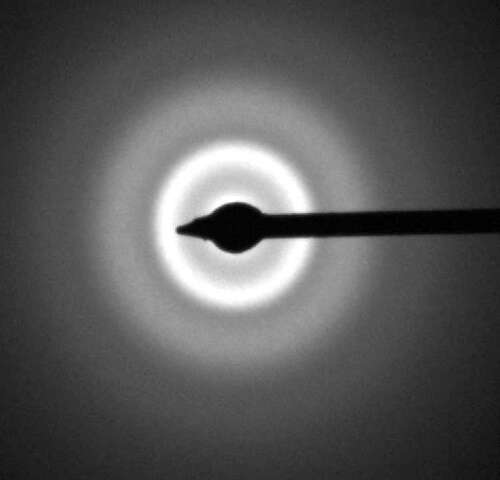
A new coating material that could help reduce thermal noise on gravity wave detector mirrors
A team of researchers from the University of Glasgow, the University of Strathclyde and Hobart and William Smith Colleges has developed a new coating for mirrors used on gravity detectors that is 25 times less noisy than mirror surfaces used on LIGO. In their paper published in the journal Physical Review Letters, the group describes how they made it and how well it performed during testing.
The mirrors used in gravity wave detectors are positioned at the ends of its arms. Coherent light rays are reflected from both mirrors and interfere with each other. Gravitational waves are measured by noting how much the mirrors shift, resulting in slight changes in length of the arms to which they are attached, to an accuracy of 10–16 cm. As impressive as that is, researchers want to improve the sensitivity of the detectors used at LIGO/Virgo, even after the recent upgrade.
To that end, members of the European Union have begun developing plans for the construction of what the Einstein Telescope, a gravitational wave detector with sensitivity 100 times higher than LIGO/Virgo. But for that to happen, improvements in the design of the current interferometer are required. One of those improvements is reducing the amount of thermal fluctuations in the mirror coatings. In this new effort, the researchers claim to have done just that.
Is the universe a hologram?
Are you — is every person you’ve ever loved, every incredible sight you’ve ever witnessed — part of a hologram? Some scientists think so.
They argue that all the information in the universe may be stored on some sort of two-dimensional object. In this video, NASA astronomer Michelle Thaller delves into frontier science — an unchartered territory that may require a new level of physics to better understand.
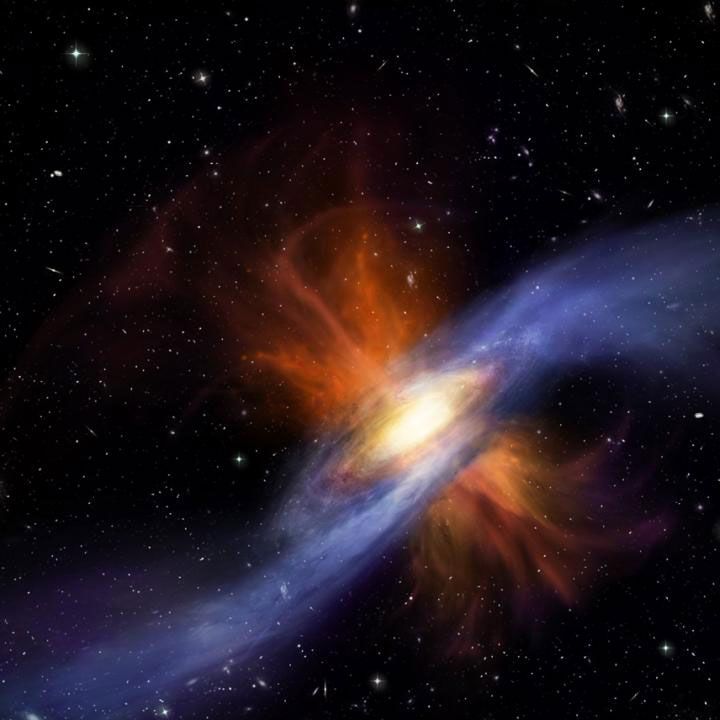
Astronomers Discover Cool Halo Gas Spinning Like Galactic Disks
A group of astronomers led by Crystal Martin and Stephanie Ho of the University of California, Santa Barbara, has discovered a dizzying cosmic choreography among typical star-forming galaxies; their cool halo gas appears to be in step with the galactic disks, spinning in the same direction.
The researchers used W. M. Keck Observatory to obtain the first-ever direct observational evidence showing that corotating halo gas is not only possible, but common. Their findings suggest that the whirling gas halo will eventually spiral in towards the disk.
“This is a major breakthrough in understanding how galactic disks grow,” said Martin, Professor of Physics at UC Santa Barbara and lead author of the study. “Galaxies are surrounded by massive reservoirs of gas that extend far beyond the visible portions of galaxies. Until now, it has remained a mystery how exactly this material is transported to galactic disks where it can fuel the next generation of star formation.”