Toggle light / dark theme

Putting the squeeze on dendrites: New strategy addresses persistent problem in next-generation solid-state batteries

New research by Brown University engineers identifies a simple strategy for combating a major stumbling block in the development of next-generation solid-state lithium batteries.

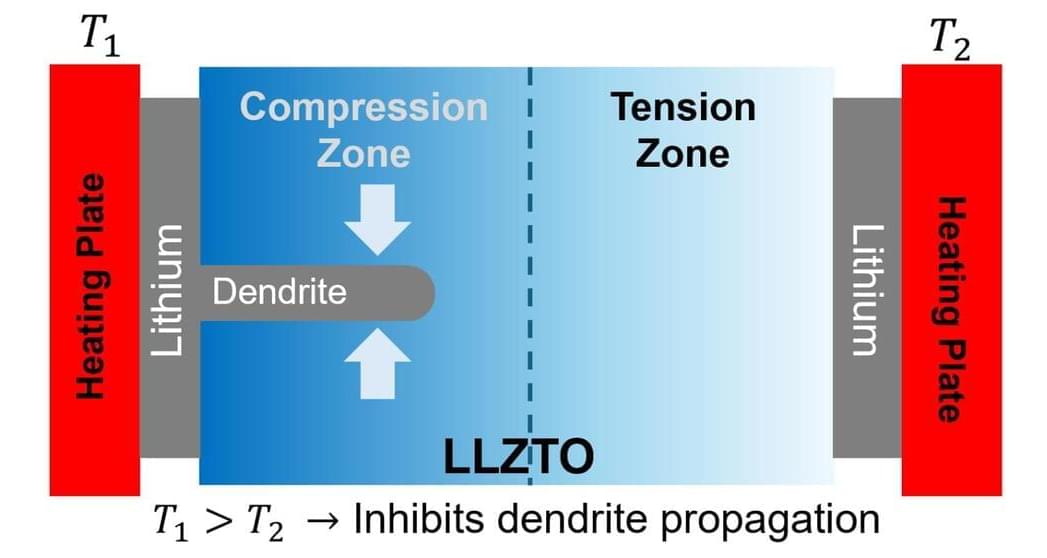
Solid-state batteries are considered the next frontier in energy storage, particularly for electric vehicles. Compared to current liquid electrolyte batteries, solid-state batteries have the potential for faster charging, longer range and safer operation due to decreased flammability. But there’s been a consistent problem holding back their commercialization: lithium dendrites.

Dendrites are filaments of lithium metal that can grow inside a battery’s electrolyte (the part of the battery that separates the anode from the cathode) during charging at high current. When they grow across the electrolyte, dendrites cause circuits between the battery’s anode and cathode, which destroy the battery. So while solid electrolytes can—in theory—enable faster charging than liquid electrolytes, the dendrite problem is one of the primary limitations that has to date prevented them from reaching that potential.

Ignorance Is the Greatest Evil: Why Certainty Does More Harm Than Malice

The most dangerous people are not the malicious ones. They’re the ones who are certain they’re right.

Most of the harm in history has been done by people who believed they knew what was right — and acted on that belief without recognizing the limits of their own knowledge.

Socrates understood this long ago: the most dangerous is not *not knowing*, but *not knowing that we don’t know* — especially when paired with power.

Read on to find why:

* certainty often does more harm than malice * humility isn’t weakness, it’s discipline * action doesn’t require certainty, only responsibility * and why, in an age of systems, algorithms, and institutions, has quietly become structural.

This isn’t an argument for paralysis or relativism.

It’s an argument for acting without pretending we are infallible.

Shaking magnets with ultrafast light pulses reveals surprising spin control

An international team of researchers led by Lancaster University has discovered a highly efficient mechanism for shaking magnets using very short light pulses, shorter than a trillionth of a second. Their research is published in Physical Review Letters.

The discovery of new fundamental properties and phenomena in magnetic materials is essential for the development of faster and energy-efficient devices.

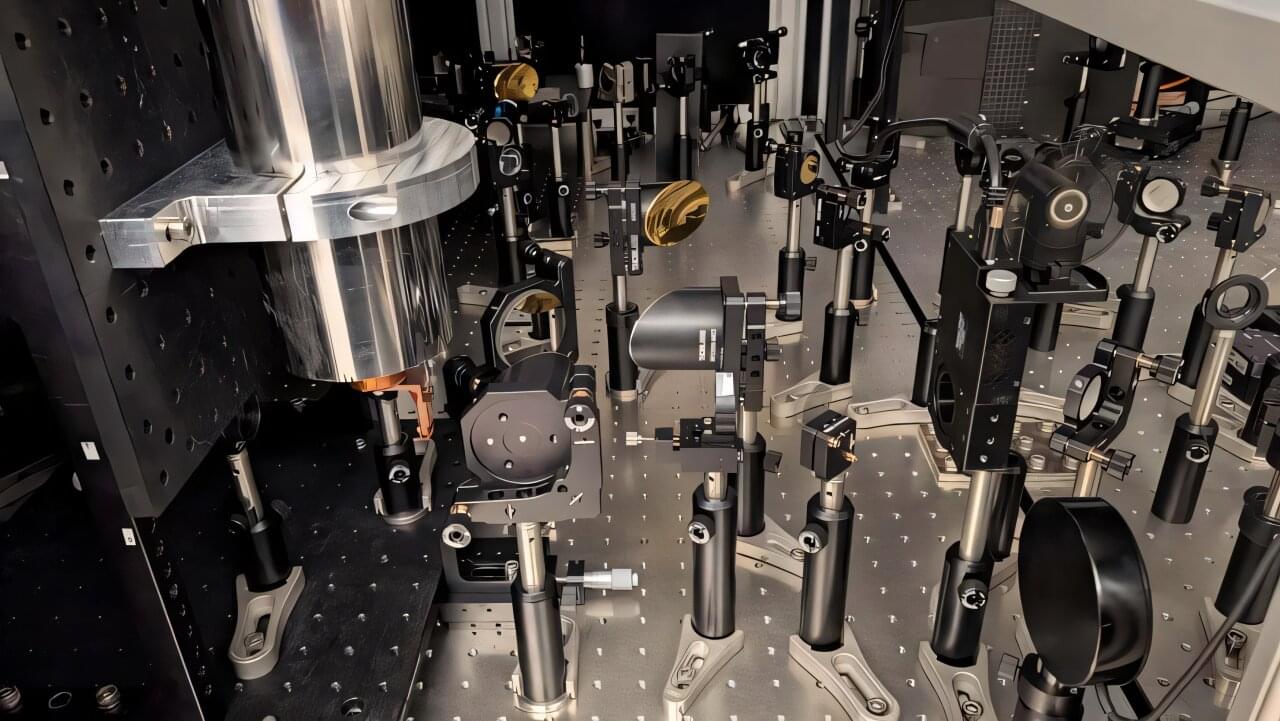
Using a very short electromagnetic pulse to shake the magnetization, researchers investigated its effect on the magnetization steering angle in two similar magnetic materials with different electronic orbitals. After shaking the magnet and subsequently analyzing its magnetic state, they found that interaction between orbital motion and spinning enables a 10-fold larger spin deflection by the light pulse than the one without such interactions.

The Coming Ecological Cold War

But the report was also marked by the flaws of its technocratic conception. Crucially, the broader stakes of the global energy transition went ignored. This is a mistake in urgent need of correction. The decarbonization agenda is not simply about reordering markets or industrial policies, but in fact represents the crucible for a new geopolitical order.

Four years ago, the International Energy Agency (IEA) published a landmark report, “Net Zero by 2050: A Roadmap for the Global Energy Sector,” that proposed a technical blueprint for a global green energy transition by the middle of this century. The report focused on the economic and technological dimensions of this energy transition. It was an admirable effort that calls for careful study.

Room-temperature electron behavior defies expectations, hinting at ultra-efficient electronics

Scientists have discovered a way to efficiently transfer electrical current through specific materials at room temperature, a finding that could revolutionize superconductivity and reshape energy preservation and generation.

The paper is published in the journal Physical Review Letters.

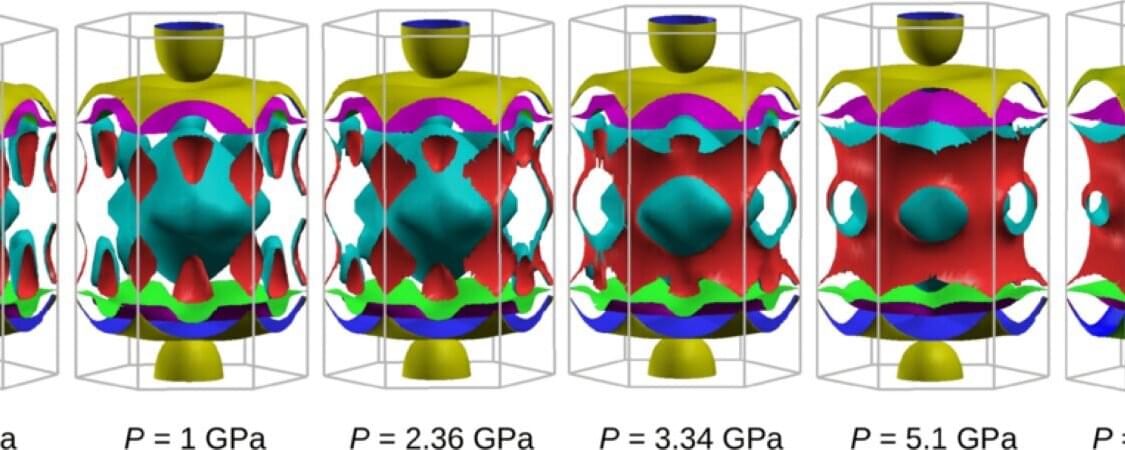
The much-sought-after breakthrough hinges on applying high pressure to certain materials, forcing their electrons closer together and unlocking extraordinary electronic behaviors.

Graphene membranes offer efficient, low-cost option for industrial CO₂ capture

Carbon capture is becoming essential for industries that still depend on fossil fuels, including the cement and steel industries. Natural-gas power plants, coal plants, and cement factories all release large amounts of CO₂, and reducing those emissions is difficult without dedicated capture systems. Today, most plants rely on solvent-based systems that absorb CO₂, but these setups use a lot of heat, require major infrastructure, and can be costly to run.

A smaller, electricity-driven alternative is what the field calls a “membrane” system. A membrane works like an ultra-fine filter that lets certain gases slip through more easily than others, separating CO₂ from the rest of the flue gas. The problem is that many membranes lose efficiency when CO₂ levels are low, which is common in natural-gas plants, and this limits where they can be used.

A new study at EPFL has now analyzed how a new membrane material, pyridinic-graphene, could work at scale. This is a single-layer graphene sheet with tiny pores that favor CO₂ over other gases. The researchers combined experimental performance data with modeling tools that simulate real operating conditions, such as energy use and gas flow. They also explored a wide range of cost scenarios to see how the material might behave once deployed in commercial plants.

Dual substitution induces room-temperature ferromagnetism and negative thermal expansion in BiFeO₃

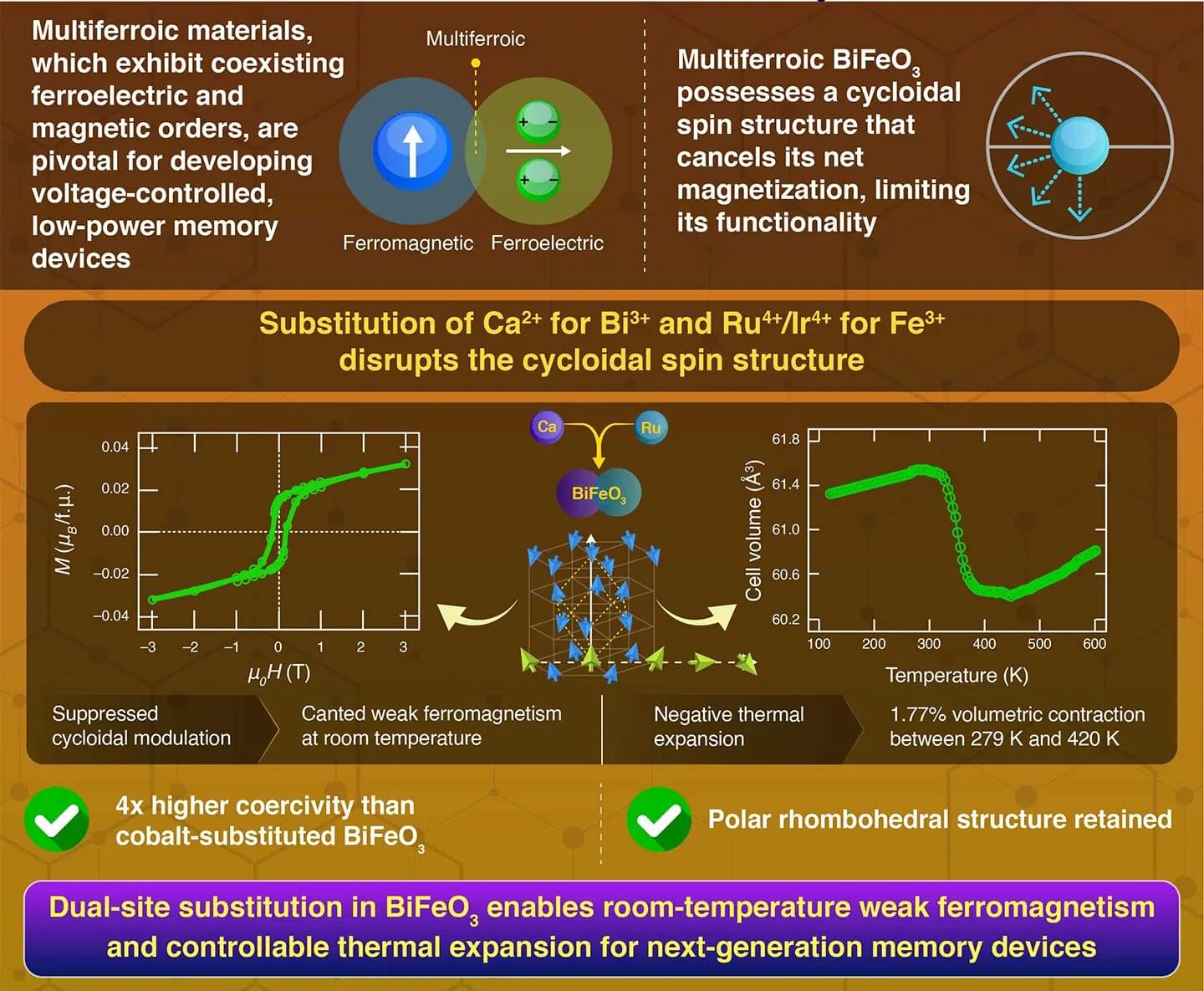
Using a dual-cation substitution approach, researchers at Science Tokyo introduced ferromagnetism into bismuth ferrite, a well-known and promising multiferroic material for next-generation memory technologies. By replacing ions at both the bismuth and iron sites with calcium ions and heavier elements, they modified the spin structure and achieved ferromagnetism at room temperature. Additionally, negative thermal expansion was observed. This ability to engineer magnetism and thermal expansion in a multiferroic material aids in realizing future memory devices.

Multiferroic materials, which show both ferroelectricity and ferromagnetism, hold strong potential for use in low-power memory devices where information can be written electrically and read magnetically. Among these materials, bismuth ferrite (BiFeO3) is one of the most widely studied because it combines ferroelectricity with antiferromagnetism at room temperature.

However, BiFeO3 naturally forms a cycloidal spin structure, which is a wave-like pattern of rotating spins. This pattern cancels out any net magnetization and makes the material difficult to use in magnetic devices.

/* */