“The universe still holds surprises beyond our imagination,” astrophysicist Shankar Ray said.

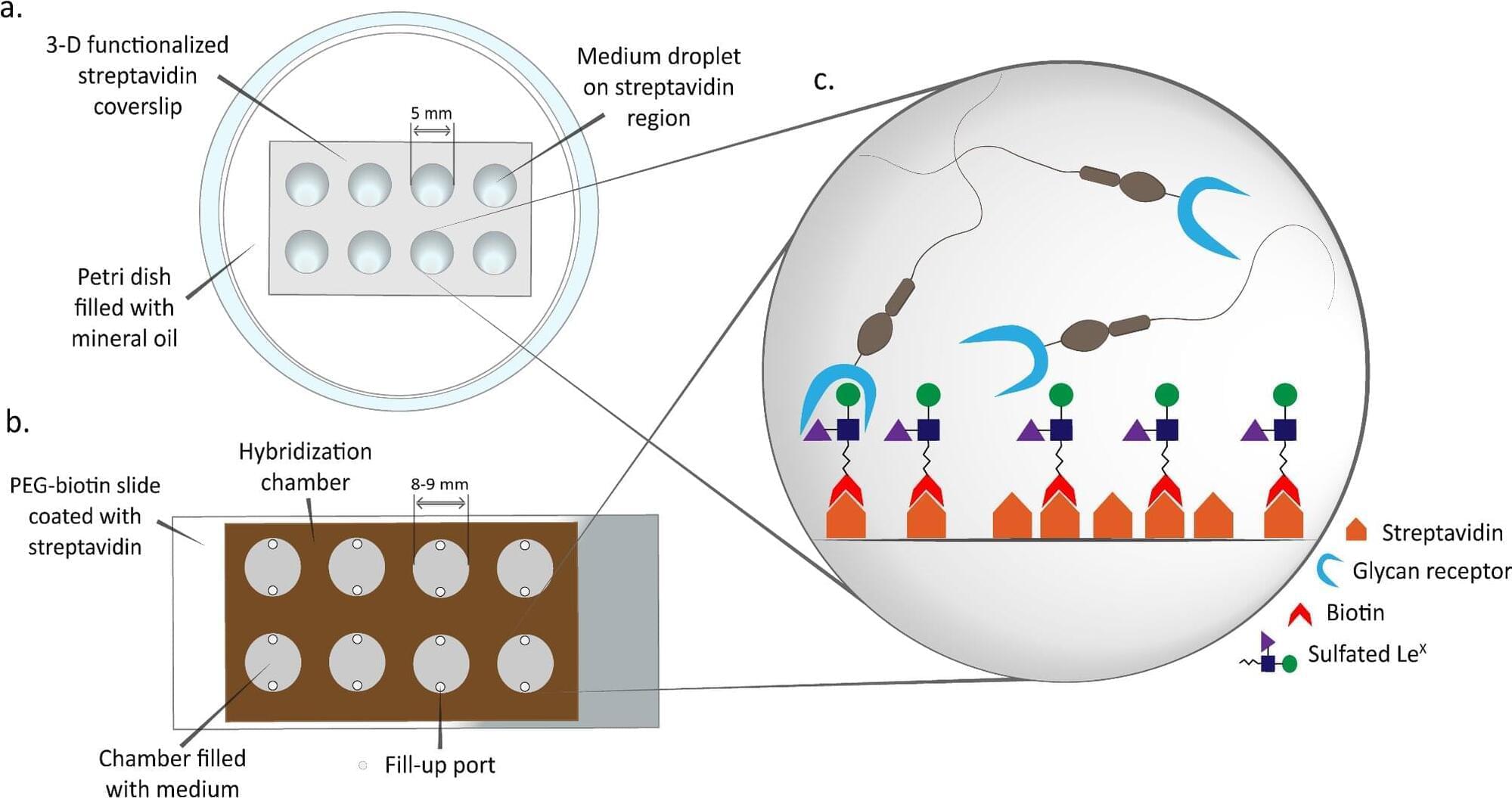
The success of in vitro fertilization depends on many factors, one of which is sperm viability. A recent study from the University of Illinois Urbana-Champaign documents a new way to select viable sperm and prolong their viability in the laboratory, reducing one source of variability during the process. The work is published in the journal Scientific Reports.
“The fallopian tube in women, or the oviduct, has an ability to lengthen sperm lifespan that, until now, we couldn’t recreate in IVF. In 2020, we discovered that complex sugars called glycans are the components of the oviduct that can bind and store sperm and keep them alive,” said senior study author David Miller, professor in the Department of Animal Sciences, part of the College of Agricultural, Consumer and Environmental Sciences at Illinois.
Miller’s group collaborated with chemists to test hundreds of oviduct glycans for their ability to bind pig sperm, settling on one called sulfated Lewis X trisaccharide, or suLeX, for further testing. They focused on pig sperm not only as a proof of concept for future human studies, but also because animal agriculture relies on IVF, too. In pig IVF, multiple sperm often fertilize single eggs, resulting in inviable embryos. The hope with using glycans was that fewer free-swimming sperm would approach and fertilize eggs simultaneously.

An Aston University researcher has conducted the first experimental demonstration of intricate and previously theorized behaviors in the fundamental patterns that govern oscillatory systems in nature and technology.
Synchronization regions, also known as Arnold’s tongues because of the shape they take when shown on a graph, help scientists understand when things will stay in sync and when they won’t.
Arnold’s tongues are observed in a large variety of natural phenomena that involve oscillating quantities, such as heartbeats, pendulum swings or flashing lights.

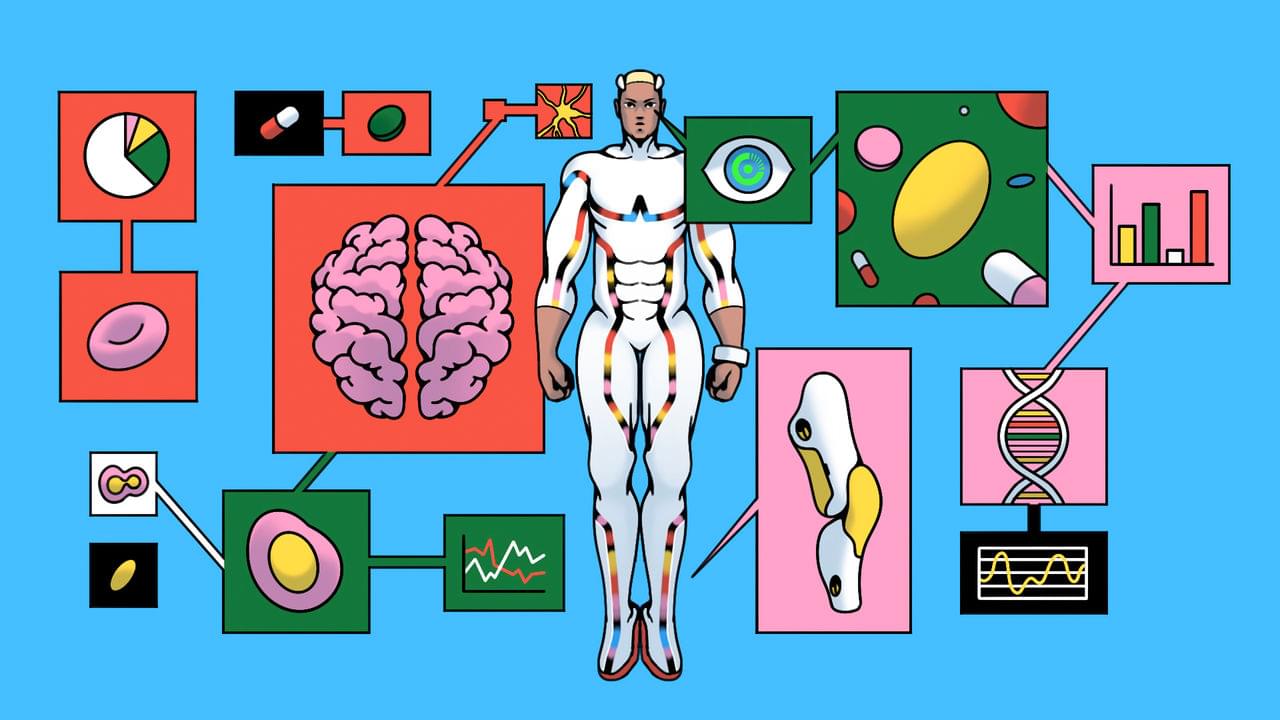
A visionary who predicted the internet and smartphones is now making an even bolder claim about the future of humanity. Revolutionary technologies could soon make immortality a reality.
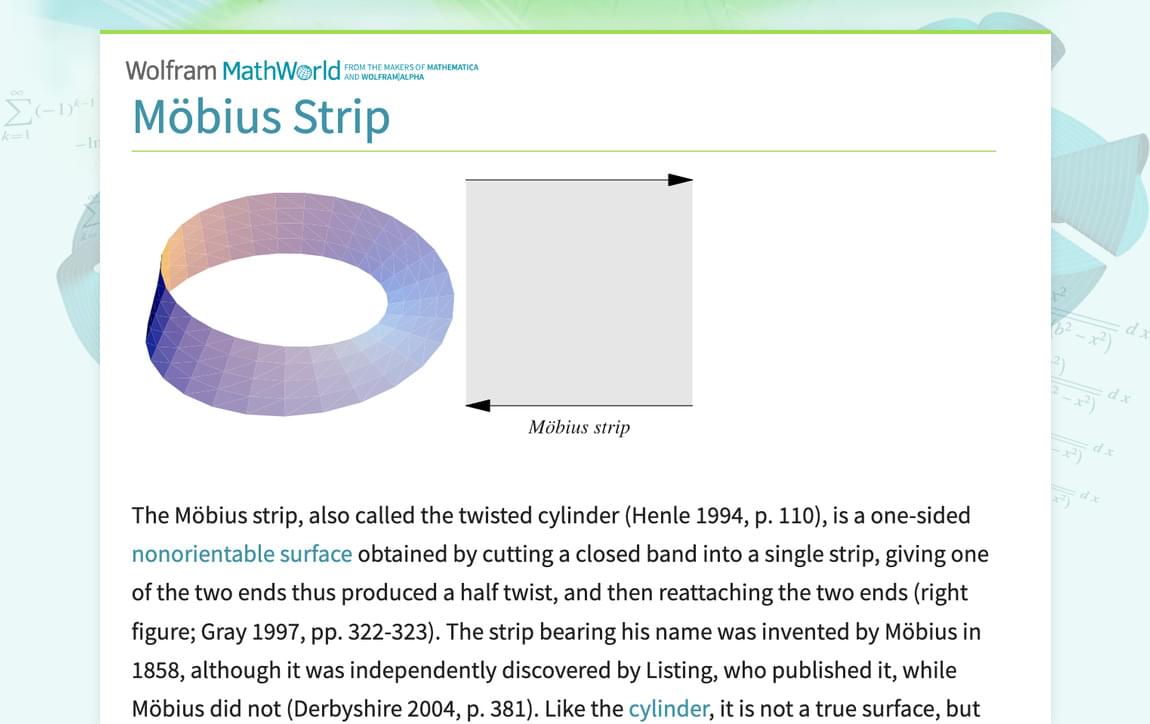
The Möbius strip, also called the twisted cylinder (Henle 1994, p. 110), is a one-sided nonorientable surface obtained by cutting a closed band into a single strip, giving one of the two ends thus produced a half twist, and then reattaching the two ends (right figure; Gray 1997, pp. 322–323). The strip bearing his name was invented by Möbius in 1858, although it was independently discovered by Listing, who published it, while Möbius did not (Derbyshire 2004, p. 381). Like the cylinder, it is not a true surface, but rather a surface with boundary (Henle 1994, p. 110).
The Möbius strip has Euler characteristic (Dodson and Parker 1997, p. 125).
According to Madachy (1979), the B. F. Goodrich Company patented a conveyor belt in the form of a Möbius strip which lasts twice as long as conventional belts. M. C. Escher was fond of portraying Möbius strips, and they appear in his woodcuts “Möbius Strip I” and “Möbius Strip II (Red Ants)” (Bool et al. 1982, p. 324; Forty 2003, Plate 70).