Sep 4, 2015
New General Relativity Area law theory suggests time runs backward inside a blackhole
Posted by Sean Brazell in categories: cosmology, physics
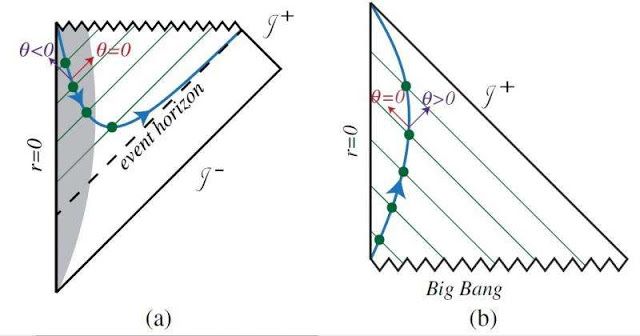
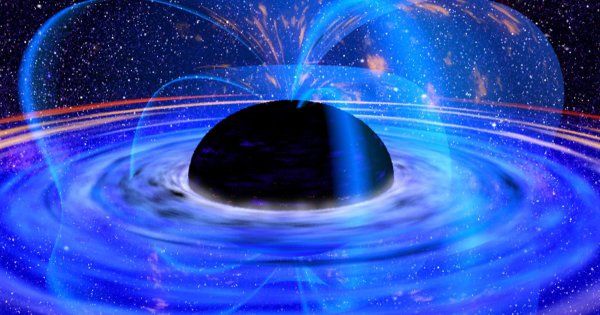
Black holes are known to have many strange properties, such as that they allow nothing—not even light—to escape after falling in. A lesser known but equally bizarre property is that black holes appear to “know” what happens in the future in order to form in the first place. However, this strange property arises from the way in which black holes are defined, which has motivated some physicists to explore alternative definitions.
They reported a new area law in general relativity that is based on an interpretation of black holes as curved geometric objects called “holographic screens.”
“The so-called teleology of the black hole event horizon is an artifact of the way in which physicists define an event horizon: the event horizon is defined with respect to infinite future elapsed time, so by definition it ‘knows’ about the entire fate of the universe,” Engelhardt told Phys.org. “In general relativity, the black hole event horizon cannot be observed by any physical observer in finite time, and there isn’t a sense in which the black hole as an entity knows about future infinity. It is simply a convenient way of describing black holes.”


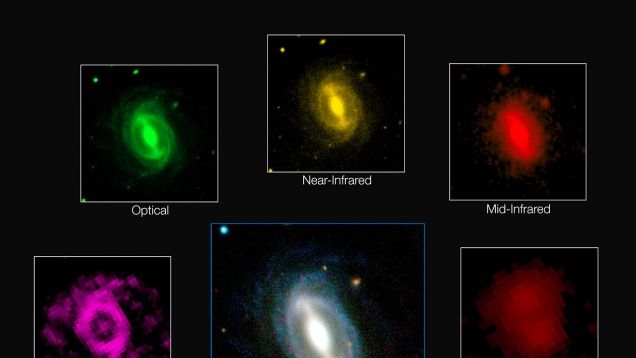
 The team checked the energy across a broad spectrum of lightwaves and other electromagnetic radiation and says it is fading through all wavelengths, from ultraviolet to far infrared.