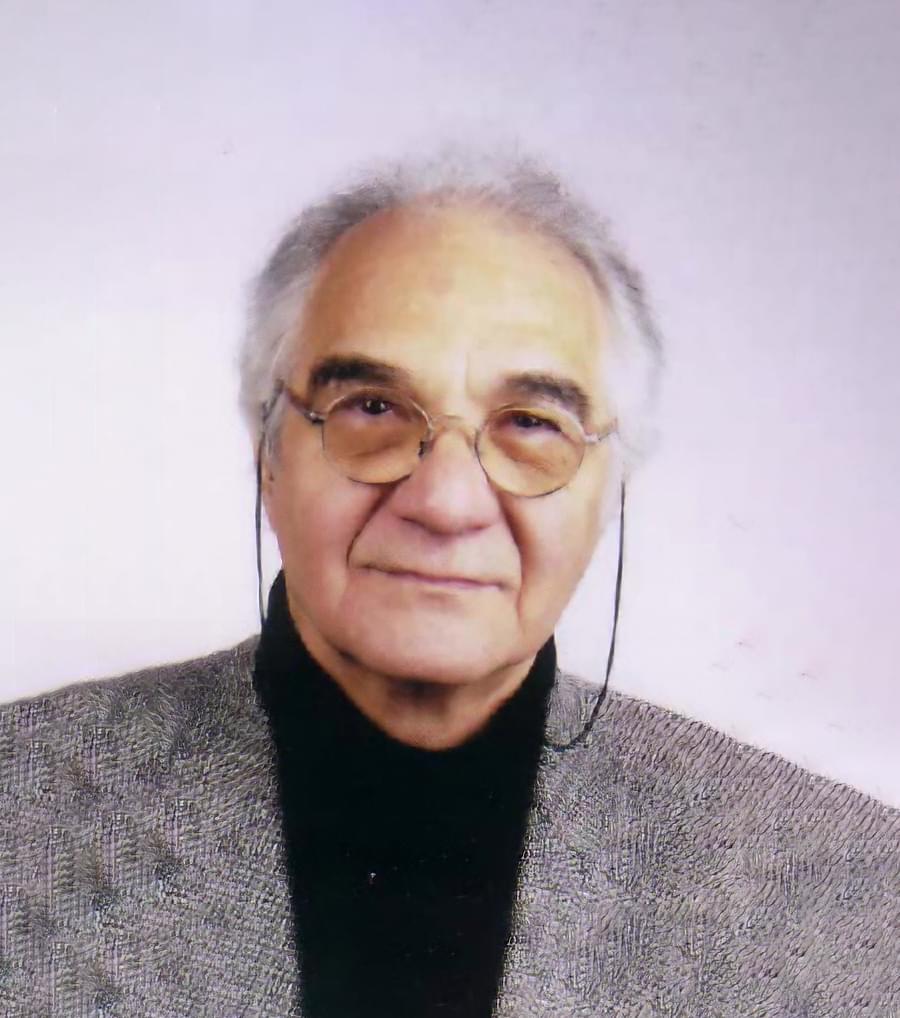
Professor Pier Luigi Luisi
Pier Luigi Luisi was Professor Emeritus of Macromolecular Chemistry at ETH Zürich and, after his retirement from Zürich, a professor of biochemistry at Roma Tre University in Rome. A pioneer of research into the origin of life and the laboratory construction of minimal cells, he introduced the term “chemical autopoiesis”, wrote the monograph The Emergence of Life: From Chemical Origins to Synthetic Biology, and coauthored The Systems View of Life: A Unifying Vision with Fritjof Capra. He died in Rome on August 26, 2025, at the age of 87.
Pier Luigi spent more than three decades at ETH Zürich, first in the Department of Chemistry and later in the Department of Materials, where he directed the Biopolymers section. His research ranged across optically active polymers, enzymes in apolar solvents, self-reproducing micelles and vesicles, and the assembly of minimal, cell-like reaction systems, the last two pursued as experimental approaches to the question of how life began.
He authored more than 300 scientific papers. His former coworkers remembered a group leader who gave his students maximum freedom and pushed them to broaden their interests within and beyond science. Read Pier Luigi Luisi (1938–2025), the obituary written by Alejandro Hochkoeppler, Mauro Giustini, Pasquale Stano, Richard M. Thomas, and Peter Walde for the journal Life, and the obituary published by the ETH Zürich Department of Materials.
His early work at ETH Zürich dealt with the mechanisms of enzymatic catalysis, using dehydrogenases as model systems. Through pioneering stopped-flow experiments, he demonstrated the functional inequality of the subunits of equine liver alcohol dehydrogenase. He then took enzymology into unconventional media, showing that enzymes could be hosted and remain active inside water-in-oil microemulsions known as reverse micelles, which opened new opportunities for both pure and applied enzymology. Read Enzymes Hosted in Reverse Micelles in Hydrocarbon Solution, his 1985 review in Angewandte Chemie International Edition.
He coedited Reverse Micelles: Biological and Technological Relevance of Amphiphilic Structures in Apolar Media with B. E. Straub, and his group went on to study giant phospholipid vesicles, microemulsion gels, and small liposomes for drug delivery. With Peter Walde, he wrote Giant Vesicles for Wiley’s Perspectives in Supramolecular Chemistry series. He also cofounded the Institute of Polymers at ETH Zürich.
Elected Professor of Macromolecular Chemistry in 1984, Pier Luigi turned increasingly to the origins of life. Through intensive discussions and collaboration with the Chilean biologist Francisco Varela, who had developed the theory of autopoiesis with Humberto Maturana, he introduced “chemical autopoiesis” as a guiding principle for how a chemical system becomes a living one, and he set out to build self-reproducing micelles and vesicles in the laboratory.
Read Self-replicating micelles — A chemical version of a minimal autopoietic system, coauthored with Varela in 1989, Autocatalytic self-replicating micelles as models for prebiotic structures in 1992 with Pascale Angelica Bachmann and Jacques Lang, and Autopoietic Self-Reproduction of Fatty Acid Vesicles in 1994.
His later synthesis of the field appeared as Autopoiesis: a review and a reappraisal in 2003. He coedited the NATO volume Self-Production of Supramolecular Structures: From Synthetic Structures to Models of Minimal Living Systems with Gail R. Fleischaker and S. Colonna.
Pier Luigi’s search for self-reproducing compartments that could host replicating macromolecules became a recognized contribution to understanding the minimal and primordial cell. In 2001, he coauthored Synthesizing life with Nobel laureate Jack W. Szostak and David P. Bartel, which outlined how a simple living cell might be assembled from its chemical parts. He set out the “bottom-up” and “top-down” routes toward a semi-synthetic minimal cell, built by loading liposomes with the minimal and sufficient set of genes and enzymes, in Toward the engineering of minimal living cells.
His interest in proteins never faded. In 2006, his team reported on “never born proteins”, polypeptides with amino acid sequences not found in nature that can nevertheless fold into stable structures. Read Investigation of de novo totally random biosequences, Part II: On the folding frequency in a totally random library of de novo proteins obtained by phage display.
After retiring from ETH Zürich as Professor Emeritus in 2003, Pier Luigi moved to Rome and continued his research at Roma Tre University, where he taught biochemistry and pursued the construction of a semi-synthetic minimal cell. His monograph The Emergence of Life: From Chemical Origins to Synthetic Biology appeared from Cambridge University Press in 2006, with a second edition in 2016, and was translated into Spanish.
Read The emergence of life: from chemical origins to synthetic biology, Dennis Rouvray’s review in Chemistry World, which recommended the book for every science library. He coedited Chemical Synthetic Biology with Cristiano Chiarabelli for Wiley in 2011 and wrote Sull’origine della vita e della biodiversità for Mondadori Università in 2013.
His collaboration with Fritjof Capra produced The Systems View of Life: A Unifying Vision in 2014 and in Italian as Vita e Natura: Una visione sistemica. The book integrates the biological, cognitive, social, and ecological dimensions of life into a single framework and applies systemic thinking to health, management, economics, and sustainability. Read A Systems View of Life, the authors’ own introduction on the Cambridge University Press blog. In 2020, he published Essays on Life Sciences, with Related Science Fiction Stories with Cambridge Scholars Publishing.
Beyond the laboratory, Pier Luigi took part across two decades in the dialogues between science and contemplative traditions convened by the Mind & Life Institute. In 2002, he joined His Holiness the 14th Dalai Lama in Dharamsala from September 30 to October 4 for Mind & Life Dialogue X, The Nature of Matter, The Nature of Life, organized by our Arthur Zajonc, alongside our Stuart A. Kauffman, Steven Chu, Eric Lander, Ursula Goodenough, Matthieu Ricard, and Michel Bitbol. Thupten Jinpa and B. Alan Wallace served as interpreters, and Mind & Life cofounder Adam Engle coordinated the meeting.
With Zara Houshmand, he wrote Mind and Life: Discussions with the Dalai Lama on the Nature of Reality, an account of these cross-cultural discussions on the origin of life, consciousness, and evolution, published in 2008. In June 2021, as a member of Mind & Life Europe, he joined Amy Cohen Varela and Elena Antonova in an online conversation with the Dalai Lama honoring the legacy of Varela. Watch Dialogue For a Better World: Remembering Francisco Varela.
He also collaborated frequently with the Bhaktivedanta Institute on questions of science, consciousness, and spirituality. In 2018, he spoke at its 11th All India Students’ Conference on Science and Spiritual Quest on Mathematics and Reality at IIT Bhubaneswar, delivering Science Facing the Spiritual Traditions. Watch A Dialogue with Prof. Pier Luigi Luisi | ETH Zurich | Vision for a Better World | BI Kolkata.
In 1985, Pier Luigi cofounded the Cortona Week with the Swiss entrepreneur and patron Branco Weiss, an interdisciplinary residential summer school in Tuscany, hosted and funded by ETH Zürich, where graduate students lived and worked alongside scientists, economists, philosophers, psychologists, musicians, artists, and spiritual leaders.
Its speakers over the years included David Bohm, Nobel laureates Anton Zeilinger and Richard R. Ernst, Fritjof Capra, Humberto Maturana, our Stuart A. Kauffman, Joan Halifax, and Brother David Steindl-Rast. When ETH ended its support after the 2017 edition, the Cortona Friends committed to carrying the concept forward, launching a new generation of Cortona Weeks in 2018 with an edition in Todi. Read the Cortona Legacy page.
From November 2015, Pier Luigi contributed 56 essays to the online magazine Meer. A prolific writer of fiction, he published novels and stories in Italian, many illustrated by his partner Hong Zhang, among them All’ombra dei fichidindia: Storie elbane quasi tutte vere, dedicated to his beloved Elba, Le cinque porte della felicità: Una storia d’amore e di buddismo, and I lampi tranquilli della mente, as well as the English-language novel The Calm Flashes of the Mind. Read his Contributions in Meer.
Pier Luigi was born on May 23, 1938, in Piombino, Tuscany, and spent most of his childhood on the island of Elba. He studied chemistry at the Scuola Normale Superiore di Pisa, from which he graduated cum laude in 1963, and remained there until 1967. He then spent postdoctoral years in Leningrad, working with Mikhail V. Volkenstein at the Institute of High-Molecular Compounds, and in Eugene, working with S. A. Bernhard at the University of Oregon, with further fellowships at Uppsala University and the Macromolecular Center in Strasbourg.
Read Mechanistic Studies on Equine Liver Alcohol Dehydrogenase. I. The Stoichiometry Relationship of the Coenzyme Binding Sites to the Catalytic Sites Active in the Reduction of Aromatic Aldehydes in the Transient State, published in Biochemistry in 1970. That year he moved to ETH Zürich, initially as Oberassistent.
He was married twice, first to Chris, with whom he had two sons, Peter and David, and then to Claudia, and spent most of his years in Rome with Hong Zhang. Read In memoriam: Pier Luigi Luisi by Robert Smith in Meer, which remembered him as a great scholar, friend, teacher, and leader.
Visit his Wikipedia page, Amazon author page, Mind & Life Institute profile, and Roma Tre research profile.