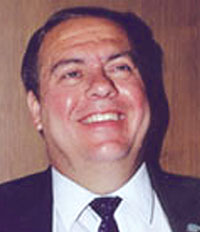
Dr. Alan Hale
Alan Hale, PhD, was the Founder and President of The Earthrise Institute and the codiscoverer of Comet Hale-Bopp, which is widely regarded as the most-viewed comet in history. An astronomer, educator, writer, and advocate of what he called “science diplomacy”, he spent more than half a century observing comets and used astronomy as a tool for building understanding between nations.
On the night of July 22–23, 1995, while taking a break between observations of two periodic comets from his home in Cloudcroft, New Mexico, Alan turned his 41-cm (16-inch) telescope toward the globular star cluster M70 in Sagittarius and noticed a diffuse 11th-magnitude object in the field of view. Over the next 40 minutes, he confirmed that it was moving against the background stars and emailed its position to the Central Bureau for Astronomical Telegrams.
That same night, amateur astronomer Thomas Bopp spotted the same object from the desert south of Phoenix, Arizona, and the two discoveries were apparently made within about five minutes of each other. Read his own account in Comet of the Week: Comet Hale-Bopp C/1995 O1.
Designated C/1995 O1, Comet Hale-Bopp was visible to the naked eye for a record 569 days, or about 18½ months, and reached a peak magnitude of roughly −1.8 in early April 1997, making it the brightest comet in two decades. It was the 199th comet Alan had observed. Its long orbit means it will not return to the inner solar system until around the year 4385. Read Alan Hale (1958–2026) in Sky & Telescope.
The comet made Thomas Bopp and Alan overnight sensations. In April 1997, Alan joined Bopp, David Levy, and Don Yeomans of the Jet Propulsion Laboratory for the panel Comet Chasers: On the Trail of a Comet at Caltech. He lectured widely, including at the Lawrence Hall of Science at UC Berkeley and for New Mexicans for Science and Reason, and his newfound prominence led to an observing session with then Vice President Al Gore. Read Renowned Comet Hunters to Gather at Caltech, Comet Hale-Bopp: Lecture by Alan Hale, and Feb. ’96 Meeting – Dr. Alan Hale.
Alan used the attention to campaign for scientific literacy. When 39 members of the Heaven’s Gate group died in a mass suicide in March 1997, timed to the comet’s approach in the belief that a spacecraft was trailing it, he called the deaths “another victory for ignorance and superstition.” He had already identified the supposed companion object as a background star and posted images online to show it. Read his essay Dirty Snowballs and Other Portents of Doom.
He set out his reasoning on extraterrestrial visitation in An Astronomer’s Personal Statement on UFOs in the March/April 1997 issue of Skeptical Inquirer, and he was a featured speaker at the 20th annual convention of the Freedom From Religion Foundation in Tampa in December 1997. Read 20th Annual FFRF Convention: Alan Hale To Speak.
Alan was born on March 7, 1958, in Tachikawa, Japan, where his father was serving in the U.S. Air Force, and the family moved later that year to Holloman Air Force Base near Alamogordo, New Mexico, where he grew up. On February 2, 1970, at age 11, he observed his first comet, Comet Tago-Sato-Kosaka, which began a lifelong passion for systematic comet observing. After graduating from Alamogordo High School in 1976, he earned his Bachelor’s Degree in Physics in 1980 from the U.S. Naval Academy. He served in the U.S. Navy at duty stations in San Diego and Long Beach, California, until 1983.
From 1983 to 1986, Alan worked at the Jet Propulsion Laboratory as an engineering contractor for NASA’s Deep Space Network, where he was involved with several spacecraft projects, most notably the Voyager 2 encounter with Uranus in 1986. He also took part in the International Halley Watch during the 1986 return of Halley’s Comet. He then returned to New Mexico and earned his Master’s Degree in 1989 and his PhD in Astronomy in 1992 from the Department of Astronomy at New Mexico State University.
His dissertation, Orbital Coplanarity in Solar-Type Binary Systems: Implications for Planetary System Formation and Detection, was published in The Astronomical Journal in January 1994 and became an early contribution to exoplanet research. After his doctorate, he served as Staff Astronomer and Outreach Education Coordinator at The Space Center in Alamogordo, now the New Mexico Museum of Space History. Read Orbital Coplanarity in Solar-Type Binary Systems.
In 1993, Alan founded the Southwest Institute for Space Research, which became The Earthrise Institute. The nonprofit uses astronomy and space to break down international and intercultural barriers, encourage global education, and create opportunities for early-career astronomers.
In August 1999, he led a delegation of American scientists, students, and educators, including Apollo astronaut Rusty Schweickart, to Iran to view the total solar eclipse of August 11 from near Chadegan and to give presentations at the Institute for Advanced Studies in Basic Sciences in Zanjan and at Lorestan University in Khorramabad. He returned to Iran in 2000 and led a further expedition to Zimbabwe in 2001. Read The Iranian Total Solar Eclipse, August 11, 1999.
In 2003, the New Mexico Legislature commended Alan and the Earthrise project for their contributions to science, science education, and cultural understanding, citing his two science-diplomacy delegations to Iran and his visit to Zimbabwe. Read Senate Joint Memorial 72.
In a 2007 interview with the Nepali Times, he explained his conviction that astronomy promotes peace because everyone shares the same sky. Read Interview with a comet-hunter.
From 2009 to early 2017, Alan taught online classes in introductory astronomy and graduate-level classes in space policy and orbital dynamics in the Space Studies program of the American Public University System, and as adjunct faculty of the New Mexico Museum of Space History he developed and taught astronomy education activities. In 2019, he taught at the International Space University’s Southern Hemisphere Space Studies Program in Adelaide, South Australia. In 2020, marking the 50th anniversary of his first comet observation and the 25th anniversary of the Hale-Bopp discovery, he ran Ice and Stone 2020, a weekly online educational program on comets and asteroids.
From 2020, he collaborated with the Global Sky Partners educators’ forum of the Las Cumbres Observatory, imaging comets and asteroids and performing follow-up observations of new discoveries. On August 24, 2023, using a 1.0-meter Las Cumbres Observatory telescope at Siding Spring Observatory in Australia, he recovered the historic periodic Comet 13P/Olbers, which had not been seen since 1956. Read Alan Hale Recovers Comet with LCO Telescopes. He also served as an Explore Alliance Ambassador for Explore Scientific.
Alan retired from systematic visual comet observing on December 31, 2024, after 55 consecutive years. By then he had made 8,147 visual observations of 760 comets, representing 533 separate objects. In 1991, the asteroid 4151 Alanhale, discovered in 1985 at Palomar Observatory by Carolyn Shoemaker and Eugene Shoemaker, was named in his honor for his visual comet observations and his promotion of small solar system body research, with the naming citation written by David Levy. Visit Alan’s Comet Page.
Alan wrote for Sky & Telescope, Astronomy, the International Comet Quarterly, Skeptical Inquirer, and Free Inquiry. For 25 years he wrote the weekly newspaper column In Our Skies, and he later wrote the monthly column Hale to the Stars. He authored Everybody’s Comet: A Layman’s Guide to Comet Hale-Bopp (1996), and in 2015, for the 20th anniversary of the discovery, he published the e-book autobiography the comet man.
From 2004 to 2006 he hosted the weekly radio program The Other Side of the Sky, and he was a frequent guest of our David Livingston on The Space Show, discussing near-Earth asteroids, Apophis, the Deep Impact mission, and Comet ISON. Watch Interview of Alan Hale, discoverer of comet C/1995 O1 (Hale-Bopp).
Alan lived in the Sacramento Mountains outside Cloudcroft, New Mexico, with his wife Vickie. He had two sons, Zachary and Tyler, and three grandchildren. He was an active member of the Cloudcroft Light Opera Company, where he was known to play the villain, and he enjoyed weight training, rock music, and football.
Alan died at his home in Cloudcroft on June 6, 2026, at the age of 68. His passing was marked by obituaries in The New York Times, The Telegraph, The Times, and Sky & Telescope. Read Passing of Alan Hale: Skywatcher and Hale-Bopp Legacy, The Hale in Hale-Bopp Dies, and his obituary on Legacy.com.
Visit his Wikipedia page, his Earthrise Institute biography, and the Earthrise Institute website.