Chasing Wisdom as Fast as Intelligence: Two Ways the Approach to the Singularity Can Fail
by Lifeboat Foundation Advisory Board member Frank D. Smith – November 15, 2026.
The Technological Singularity is the idea that technological change could accelerate to a point beyond which we can no longer forecast what comes next, or how it will reshape human civilization. The word is borrowed from mathematics and physics, where a singularity is a point at which our usual equations stop giving useful answers. Earlier thinkers, I. J. Good among them, had described machines that could improve their own intelligence. The person who gave the idea its name and its modern form was Vernor Vinge, a mathematician, computer scientist and science fiction writer, in his 1993 essay “The Coming Technological Singularity,” presented at a NASA-sponsored symposium [1]. Much of the conversation since, including the predictions and the arguments, traces back to that essay.
This article is my view of that conversation, built around a single graph.
What Vinge Actually Said
I first read Vinge’s essay in 1999 and have been tracking the idea ever since. In it he said that within thirty years we would have the technological means to create superhuman intelligence, and that shortly afterward “the human era will be ended” [1].
What made the essay lasting was the argument behind that forecast. Vinge called the point a Singularity because beyond it our old models of the future stop working. Technology would be changing too fast, and in too unfamiliar a way, for us to predict what comes next or how it would reshape human civilization. His own words were that he had only analogies to point to, such as the rise of humankind.
He did make a dated forecast. The abstract says “within thirty years,” and later in the essay he narrows it: “I’ll be surprised if this event occurs before 2005 or after 2030” [1]. Thirty years from 1993 is 2023, but the far end of his range is 2030, so by his own wording the window has not closed. What matters more than the date is the horizon it points to: a stretch of history where prediction itself fails.
Later writers filled in the blank with specifics, among them human immortality, mind uploading and human extinction. I think that cheats the premise. If the Singularity is defined by what we cannot foresee, then confident predictions about what lies beyond it are a contradiction. At best they describe possible outcomes in the final approach, not the Singularity itself. The rest of this article is about that approach, and why it is dangerous whether we speed up or slow down.
Why the Technology Curve Is Flat for Millions of Years
The model starts with a unit I call an adapton: a unit of technological change that society must understand, accept, regulate and absorb. The oldest known stone hand axes are about 1.76 million years old, and simpler Oldowan flake tools go back about 2.6 million years [2]. For a very long time after that, the technology curve barely moves.
The reason is logical, not mystical. Each new adapton is built on the adaptons already in place, so it can appear only when its prerequisites exist. Even then it must spread through small populations, with limited communication and fragile human memory. With rare exceptions, adaptons arrive when their time arrives. The archaeological record fits this: Oldowan and Acheulean tools turn up together at the same Kenyan site, which suggests the new technique grew out of the old one instead of replacing it [3].
Two details of the curve follow from this. It does not start at zero, because the hand axe was preceded by organic technologies that rotted away and left no trace. And it is not perfectly flat in the early stretch, because even slow adoption adds up.
The acceleration comes from compounding. Every adapton in place enlarges the set of adaptons that can be built next, and also improves the means of spreading them: larger populations, then writing, then printing, then networks. In the model, the rate of new adaptons grows with the number already in place. That is the definition of exponential growth, and it explains why the curve is shallow for millions of years and almost vertical in the last few centuries.
The Graph
The graph is a theoretical explanatory model, not an empirical dataset or a calibrated forecast. It puts everything on one set of axes.
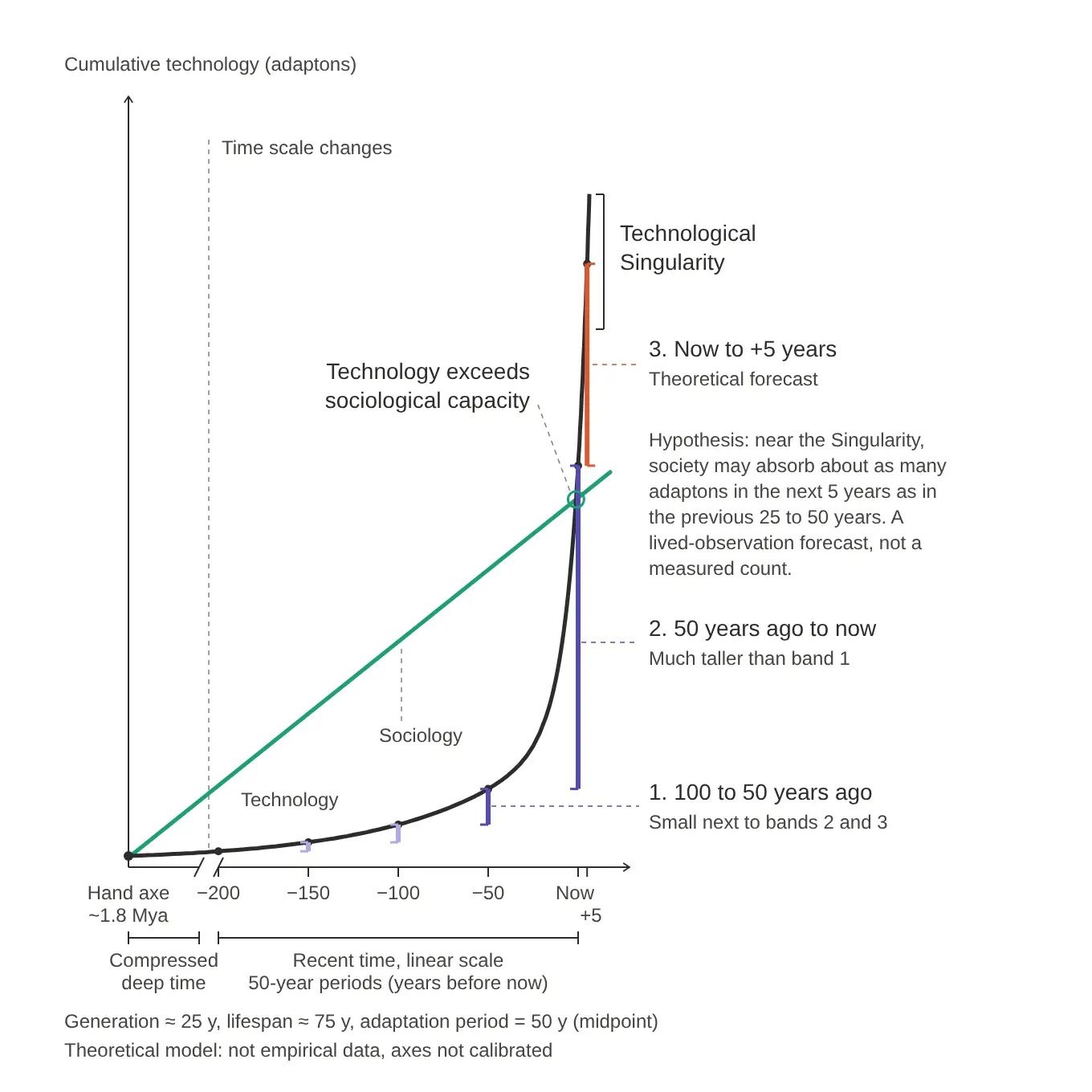
Figure 1. Technology, sociology and adaptons over human history: a theoretical model.
Time runs left to right. Millions of years of deep history are compressed into the left portion, and the last 250 years are on a linear scale marked every 50 years. The break between the two scales is marked on the axis, so it should not be read as a uniform calendar. The vertical axis is the cumulative number of adaptons and is not calibrated to any historical unit.
The sociology line is a straight diagonal. It stands for collective wisdom, institutions, communication and governance: society’s ability to understand and absorb change. The technology curve is one continuous cumulative exponential. It starts at a small positive value, stays shallow for millions of years, and turns nearly vertical at the right edge. That near-vertical stretch is the Technological Singularity. It does not restart and it is not a sigmoid.
Where the two lines cross, technology exceeds sociological capacity. I give that crossing no date and tie it to no invention. Its position in the drawing is a consequence of how steep each line is, and moving the sociology line moves the crossing. It is also a different thing from the Singularity: the crossing is where the gap opens, and the Singularity is where the curve becomes too steep to see past.
The short vertical bars measure adaptons. Each one sits at the end of a 50-year period and runs from the technology level at the start of that period to the level at the end. Its height is the number of adaptons society had to absorb in that period. The bars are independent measurements, not steps in a staircase. Earlier bars are almost invisible, the bar for 100 to 50 years ago is small but visible, and the bar for the last 50 years is far taller. The final bar covers only the next five years, one-tenth the width of a 50-year period on the linear scale, and is still more than half as tall.
First Way to Fail: Stopping or Slowing Down
Civilization is a maintained structure, not a finished one. The stack of adaptons we live on is interlocked, and removing any one of them can pull others down with it.
The clearest example is nitrogen. Vaclav Smil’s study of the Haber-Bosch process finds that at least two-fifths of the world’s population now owes its food to synthetic ammonia fertilizer, and that the process supplies over 99 percent of the inorganic nitrogen used on farms [4]. Cities, medicine and supply chains all rest on the people that one adapton feeds.
Joseph Tainter’s The Collapse of Complex Societies explains why maintenance gets harder. Societies collapse when their investment in complexity reaches diminishing marginal returns, and he argued that innovation is, in the long run, the main way out of that squeeze [5]. A civilization that stops innovating keeps paying the rising cost of upkeep without the thing that offsets it.
Eric Cline’s account of the Late Bronze Age collapse shows how fast an interdependent system can unravel. Trade routes, palaces and diplomacy failed in a cascade, and the interdependence itself hastened the fall [6]. It also sets the scale of the worst case. What followed was a dark age of centuries, and then new peoples and states emerged. A modern collapse would be catastrophic, but history does not say it would return us to the hand axe.
Physics offers an analogy. Ilya Prigogine won the 1977 Nobel Prize in Chemistry for showing that ordered structures far from equilibrium persist only while energy keeps flowing through them [7]. I use this as an analogy for civilization, not as proof. Entropy does not itself guarantee a crash.
Finally, restraint is unstable when others keep going. Armstrong, Bostrom and Shulman model teams racing to build advanced AI, where relaxing safety precautions improves a team’s chance of winning [8]. Their point is that racing is dangerous. It is also why one actor slowing down alone cannot be counted on to slow the whole curve.
Second Way to Fail: Not Slowing Down Enough
The opposite failure is older than the Singularity idea. In 1922 the sociologist William Ogburn argued that material culture, meaning tools and technology, changes faster than adaptive culture, meaning laws, customs and institutions. The delay is what he called cultural lag, a period of maladjustment that shows up as social problems [9]. Critics have called his framing technologically deterministic, and Ogburn himself noted that change can run in both directions [10].
Alvin Toffler took the idea to individuals in Future Shock (1970), defined as a person’s experience of “too much change in too short a period of time” [11]. Hartmut Rosa’s Social Acceleration (2013) describes three speeding processes: technology, social change and the pace of life. He argues they feed each other, and that the present shrinks as expectations based on past experience stop matching the future [12].
My claim goes one step further. The system we have still relies on human participation: workers, voters, regulators, courts and families have to understand, accept and absorb each adapton. If the adaptons arrive faster than people can do that, the human layer is what fails, and the technology on top of it fails with it.
On the graph this is the gap between the two lines. I use a 50-year adaptation period, the midpoint between a 25-year generation and a 75-year lifespan. As the technology curve steepens, the number of adaptons landing in each period grows sharply. My hypothesis, and it is a hypothesis drawn from lived observation, not a measurement, is that society may soon be asked to absorb about as many adaptons in five years as it absorbed in the previous 25 to 50.
What the Steep Part Looks Like Now
I cannot count adaptons, so none of the following is a measurement of my curve. It is evidence that the steep part is no longer a hypothetical, and that society is straining to keep up.
Capability. The research group METR measures the length of tasks, in human working time, that AI agents can complete autonomously at 50 percent reliability. Over the long run that length has doubled about every seven months. Its January 2026 update puts the doubling time since 2023 at about 131 days, and since 2024 at about 89 days [13]. There are caveats: the measure is mostly software tasks, it is at 50 percent reliability, and METR itself says its task suite becomes unreliable beyond about 16 hours of human work [14].
Work and adoption. A Gallup survey in spring 2026 found that half of US workers now use AI at least a few times a year, and that workers in AI-adopting organizations report more disruption [15]. The Stanford AI Index 2026 reports that employment among software developers aged 22 to 25 has fallen by nearly 20 percent since 2024, while older colleagues’ headcount grows [16].
Physical machines. Robotics lags AI but has moved from demonstration to production. Figure AI reported raising output of its Figure 03 humanoid from one robot a day to one an hour, and China’s Agibot reported its 10,000th humanoid in March. The same report says the machines still have to prove they are reliable and cheap enough to compete with workers and simpler automation [17]. Other analyses note that most deployments are pilots doing a narrow set of tasks [18].
The human layer. The same Stanford report found that only 31 percent of Americans trust their government to regulate AI, the lowest among the countries surveyed [16]. A Council on Foreign Relations outlook for 2026 expected binding international agreements on AI governance to be unlikely this year [19]. That is the sociology line lagging in real time: capability doubling in months while institutions, trust and agreements move in years.
The Way Through: Raise the Sociology Line
The two lines on my graph are clean abstractions. In real life both are averages, and both are fuzzy and jagged. The sociology line is also not fixed. People and events can push it in either direction: a tyrant can push it down, and a moral leader can push it up. So can education, and so can some technologies. As we climb the technology curve, comfort grows and our acceptance of others, even at a greater social distance, tends to extend with it.
That is why the situation is not a trap. Stopping the curve fails, and ignoring the gap fails. What remains is to move the other line. The danger is that we are now far more powerful technologically than we are collectively wise. The practical answer is to chase wisdom as fast as we chase intelligence.
That means treating society’s capacity to absorb change as something to build deliberately, not something that will arrive on its own. A UK analysis of AI and work makes a similar point: halting automation is unlikely to be the best policy, and strengthening society’s capacity to adapt is the better focus [20]. The race model above points the same way. If racing is what makes slowing alone impossible, then the levers are the ones that change the incentives: coordination, shared standards, and institutions that can move at the pace of what they govern.
None of this guarantees the sociology line rises fast enough. I do not claim to know that. Vinge’s central point still stands: past some point we cannot see what comes next. What we can do is arrive at that horizon with more wisdom, stronger institutions and wider trust than we have today, and the time to build them is the next two to five years.
Notes and References
- Vernor Vinge, The Coming Technological Singularity: How to Survive in the Post-Human Era, Vision-21: Interdisciplinary Science and Engineering in the Era of Cyberspace, NASA Conference Publication 10129, 1993. Author’s copy: edoras.sdsu.edu.
- Science News, Oldest hand axes found.
- Columbia Climate School, Humans Shaped Stone Axes 1.8 Million Years Ago, Study Says, State of the Planet, September 1, 2011.
- Vaclav Smil, Enriching the Earth: Fritz Haber, Carl Bosch, and the Transformation of World Food Production, MIT Press, 2001. Reviewed in American Scientist: From Fertile Minds.
- Joseph A. Tainter, The Collapse of Complex Societies, Cambridge University Press, 1988. Overview.
- Eric H. Cline, 1177 B.C.: The Year Civilization Collapsed, Princeton University Press, 2014.
- Ilya Prigogine, entry on dissipative structures, Encyclopedia.com. See also Grégoire Nicolis and Ilya Prigogine, Self-Organization in Nonequilibrium Systems, Wiley, 1977.
- Stuart Armstrong, Nick Bostrom, Carl Shulman, Racing to the Precipice: A Model of Artificial Intelligence Development, AI & Society 31(2016):201–206.
- William F. Ogburn, Social Change with Respect to Culture and Original Nature, 1922. See the Society for the History of Technology memorial.
- Review of Ogburn, Social Change with Respect to Culture and Original Nature, Technology and Culture.
- Alvin Toffler, Future Shock, Random House, 1970.
- Hartmut Rosa, Social Acceleration: A New Theory of Modernity, Columbia University Press, 2013.
- METR, Time Horizon 1.1, January 29, 2026.
- METR, organization overview.
- Gallup, Rising AI Adoption Spurs Workforce Changes, April 12, 2026.
- Stanford HAI, Inside the AI Index: 12 Takeaways from the 2026 Report.
- The AI Insider, The State of Humanoid Robotics in 2026: Trends, Challenges and Opportunities, August 21, 2026.
- EVS International, Humanoid Robots in Industrial Manufacturing: What They Can (and Can’t) Do in 2026.
- Council on Foreign Relations, How 2026 Could Decide the Future of Artificial Intelligence.
- From Turing to Tomorrow: The UK’s Approach to AI Regulation, arXiv:2507.03050, 2025.