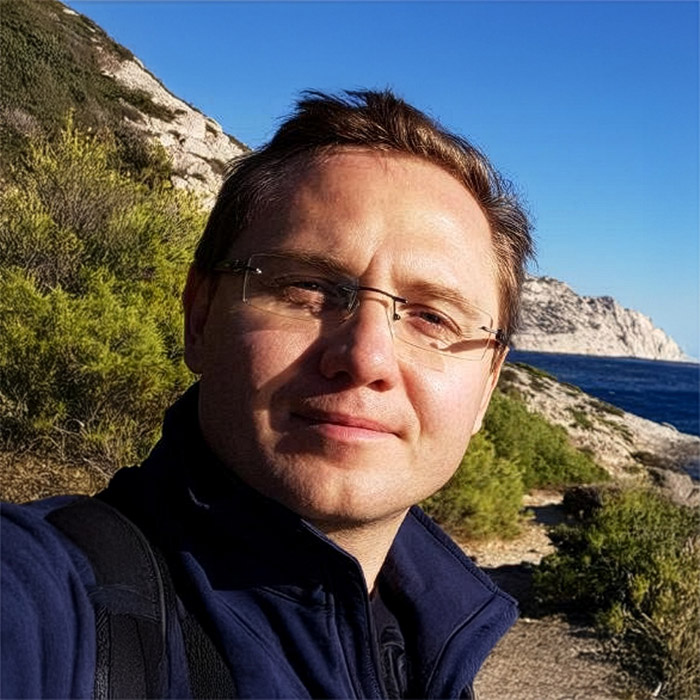
Dr. Sergey Rodionov
Sergey Rodionov, PhD is an AI Researcher at SingularityNET, the decentralized artificial intelligence foundation founded and led by our Ben Goertzel and a founding member of the Artificial Superintelligence Alliance.
An experienced research scientist with 35 scientific publications spanning numerical simulations and artificial intelligence, he brings together expertise in machine learning, data analysis and big data, high-performance computing, software architecture, and blockchain smart contracts — a combination forged over a decade in computational astrophysics followed by nearly a decade at the frontier of artificial general intelligence research.
In 2026, Sergey sole-authored Executable World Models for ARC-AGI-3 in the Era of Coding Agents, accepted at the 19th annual International Conference on Artificial General Intelligence (AGI-26) and published in the Springer proceedings volume Artificial General Intelligence. The paper targets ARC-AGI-3, the interactive reasoning benchmark launched by the ARC Prize Foundation in March 2026, in which agents must explore video-game-like environments with no instructions, no stated rules, and no explicit goals.
Sergey’s system has a coding agent maintain an executable Python world model of each game, verify it against previous observations, refactor it toward simpler abstractions, and plan through the model before acting. With no game-specific code or heuristics, the agent fully solved 15 of the 25 public ARC-AGI-3 games, and the complete run artifacts were released open source in his arc-3-agents-baseline1 repository.
Tech Times has credited this work as the foundation of the code-as-world-model approach to ARC-AGI-3 agents. Read ARC-AGI-3 Gets Open-Source Agent That Writes Python World Models Instead of Neural Weights.
Sergey joined SingularityNET as an AI Researcher in January 2018. With Zarathustra Amadeus Goertzel and Ben Goertzel, he authored An Evaluation of GPT-4 on the ETHICS Dataset in 2023, an early systematic demonstration that GPT-4 substantially outperforms prior state-of-the-art models at predicting human moral judgments across justice, deontology, virtue ethics, utilitarianism, and commonsense morality — evidence, the authors argue, that AI safety research can move beyond asking whether machines can learn human values and toward deploying ethical agents in practice.
His other SingularityNET-era publications include Analyzing Elementary School Olympiad Math Tasks as a Benchmark for AGI, presented at AGI 2020, and Vision System for AGI: Problems and Directions, presented at AGI 2018. His GitHub profile hosts 28 open-source repositories that reflect the breadth of his work, from escrow smart contracts to combinatory logic research tools and AI agents.
Sergey’s engagement with artificial general intelligence predates SingularityNET by years. Between 2012 and 2014, while holding his research post in Marseille, he collaborated with our Alexey Potapov through the AIDEUS research initiative on the mathematical foundations of AGI.
Together they authored Extending Universal Intelligence Models with Formal Notion of Representation, presented at AGI 2012, Universal Induction with Varying Sets of Combinators, presented at AGI 2013, and Making Universal Induction Efficient by Specialization, presented at AGI 2014.
Their paper Universal Empathy and Ethical Bias for Artificial General Intelligence, published in the Journal of Experimental & Theoretical Artificial Intelligence in 2014, proposed an extension of the AIXI framework in which rewards serve only to bootstrap hierarchical value learning — an early formal contribution to the value learning problem in safe AGI.
Before turning fully to AI, Sergey built a substantial career in computational astrophysics. From 2010 to 2017, he was a Research Engineer at the CNRS (France’s Centre national de la recherche scientifique), based at the Laboratoire d’Astrophysique de Marseille, where he developed and ran large N-body and hydrodynamical simulations of galaxy formation and evolution.
As first author, with Lia Athanassoula and Natalia Sotnikova, he introduced the iterative method for constructing equilibrium models of stellar systems in An iterative method for constructing equilibrium phase models of stellar systems, published in Monthly Notices of the Royal Astronomical Society in 2009 — a technique for building equilibrium initial conditions of N-body galaxy simulations with arbitrary geometry and kinematical constraints that has since been adopted well beyond his own group.
He coauthored Bar formation and evolution in disc galaxies with gas and a triaxial halo in 2013 and Forming Disk Galaxies in Wet Major Mergers. I. Three Fiducial Examples, published in The Astrophysical Journal in 2016, and was first author of the series’ second paper, Forming disk galaxies in major mergers. II. The central mass concentration problem and a comparison of GADGET3 with GIZMO, published in Astronomy & Astrophysics in 2017, which diagnosed the unrealistic central mass concentrations that arise in merger simulations and proposed a parametric AGN-like feedback scheme to resolve them.
Sergey began his career at Saint Petersburg State University, where he served as a Researcher at the Sobolev Astronomical Institute from 2005 to 2010 and, before that, as a Linux System Administrator between 2001 and 2005. It was during these Saint Petersburg years that he and Natalia Sotnikova developed the earliest versions of the iterative method.
He earned his PhD in Astronomy and Astrophysics from Saint Petersburg State University in 2005 with the thesis Numerical simulations of dynamical evolution of stellar disks in spiral galaxies, having earned his Diploma of Astronomer and Mathematician with honors in 2002 with the thesis Numerical modelling of vertical structure of stellar disks.
Sergey is based in Tbilisi, Georgia.
Visit his LinkedIn profile, GitHub profile, and ResearchGate profile. Follow him on Facebook.