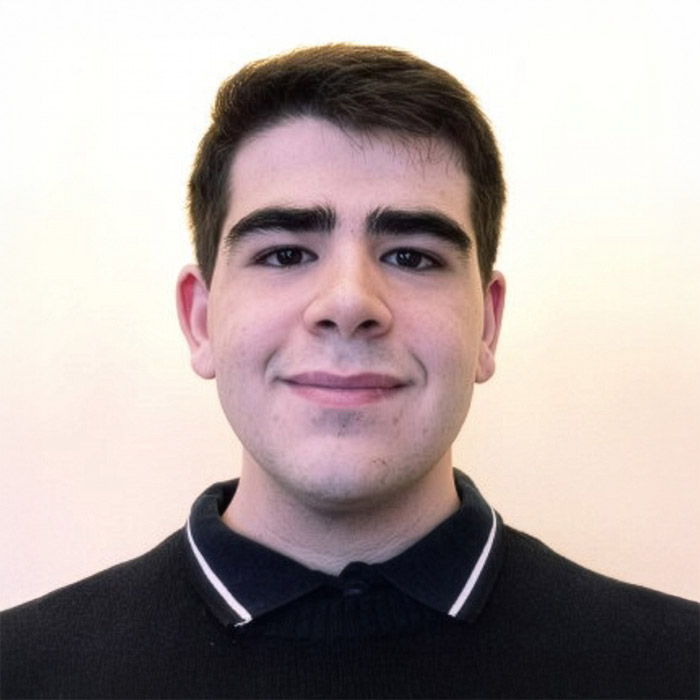
Pablo De los Riscos Mayorga, MSc
Pablo De los Riscos Mayorga, MSc is a Senior Data Scientist at Cognodata and an Industrial PhD candidate in Computer Science and Artificial Intelligence at the Universidad Autónoma de Madrid.
A mathematician by training, Pablo works at the intersection of applied data science and foundational research in artificial general intelligence. At Cognodata, an artificial intelligence and data consultancy headquartered on Madrid’s Paseo de la Castellana, he progressed from Data Science Intern in 2022 to Junior Data Scientist in 2023 and to Senior Data Scientist in 2025, working across the firm’s generative modeling, machine learning, and research and development practice.
Founded in 2001, Cognodata has delivered more than 600 projects and over 1,500 analytical models for clients in 18 countries across Europe and Latin America, serving the banking and finance, payments, insurance, healthcare, retail, and travel and media sectors through its Cognomind, Cognospace, and Cognopay platforms. The firm was acquired by the French digital transformation group Audensiel in 2022 and maintains offices in Madrid and Mexico City. Pablo’s professional skill set spans research and development, generative models, artificial intelligence, machine learning, and Python.
His doctoral research addresses one of the central open problems in artificial intelligence: how an agent can construct internal causal models of its environment from scratch and progressively restructure them through interaction and experience. His thesis, AGI Agents in Dynamic and Partially Observable Environments: Formalization, Implementation and Proof of Concept in Autonomous Robotics and Systems Medicine, pursues general-purpose agents capable of open-ended learning, long-term autonomy, and structural adaptation, combining formal mathematical treatment with working implementations and simulation.
Pablo coauthored Active Causal Structure Learning with Latent Variables: Towards Learning to Detour in Autonomous Robots with Fernando Corbacho, a founding partner of Cognodata who earned his PhD in computer science and systems neuroscience at the University of Southern California and is coinventor of the schema-based learning paradigm.
The paper introduces active causal structure learning with latent variables, a framework in which an agent acts in its environment, discovers new causal relations, detects latent variables when observations violate expectation, and rebuilds its internal causal graph and associated probability estimates in response. The authors demonstrate the framework on a simulated robot that encounters a transparent barrier for the first time and must learn a planning-based detour behavior.
The work introduces a coefficient of surprise that allows the agent to recognize genuinely unprecedented situations, and it was presented at the Second International Conference on Applied Intelligence and published by Springer Nature in Communications in Computer and Information Science, volume 2388, in February 2025. Read the preprint on arXiv.
More recently, Pablo has turned to category theory as a formal language for comparing artificial general intelligence architectures. With Corbacho and the computational neuroscientist Michael A. Arbib of the University of California San Diego, he authored Working Paper: Towards a Category-theoretic Comparative Framework for Artificial General Intelligence, which argues that despite an abundance of proposed architectures — reinforcement learning, universal artificial intelligence, active inference, causal reinforcement learning, and schema-based learning among them — no formal framework exists to state precise relationships between them or derive structural guarantees.
The paper develops an algebraic and category-theoretic treatment of agent architectures intended to expose their commonalities, differences, and unexplored regions. The same collaboration produced Working Paper: Towards Schema-based Learning from a Category-Theoretic Perspective, which sets out a four-level hierarchical categorical framework for schema-based learning spanning syntactic schemas, implemented schemas, cognitive modules, and multi-agent worlds.
In 2026, Pablo announced that his paper on an artificial general intelligence formal comparative framework based on category theory had been accepted at AGI-26, the nineteenth annual conference of the Artificial General Intelligence Society, which has convened the field since 2008 and publishes its proceedings with Springer.
Pablo earned his Bachelor’s Degree in Mathematics (Grado en Matemáticas) from the Universidad Autónoma de Madrid in 2023. He then earned his MSc in Statistical and Computational Information Processing in 2024 from the Universidad Complutense de Madrid, a degree offered jointly by the Complutense and the Universidad Politécnica de Madrid through the Complutense Faculty of Mathematical Sciences.
He began his Industrial PhD at the Universidad Autónoma de Madrid in 2024 under its Escuela de Doctorado, the university’s doctoral school, which coordinates programs across engineering, the sciences, health sciences, social sciences, and the arts and humanities. The Industrial PhD structure allows him to conduct doctoral research within Cognodata’s research and development function rather than separating academic and industrial work.
In 2021 Pablo received a Becas Santander Tecnología | Digital Experience scholarship from IBM, a program run by Banco Santander with IBM and Universia España that awarded 1,000 scholarships covering foundational digital competencies including design thinking, blockchain, cybersecurity, problem solving, and Watson-based artificial intelligence. He holds the B2 First Certificate in English from Cambridge University Press and Assessment, earned in 2022.
Pablo lives in Madrid and works in Spanish and English.
Visit his LinkedIn profile and his GitHub profile.