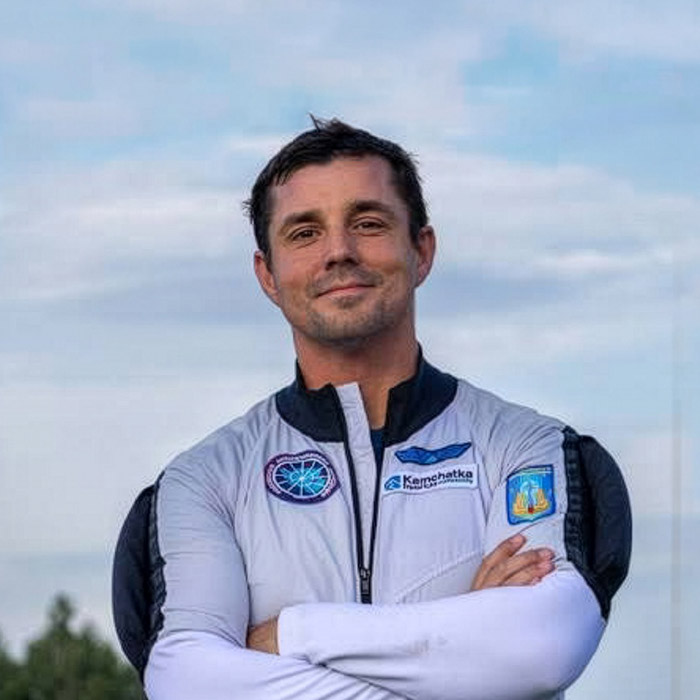
Dr. Nikolay Osetskiy
Nikolay Osetskiy, M.D., PhD is a Research Fellow at the Institute of Biomedical Problems of the Russian Academy of Sciences (IBMP), Russia’s lead institution for space biology and medicine, and Associate Editor of the Journal of Space Safety Engineering, the quarterly journal of the International Association for the Advancement of Space Safety (IAASS).
A physician-scientist working where space medicine, human physiology in extreme environments, and emergency care meet, he spent a full year as the wintering physician at Russia’s Vostok Station in central Antarctica, one of the most isolated and hostile inhabited places on Earth, and now applies that experience to designing resilient health systems for long-duration deep-space missions.
Nikolay joined the Institute of Biomedical Problems in 2017. Founded in 1963, the IBMP has provided medical support for more than 150 human spaceflights, runs the SIRIUS isolation missions, and has been directed since 2015 by Oleg Orlov, a full member of the Russian Academy of Sciences.
Nikolay’s research examines how the human cardiorespiratory system adapts to hypobaric hypoxia, isolation, and hypokinesia, treating a year-long Antarctic wintering as a ground-based analogue for a future lunar base. With colleagues Olga Manko, Anton Artamonov, and Orlov, he has published a series of first-author papers in the Journal of Space Safety Engineering.
Read Antarctic station Vostok as an analogue of a future lunar base: physiological reactions of the human cardiorespiratory system during a year-long exposure to the conditions of hypobaric hypoxia, isolation and hypokinesia, Functional status of the human cardiorespiratory system during a one-year expedition at Vostok station in central Antarctica as a model of a long-term lunar base, Organising the investigation of the human cardiorespiratory system during yearlong wintering at Vostok Station as an analogue for a lunar base, and Lack of Geomagnetic Influence on Human Cardiorespiratory Adaptation to Chronic Environmental Stress During Antarctic Overwintering.
In Human Physiology, he reported a link between geomagnetic disturbance and blood oxygen saturation in expedition members and proposed oxygen saturation as an indicator of geomagnetic effects on cosmonauts in orbit. Read Relationship between Geomagnetic Field Variations and Human Cardiorespiratory System Functioning during Overwintering at the Vostok Antarctic Station.
The data behind this work come from Nikolay’s own wintering. From November 2018 to July 2020, he served as Staff Anesthesiologist at Vostok Station with the Arctic and Antarctic Research Institute, the body that runs the Russian Antarctic Expedition, as a member of the 64th expedition’s wintering team. Vostok sits at 3,488 meters on the East Antarctic Ice Sheet and holds the lowest reliably measured temperature on Earth, −89.2 °C. Alongside his clinical duties, he designed and executed a year-long program of physiological monitoring and biological sampling of eleven wintering expedition members, which has since fed immunology and genetics studies at the IBMP.
Read Reactivation of latent human intracellular infections during a months-long expedition at the Antarctic Vostok station, Adaptive Changes in Human Leukocytes in Response to a Long-Term Stay in Antarctica, and The Antarctic Wintering Alters the Properties of Human Plasma Cell-Free DNA, all coauthored with IBMP immunologist Sergey Ponomarev.
Nikolay has been Associate Editor of the Journal of Space Safety Engineering since January 2025 and advises the IAASS on human performance standards. He was lead author of Advancing safety standards for autonomous deep space missions: outcomes of the 2024 IAASS workshop, written with our James Kass, the IAASS’s Development Manager, and colleagues, and in 2026 coauthored the editorial No surprise! – ISS lifeboat concept and medical evacuation with our Tommaso Sgobba, President and Cofounder of the IAASS and one of the journal’s founders.
Before Antarctica, Nikolay’s work at the IBMP focused on how long-duration spaceflight alters human locomotion and posture, working in the sensory-motor physiology group of the late Inessa Kozlovskaya alongside Elena Tomilovskaya. He was first author of Changes in the characteristics of voluntary movements after long duration spaceflight, a study of eleven cosmonauts conducted jointly with NASA Johnson Space Center neuroscientist Millard Reschke and his team and presented at the 39th meeting of the International Society for Gravitational Physiology in 2018.
He coauthored Foot-ground reaction force during long-term space flight and after it: walking in active treadmill mode, Comparative Study of the Lower Limb Muscle Tone under the Conditions of Five-day Support Unloading Coupled with Different Regimens of Electromyostimulation, and Sleep in 21-Day Dry Immersion. Are Cardiovascular Adjustments Rapid Eye Movement Sleep-Dependent?, and contributed a chapter on the Motocard treadmill experiment to the IBMP’s 2021 volume on biomedical experiments aboard the Russian Segment of the International Space Station.
Between 2017 and 2021, he presented this research at the International Society for Gravitational Physiology, the 43rd Scientific Assembly of COSPAR, the 71st International Astronautical Congress, and NASA’s Human Research Program.
As part of the IBMP’s operational medical support for crewed flights, Nikolay has carried out medical protocols for Soyuz launches at the Baikonur Cosmodrome and for landings in the remote Kazakh steppe. His stated focus is practical innovation: adapting space-grade diagnostics for resource-limited settings, improving crisis response in extreme climates, and mentoring clinicians and engineers in multidisciplinary problem-solving.
Nikolay’s career began in emergency medicine. From 2013 to 2016, he was an Emergency Physician at the A.S. Puchkov Emergency and Urgent Medical Care Station in Moscow, the city’s ambulance service, where he led emergency care teams. In 2016, he spent four months as a volunteer physician at Tumaini Health Center in Arusha, Tanzania.
Nikolay earned his medical degree in 2011 from the Russian State Medical University, now Pirogov Russian National Research Medical University, and holds a PhD in aerospace medicine. He is a native Russian speaker with full professional proficiency in English and is based in Moscow.
Visit his LinkedIn profile, ResearchGate profile, Loop profile, and ISTINA profile. Follow him on Facebook and X.