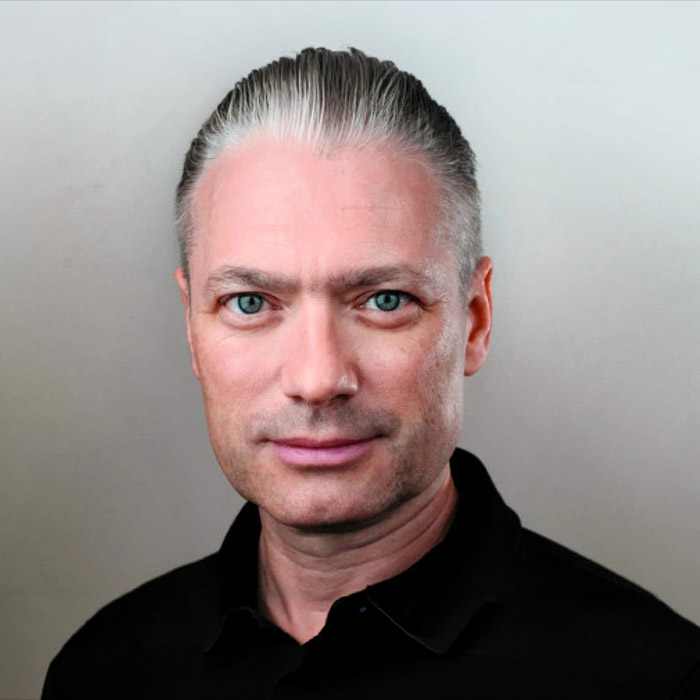
Dr. Max Talanov
Max Talanov, PhD, is a neuromorphic computing and neurosimulation researcher who is an Associate Researcher at the IRCCS Centro Neurolesi Bonino-Pulejo in Messina, Italy, and a Senior Research Associate at the Institute for Artificial Intelligence of Serbia in Novi Sad.
He is best known for advancing bio-plausible spiking neural networks, memristive neurohybrid hardware, and the concept he calls the "neuropunk revolution" — the use of real-time neurosimulation and neuromorphic devices to compensate for the pathological function of the human nervous system.
At the IRCCS Centro Neurolesi Bonino-Pulejo, Max conducts spiking neural network research using bio-plausible models of the spinal cord and hippocampus, aimed at neurorehabilitation, neuroprosthetics, and energy-efficient machine intelligence. His recent work proposes a "synthetic hippocampus" for robots that separates an online phase of sensorimotor interaction from an offline phase of replay and consolidation, implemented with spiking neural networks and neuromorphic substrates. Read A Bio-realistic Synthetic Hippocampus for Robotic Cognition and Why would robots need to sleep?
He also studies the energy cost of neural computation, benchmarking energy per synaptic event across GPUs, digital spiking processors, and memristive devices down to the biological range. Read Critical Analysis of Energy Consumption in Neuro-Computational Systems.
The "neuropunk revolution" is the signature theme of Max's research program. It identifies a set of technologies — memristive and bio-plausible simulation, brain–computer interfaces, and neurointerfaces — directed at bypassing or repairing damaged neural pathways, for example, by processing motor-cortex signals in real-time thalamus, brain-stem, and spinal-cord models to orchestrate muscle stimulation with a feedback loop. Read Neuropunk Revolution. Hacking Cognitive Systems towards Cyborgs 3.0 and Neuropunk revolution in short.
Within this program he has demonstrated a memristive self-organizing spiking network that replicates walking-pattern recovery in a rat after spinal cord injury, and a paired nerve-stimulation method that produces a selective inhibitory compensation effect over motor responses in healthy volunteers. Read Paired nerve stimulation with selective compensation effect.
Earlier in his career Max became known for computational models of emotion. Working with philosopher Jordi Vallverdú and colleagues, he developed NEUCOGAR (NEUromodulating COGnitive ARchitecture), a neurobiologically inspired framework that maps the influence of dopamine, serotonin, and noradrenaline onto computational processes, extending Hugo Lövheim's "Cube of Emotions" and Marvin Minsky's "Emotion Machine." Read A Cognitive Architecture for the Implementation of Emotions in Computing Systems.
He has since collaborated widely on memristive neurohybrid systems, coauthoring work on chips that couple living neuronal cultures with metal-oxide memristive arrays and CMOS electronics for biosensors and neuroprosthetics. Read Neurohybrid Memristive CMOS-Integrated Systems for Biosensors and Neuroprosthetics and Memristive circuit-based model of central pattern generator to reproduce spinal neuronal activity in walking pattern.
His collaborators include unconventional-computing researcher Andrew Adamatzky, cybernetics pioneer Kevin Warwick, and memristor scientist Victor Erokhin. His publications have accumulated more than 900 citations on Google Scholar, spanning computational neuroscience, neurorehabilitation, neurointerfaces, neuromorphic computing, and neurosimulation. He is also listed among the top 10% of Serbian scientists.
Max built his research career at Kazan Federal University, where he served as Head of the Neuromorphic computing and neurosimulation laboratory between 2014 and 2021 and as Docent of the intelligent robotics chair. From 2016 to 2018, he was Deputy Director for Science at the university's Institute of Information Technologies and Intelligent Systems (ITIS).
Between 2020 and 2023, he was Founder and Chief Research Officer of B-Rain Labs LLC in Kazan, where the research group published in journals including Nature, Frontiers in Neuroscience, Frontiers in Cellular Neuroscience, and Chaos, Solitons & Fractals.
In 2024, he was a Consultant to the United Nations Development Programme. Before turning to neuroscience, he spent eight years as a Software Design Architect at Fujitsu and lectured on affective computation at Innopolis University.
Max earned his PhD from Kazan State Technological University in 2000, with doctoral research on the mathematical modeling of electromagnetic fields in plasma. He later completed the Machine Learning Fundamentals for Lecturers program at the Higher School of Economics in 2021 and holds an IBM Certified Solution Developer credential. He is a regular member of the BICA Society (Biologically Inspired Cognitive Architectures), the community in whose journal much of his NEUCOGAR work first appeared.
A frequent keynote speaker, Max has presented on neuromorphic computing, spiking neural networks, and the neuropunk revolution at conferences including DSC Europe.
Watch Recap and Closing Remarks: Neuropunk revolution and energy consumption | Max Talanov | DSC EUROPE 24 and Robotic emotions | Max Talanov | DSC Europe 23. View his slides from Max Talanov — Cyberpunk revolution and watch his interview on Spiking Neural Networks.
Visit his LinkedIn profile, Google Scholar page, ResearchGate profile, Academia page, Frontiers Loop profile, SciProfiles page, and dblp record. Follow him on GitHub, Facebook, Instagram, and ORCID.