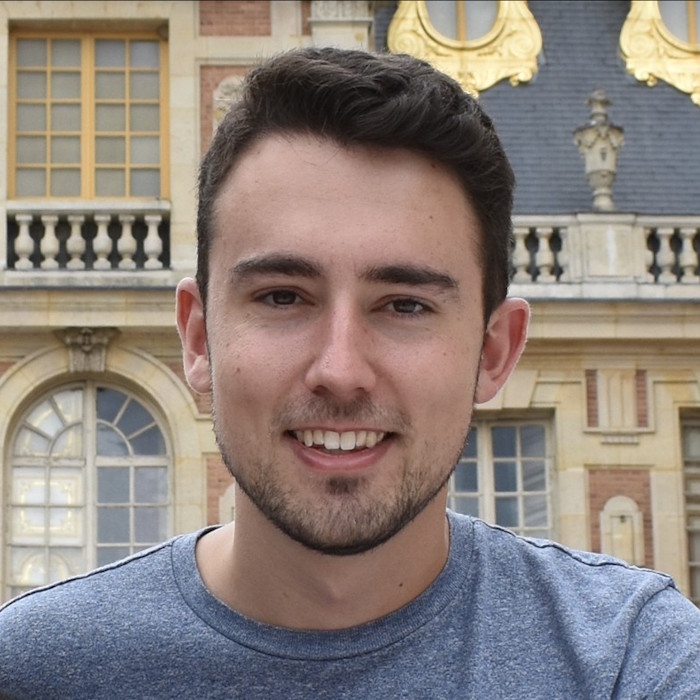
Dr. James Blake
James Blake, PhD, is a Research Fellow specializing in space debris at the Centre for Space Domain Awareness (CSDA) of the University of Warwick, Secretary of the CSDA, and Secretary to the Steering Board of the Global Network On Sustainability In Space (GNOSIS). His research applies astronomical tools and techniques to the detection and monitoring of satellites and orbital debris.
Since April 2024, James has held a Research Fellowship funded by the Science and Technology Facilities Council (STFC). In this role he investigates event-based sensing technology for space domain awareness and simulates optical sensor network architectures to identify capability gaps that event-based sensors could fill.
He also continues to lead the DebrisWatch Programme, a survey of the geosynchronous region roughly 36,000 km above the Equator, where small debris remains poorly characterized because such objects are faint at that range. DebrisWatch partners include the Defence Science and Technology Laboratory (Dstl), the Japan Aerospace Exploration Agency (JAXA), the Australian National University (ANU), and the University of Auckland.
In 2026, James was lead author of DebrisWatch II: Digging deeper for geosynchronous debris, published in the Journal of the Astronautical Sciences. The team, which included our Stuart Eves, reprocessed archival survey data with new image-processing algorithms and a blind stacking technique, recovering 25 detections the original analysis had missed and reaching fragments about 5 cm across. Nearly 80% of the faint objects were absent from public catalogues, and many showed signs of tumbling. The paper also reported preliminary results from a multinational follow-up campaign with telescopes in Australia, Japan, and La Palma.
Read More than meets the eye: astronomers dig deep to find tiny but dangerous space debris, and Astronomers Found a Hidden Swarm of Space Junk Threatening Earth’s Most Valuable Orbit.
From 2021 to 2024, James held a Research Fellowship funded by Dstl. He led the DebrisWatch Programme, remotely observing the geosynchronous region with large-aperture telescopes in La Palma, Australia, and Japan, and simulated optical sensor network architectures to inform UK cross-government requirements through the Astroscopes programme of Dstl. His work in this period includes Exploring SDA Sensor Architectures for the Surveillance of Geosynchronous Spacecraft, presented at the AMOS Conference in 2023, and the coauthored study Lord of the (sub-)Rings: mapping the surface reflectance and spin-axis of Ajisai.
James has served as Secretary of the CSDA since July 2021, two months before the University of Warwick launched it as the first UK research center dedicated to the sustainable use of near-Earth space. Since 2019, he has been Secretary to the Steering Board of GNOSIS, an STFC network founded by Eves that connects academia, defence, industry, and policy on space debris and space weather. He organizes its workshops, conferences, and meetings for 50 to 100 participants and manages its social media. Read his invited review Looking out for a sustainable space and Space junk traffic dangers to be tackled by first-of-its-kind research centre in UK.
James earned his Master’s Degree of Physics with First-Class Honours in 2017 from the University of Warwick. He earned his PhD in 2021 from the University of Warwick under Don Pollacco, with the thesis Optical imaging of space debris in low and high altitude orbits. His doctoral research used the 2.54 m Isaac Newton Telescope on La Palma for eight nights and commissioned a 14-inch Rowe-Ackermann Schmidt astrograph. The resulting paper, DebrisWatch I: A survey of faint geosynchronous debris, published in Advances in Space Research in 2021, found that over 75% of the debris detected could not be matched to public catalogues.
Read Faint orbital debris that threatens satellites not being monitored closely enough, warn astronomers and Space junk: We don’t know where over 75 per cent of orbital debris actually came from.
In 2019, he gave the invited talk A watchful eye on the sky: monitoring the mess of near-Earth space at UC Irvine, and he has also spoken at NASA JPL.
As an undergraduate, James completed three summer research internships in exoplanetary science. He coauthored Variability in the atmosphere of the hot giant planet HAT-P-7 b in 2016, developing its initial phase curve model, and Dynamical and biological panspermia constraints within multi-planet exosystems in 2018, which simulated the transfer of life via asteroids within the TRAPPIST-1 system. With Dimitri Veras he wrote Five reasons future space travel should explore asteroids for The Conversation, republished by Space.com.
James received the 2019 Student Award at the AMOS Conference in Maui for Optical Imaging of Faint Geosynchronous Debris with the Isaac Newton Telescope. In 2018, he won the Posters in Parliament competition at the Palace of Westminster with Modelling panspermia in the TRAPPIST-1 system. He also won second prize in the Warwick Physics PhD. Poster Competition in 2019. His poster DebrisWatch: Eyes on the sky appears in the Royal Astronomical Society poster contest.
A committed advocate of widening participation, James served as an Outreach and Recruitment Ambassador at the University of Warwick from 2014 to 2021, mentoring for the Sutton Scholars programme and leading residentials for school students. He cofounded the Outreach and Recruitment Ambassadors’ Community and the Warwick Astronomy Society, which won the Students’ Union Award for Best New Society. He speaks English natively and has limited working proficiency in French.
Visit his LinkedIn profile, University of Warwick page, ResearchGate profile, ORCID page, The Conversation profile, and GitHub page.