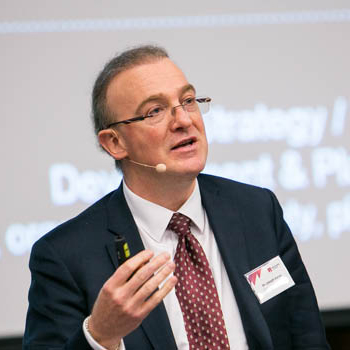
Dr. Joseph Voros
Joseph Voros, PhD, is Adjunct Professor at the National Security College within the Australian National University, where he is an Expert Affiliate of the College's Futures Hub and a member of its Futures Council — a select group of individuals with outstanding expertise in futures, foresight, intelligence analysis, and national security strategic planning.
He is also a Senior Partner at Longviews, an international strategic foresight firm in defense and security. A theoretical physicist turned professional futurist with more than 25 years of experience in futures and strategic foresight teaching, research, and consulting, he has run TheVoroscope, his freelance futures intelligence and strategic foresight practice, since 2020.
Since 2019, Joe's work has centered on the Australian defense and national security community and, more recently, on NATO's strategic foresight activities, including consulting to NATO Allied Command Transformation. Commissioned by NATO ACT, he authored the thematic paper The Future of the Rules-Based International Order, which maps possible futures for the international order and is accompanied by a companion foresight radar built by Futures Platform. Read Of things NATO, 1: The future of the rules-based international order.
He delivered a plenary presentation at the second Allied Foresight Conference at the NATO Defense College in Rome and a scene-setting keynote at TechDef25, hosted by VIKI, the Defense Innovation Research Institute of Hungary.
Since 2019, Joe has also been a regular Guest Lecturer and Visiting Fellow at the Australian Defence College in Canberra, teaching futures thinking and foresight methods across its courses and other parts of Defence, and since 2022 a Guest Presenter in the National Security College's advanced futures thinking and methods courses.
Joe's path from physics to foresight unfolded across a 26-year association with Swinburne University of Technology in Melbourne. Engaged in 2000 as a Foresight Consultant to the Australian Foresight Institute — established at Swinburne by foresight pioneer Richard Slaughter — he then served as Strategic Foresight Analyst in the Office of the Vice-Chancellor from 2000 to 2002, helping to build the university's organization-wide foresight capacity.
From 2003 to 2020, he was Senior Lecturer in Strategic Foresight, the longest-serving academic associated with the Master of Strategic Foresight across the program's entire run between 2001 and 2018, teaching for many years alongside his colleague Peter Hayward. Read Celebrating the Master of Strategic Foresight.
Following the COVID-driven redundancies imposed upon the Australian university sector in 2020, he stayed on as Adjunct Professor of Foresight in Swinburne's School of Business, Law & Entrepreneurship until April 2026, ensuring his PhD students could finish their doctoral work with continuity of supervision — read his farewell reflections. From 2023 to 2026, he was also Adjunct Professor in the Leadership, Futures, and Foresight program at the University of Southern Queensland.
Joe is best known for developing the multiple-award-winning Generic Foresight Process framework, which grew out of his foresight work at Swinburne and later formed the basis of the Master of Strategic Foresight's teaching. Its founding paper, A generic foresight process framework, earned a Highly Commended Award in the 2004 Emerald Literati Network Awards for Excellence, as did Introducing a classification framework for prospective methods in 2007, while Morphological prospection: profiling the shapes of things to come received an Outstanding Paper Award in 2010.
The framework, with its signature “prospection” phase — the deliberate generation of forward views of alternative futures — continues to be taught and applied internationally. Read also The Futures Cone, use and history, his account of the widely used taxonomy of alternative futures he helped popularize, and his primer on Futures Studies, foresight and the use of scenarios.
A founding member of the International Big History Association and a member of its board from 2012 to 2017, Joe has long explored cosmic evolution — from quarks to consciousness — as a framing perspective for thinking about the long-term future of humanity, describing himself as a civilizational-transition futurist.
His work at the intersection of Big History, astrobiology, and SETI includes Big History in its Cosmic Context, On a morphology of contact scenario space, the chapter Galactic-scale macro-engineering: Looking for signs of other intelligent species, as an exercise in hope for our own in Teaching & Researching Big History, and the essay Is 'Hoag's Object' an 'engineered' galaxy?
In 2012, he presented Macro-prospection: Thinking about the future using macro- and Big History at the Global Future 2045 International Congress in Moscow — watch GF2045: Joseph Voros. He is also a member of the Great Transition Initiative — read The Power of the Long View.
Joe earned his PhD in Theoretical and Mathematical Physics in 1996 from Monash University, with the thesis “On the Electrodynamics of Einstein's Non-symmetric Unified Field Theory,” and earned his Bachelor of Science with Honors in the same field there in 1989.
Before turning to futures work, he spent the early internet years as an Internet Education Consultant and Webmaster at Franklin Collins, as the first employee of Intranet Australia, and as a Systems Engineer and Channel Programs Manager for Asia-Pacific at Netscape Communications from 1997 to 1998, before running his own technology and foresight consultancy, Blue Sky Consulting, between 1998 and 2000.
Joe serves on the editorial boards of Foresight (since 2007), the European Journal of Futures Research (since 2013), the Journal of Big History (since 2016), and the Journal of Futures Studies (since 2021). He is a member of the Content Advisory Board of Futures Platform (since 2024) and of the Scientific Council of the Alternative Planetary Futures Institute (since 2021), and he has served on the Advisory Board of the Lifeboat Foundation since 2020. He was a member of the World Futures Studies Federation from 2002 to 2025 and of the Association of Professional Futurists from 2017 to 2025.
Beyond his Emerald Literati awards, Joe was a Top-3 finalist in the Association of Professional Futurists' Most Significant Futures Works Awards in 2009 for the co-edited special issue Integral Futures of Futures (2008), and a National Finalist in the Unijobs Lecturer of the Year Awards the same year. Listen to EP 18: Big History and Civilisational Foresight on FuturePod, and watch Futures studies with Joseph Voros.
Now semi-retired — though, as he puts it, open to interesting stuff — Joe devotes part of his time to Reverse-Engineering Quantum Mechanics, a long-form research series on his blog. He lives in Australia and speaks Esperanto and Hungarian. Browse his publications.
Visit his Homepage, National Security College profile, LinkedIn profile, ResearchGate profile, Google Scholar page, ORCID record, and Sociostudies author page. Follow him on X.