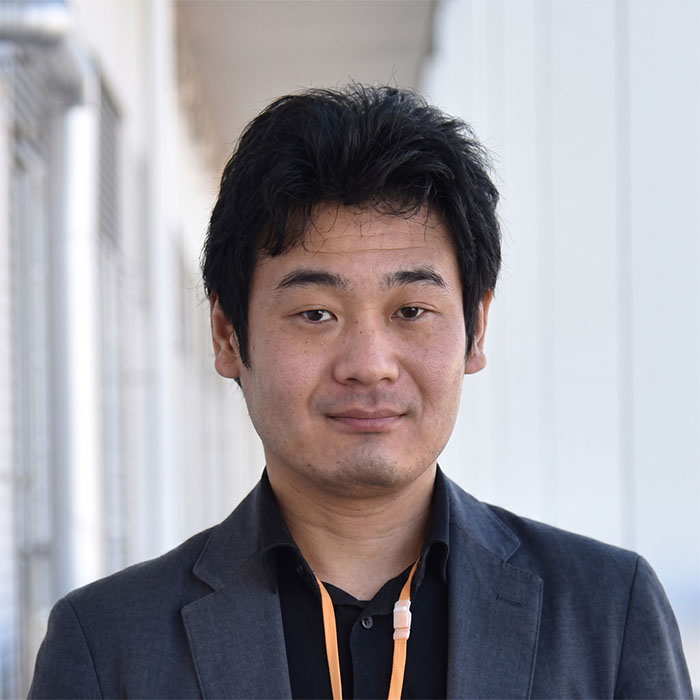
Dr. Yuta Aoki
Yuta Aoki, DSc is an Application Scientist at Matlantis, the cloud-based universal atomistic simulation platform whose core technology is developed by Preferred Networks. A condensed-matter physicist by training who moved into materials informatics, he combines first-principles calculations, machine learning, and universal neural-network interatomic potentials to accelerate the discovery and design of new materials.
At Matlantis, Yuta works in the Technical Solutions Department, where he develops and demonstrates simulation workflows built on PFP (Preferred Potential), a universal machine-learning interatomic potential that predicts a broad range of materials properties with a single model. His recent work targets crystal-structure prediction, combining an efficient convex-hull expansion algorithm with PFP for rapid energy evaluation to explore novel stable structures and determine solid-solubility limits — an approach he has applied to the search for previously unknown hydrogen-rich rare-earth hydrides.
He presented this method at the 26th Asian Workshop, a workshop on computational physics and materials science that has been held since 1998, at the Tsukuba International Congress Center between October 27 and 29, 2025, and delivered a related oral presentation at the Materials Research Meeting (MRM2025) in Yokohama on December 2025. Read Matlantis gave a presentation at the 26th Asian Workshop.
Before joining Matlantis in 2025, Yuta was a Senior Scientist at Schrödinger between 2023 and 2025, working in the materials science division of the physics-based molecular simulation company.
From 2020 to 2023, he was a Project Assistant Professor at the Data Science Center for Creative Design and Manufacturing of The Institute of Statistical Mathematics in Tokyo, working in materials informatics under Ryo Yoshida. There he was first author of Multitask Machine Learning to Predict Polymer–Solvent Miscibility Using Flory–Huggins Interaction Parameters, published in Macromolecules in 2023 — a study carried out with collaborators including Mitsubishi Chemical that fused quantum-chemical calculations with experimental data to build a generalized model of polymer–solvent compatibility across a wide chemical space. Read about the work from the Institute of Statistical Mathematics.
Yuta’s move into data-driven materials science took shape at the National Institute for Materials Science (NIMS) in Tsukuba, where he was a Postdoctoral Researcher between 2016 and 2018 within the Materials Research by Information Integration Initiative (MI²I), Japan’s national materials-informatics program, and continued as a Visiting Researcher into 2020. In parallel, he served as a Research Specialist at Nitto Denko Corporation between 2018 and 2020 and as an Invited Researcher at SANKEN, the Institute of Scientific and Industrial Research, at Osaka University between 2019 and 2021, applying materials informatics across both industrial and academic settings.
Yuta earned his Bachelor of Science in Physics in 2010, his Master of Science in Condensed Matter Physics in 2012, and his Doctor of Science in Condensed Matter Physics in 2015, all from Tokyo Institute of Technology (now part of the Institute of Science Tokyo), where he conducted his research in the group of Susumu Saito. During his doctoral studies, he held a Japan Society for the Promotion of Science (JSPS) Research Fellowship between 2014 and 2016 and spent the autumn of 2014 as a Visiting Scholar at the University of California, Berkeley.
His doctoral and early postdoctoral research centered on first-principles, many-body studies of titanium dioxide polymorphs and related oxides — their electronic structure, thermodynamic stability, and impurity effects. He was first author of Insulating titanium oxynitride for visible light photocatalysis, proposing titanium oxynitrides as candidate visible-light water-splitting photocatalysts, and a coauthor of Alternative structure of TiO₂ with higher energy valence band edge — both produced with Berkeley theorists Steven G. Louie and Marvin L. Cohen alongside his Tokyo advisor Susumu Saito.
Yuta’s research spans solid-state physics, computational chemistry, and materials informatics, and he remains an active presenter at computational-materials and chemistry conferences. A native Japanese speaker who has also studied and worked internationally — including at UC Berkeley and, earlier, as an intern at the Science Museum in London — he is based in Tokyo.
Visit his LinkedIn profile, Google Scholar page, researchmap profile, and Academia.edu page. Follow him on X.