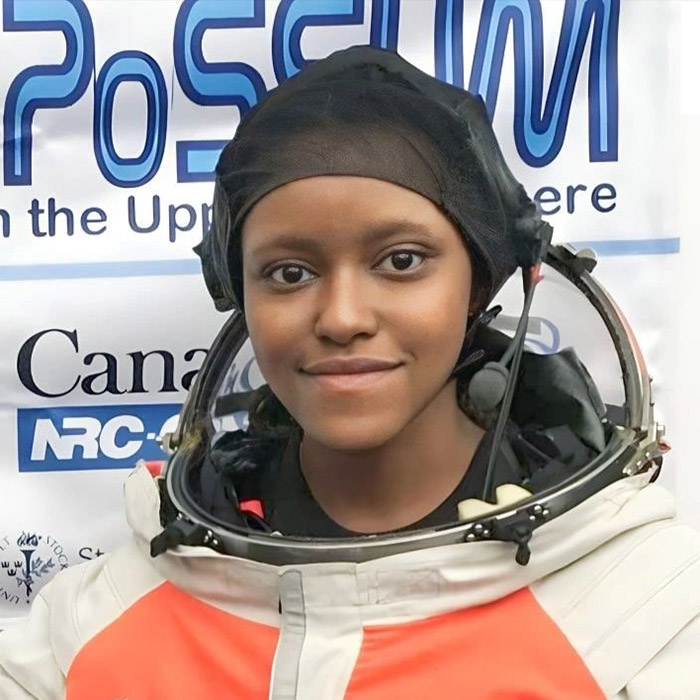
Wanjiku Chebet Kanjumba, M.Sc.
Wanjiku Chebet Kanjumba, Eng., Ph.D. cand., M.Sc., B.Sc. is a Kenyan-born aerospace engineer, futurist, and space-infrastructure strategist, and the Co-Founder, CEO, and Chairwoman of Vicillion, a global commercial space infrastructure and strategy consultancy headquartered in the United States.
She is a PhD candidate in Aerospace Engineering at the University of Florida, a Research & Development Career Astronaut-Candidate with Titans Space Industries, and a Citizen Scientist at the European Space Agency.
Born and raised in Nairobi, she is a pioneering voice in commercial spaceport development, interplanetary logistics, and space accessibility for emerging markets across Africa and the Global South. Read Kenyan Astronaut Seeking to Launch Kenya into Space and Wanjiku Chebet Kanjumba: A Trailblazer in Aerospace Engineering.
As Cofounder and Chair of Vicillion since 2021, Wanjiku leads strategic development and advisory work at the intersection of commercial space infrastructure, geopolitics, and economic development. The firm has grown from a technology research and development laboratory into a global infrastructure company with a talent network spanning all six continents, providing clients with expertise in spaceport feasibility and site development, orbital mechanics strategy, public-private partnership frameworks, space regulatory compliance, and space access policy for emerging markets.
Vicillion’s flagship initiative is the Omega Spaceport, designed as the world’s first equatorial commercially operated spaceport, strategically situated on Kenya’s east-facing coastline near the geographic equator. To support the initiative, Vicillion has launched the Omega Fund, a $500 million investment vehicle focused on transforming the commercial aerospace landscape. Read Wanjiku Kanjumba’s Journey from Aerospace Engineer to Industry Game-Changer.
The Omega Spaceport capitalizes on Kenya’s equatorial position, which maximizes Earth’s rotational velocity of approximately 465 m/s eastward and enables up to 15% greater payload capacity for Low-Earth Orbit and Geostationary Transfer Orbit missions compared to higher-latitude sites.
Wanjiku’s technical framework integrates AI-augmented range safety, autonomous pre-launch diagnostics, modular ISO-compliant pad infrastructure, sustainable renewable microgrids targeting more than 80% renewable energy supply, and a novel Fast-Track Licensing Protocol (FTLP) for small satellite launches with approval timelines under 30 days. Read Eagle Aims to Leave Legacy as an Engineer and Entrepreneur and Meet Wanjiku Chebet Kanjumba; the First Kenyan Graduate from the Advanced PoSSUM Academy.
Wanjiku presented five papers at the AIAA SCITECH 2026 Forum in Orlando, Florida in January 2026: Foundations for Interplanetary Logistics: Spaceport Infrastructure for Lunar and Martian Surface Access. HARMONIA: A Hybrid Docking and Grappling System for Next-Generation In-Orbit Servicing and Active Debris Removal. A Transformative Dual-Layer Architecture for Global Space Traffic Management. Designing a Resilient Space Ecosystem: Advanced Technologies, Sustainability Metrics, and Human-Centric Operations. and Integrated Network for Commercial Spaceports: A Framework for Global Launch Accessibility and Multinational Collaboration.
At the International Astronautical Congress (IAC) 2025 in Sydney, Australia, she presented Integrated Network for Commercial Spaceports: A Framework for Global Launch Accessibility and Multinational Collaboration. A Unified Approach to Space Traffic Management: Ensuring Safe and Sustainable Operations in Earth’s Orbits and Beyond. Next Frontier of Economic Systems for the New Space Age: Models for a Multi-Planetary Society. Titans Space Industries Spaceplane: A Novel Platform for Orbital Microgravity Research. and Omega Spaceport: Establishing Kenya as a Global Hub for Equatorial Space Access and Commercial Space Sector Growth.
She has also published research with the Committee on Space Research (COSPAR) on interplanetary spaceport logistics and integrated space ecosystem resilience. In January 2026, Wanjiku delivered a TINA Talk on the main stage at SpaceCom 2026 on the Integrated Network for Commercial Spaceports. Since June 2025, Wanjiku has served as a Research & Development Career Astronaut-Candidate with Titans Space Industries, scheduled for an inaugural spaceflight in June 2030.
Since February 2025, she has been a Member of the Space Generation Advisory Council (SGAC), joining the Commercial Space Project Group as a Research Member in January 2026. Since June 2023, she has contributed to the European Space Agency as a Citizen Scientist on the Systematic Threat Analysis of Radiation from Space (STARS) project, studying the effects of ionizing radiation on astronauts. Between May and November 2025, she was a Space Architecture Researcher in the Andromeda Pioneer Program at the Deep Space Initiative.
Since November 2025, she has been a Spaceport Member of the Global Spaceport Alliance through the Omega Spaceport. Between April 2022 and May 2024, Wanjiku served as Functional Lead, Airworthiness Engineer, and Completions Certification Engineer at Gulfstream Aerospace in Savannah, Georgia, overseeing flight operations, certifying aircraft vehicles, and collaborating with internationally recognized powerplant and aircraft manufacturers. Concurrently, between 2020 and 2024, she served as Director, Aerospace Engineer, and Assistant Head of Strategy and Communications at SPARC (K), an independent space company.
Between July 2021 and January 2022, she was an Aerospace Controls Engineer at Switched Source LLC in Chicago. Since August 2024, she has held a Graduate Assistantship in Mechanical and Aerospace Engineering at the UF Herbert Wertheim College of Engineering, serving additionally as a Supervised Teaching Assistant in Astrodynamics (August–December 2025), Teaching Assistant in Statics (May–August 2025), and Innovation Fellows Coordinator at the University of Florida’s IGNITE Engineering Innovation Institute (May–October 2025).
Her doctoral research focuses on modular docking mechanics, autonomous in-situ construction for lunar and Martian habitats, orbital mechanics optimization via Successive Convexification (SCvx), machine learning-based atmospheric forecasting trained on Indian Ocean climatology data, and digital twin simulation using Ansys STK and Siemens NX platforms.
Wanjiku is pursuing her Doctor of Philosophy in Aerospace, Aeronautical and Astronautical/Space Engineering at the University of Florida (2024–2028), alongside in-progress certifications in Engineering Project Management, Engineering Leadership, and Engineering Innovation.
She earned her Master of Science in Aerospace Engineering with Distinction from Embry-Riddle Aeronautical University in 2021, specializing in dynamics and control of aerospace vehicles including six-degrees-of-freedom rigid body dynamics, computational fluid dynamics, aeroacoustics, guidance, navigation and control, and hypersonic and rocket propulsion. She earned her Bachelor of Science in Aerospace Engineering with a Minor in Space Operations from Embry-Riddle in 2020, and was named to the Dean’s Honor List.
She is a graduate of the International Institute for Astronautical Sciences (IIAS) Scientist-Astronaut Candidate Program, having completed the Advanced Project PoSSUM (Polar Suborbital Science in the Upper Mesosphere) Academy in April 2018 as the first Kenyan-born graduate. As an undergraduate, she competed in NASA’s RASC-AL competition, designing lunar landers and Mars mission architectures. Read Ready for Take-Off: Kenyan Astronaut in the Making.
Wanjiku additionally holds a Remote Pilot license for Small Unmanned Aircraft Systems from the Federal Aviation Administration, a Trusted Operator Program Remote Pilot Certification from AUVSI, a Certificate of Drone and Data Technology Level 1 from Virginia Tech, a Data Visualization and Cartography Certification from Furman University, Lean Six Sigma Green and Yellow Belt certifications, and MEDIC PediatricPlus CPR, AED, and First Aid certification from the American Heart Association.
Her recent honors include recognition as one of the 2025 Top 30 Bold African Female Voices in Education and Innovation, the Corporate Leadership Award 2025–26 from the Golden Torch Awards, and the Top 40 Under 40 Women 2024 from Business Daily Africa.
Vicillion has been named Global Infrastructure Firm of the Year (2023) by Corporate LiveWire, Best Collaborative Aerospace Infrastructure R&D Partner at the Innovation & Excellence Awards 2023, and Most Collaborative Aerospace R&D Partner – USA at the Aviation and Aerospace Awards 2023.
In 2021, she received the Graduate Student of the Year Award and the Academic Pyramid of Excellence Achievement from the National Society of Black Engineers, the 2020–2021 Resident Advisor of the Year and Community of the Year honors from Embry-Riddle, and the Boeing Company Career Enhancement Scholarship and NKL Aerospace Engineering Scholarship from Women in Aviation International.
She is also an Alpha Eagle Aviation and Science Foundation Fund Award recipient (2019) and a Scholar Award recipient of the Tau Beta Pi Engineering Honor Society (2018). A dedicated martial artist, Wanjiku holds a 2nd Degree Black Belt in Taekwondo from Global Traditional Martial Arts (GTMA), having earned the Global Champion title in the Color Belt Female category for 2023/2024, and a 1st Sho Dan Black Belt in Shotokan Karate.
She also holds a Grade 5 (Level 2) certification from the Associated Board of the Royal Schools of Music and plays piano. She is an Ambassador for Mission ShakthiSAT and a Mentor for the Zed Factor Fellowship and Women in Space Kenya (WiSK), through which she promotes STEM education and space careers for women and underrepresented communities across Africa.
Visit her LinkedIn profile, ORCiD profile, ResearchGate profile, and Wikipedia page. Follow her on Facebook.