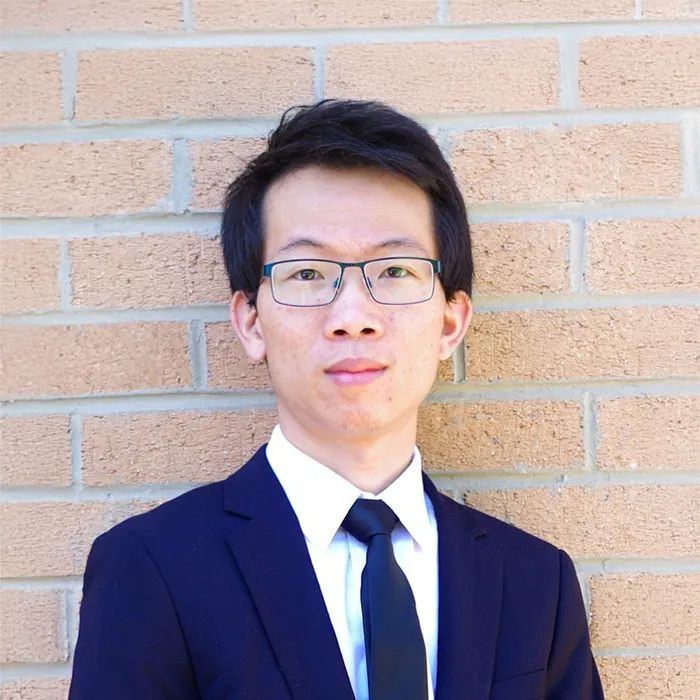
Dr. Shenghong He
Shenghong He, PhD is a Parkinson’s UK Senior Research Fellow and Neuroscientist at the University of Oxford, specializing in brain-computer interfaces, deep brain stimulation, and neuromodulation for movement disorders. He is based at the MRC Brain Network Dynamics Unit (BNDU) within the Nuffield Department of Clinical Neurosciences (NDCN), where he leads the He Group, his own independent research group established in 2025.
Shenghong’s research focuses on integrating brain-computer interfaces (BCIs) with neuromodulation techniques to investigate how neural activity drives behaviour and how brain stimulation interacts with these processes, with a particular emphasis on improving treatments for Parkinson’s disease and essential tremor. His work has been cited over 1,668 times across 59 publications in leading neuroscience journals, including Brain, Movement Disorders, The Journal of Neuroscience, and eLife.
In 2025, Shenghong was awarded a prestigious Senior Research Fellowship by Parkinson’s UK, a distinction designed to recognize future leaders of Parkinson’s research and provide them with funds to establish their own project teams. His Fellowship research is focused on gaining a better understanding of the brain functions that contribute to tremor and gait disturbances in Parkinson’s, with a view to using this knowledge to improve brain stimulation techniques for better clinical outcomes.
Unit Director Professor Peter Magill commented that the Fellowship was “richly deserved” and that Shenghong is “an outstanding researcher, and a valued colleague and collaborator.” Read Shenghong He awarded Parkinson’s UK Senior Research Fellowship.
Previously, in 2021, Shenghong was awarded a Guarantors of Brain Non-Clinical Postdoctoral Fellowship, a competitive fellowship from a charity that aims to promote teaching, education, and research in neurology and related clinical-academic disciplines. His Guarantors of Brain Fellowship research was focused on investigating the utility of gait-phase-dependent adaptive deep brain stimulation and neurofeedback training for people with gait disturbances, carried out under the mentorship of Associate Professor Alex Green of the Nuffield Departments of Clinical Neurosciences and Surgical Sciences, and Unit Group Leader Professor Huiling Tan.
Read Gait-Phase Modulates Alpha and Beta Oscillations in the Pedunculopontine Nucleus and Shenghong He awarded Guarantors of Brain Non-Clinical Postdoctoral Fellowship.
In 2022, he received a Royal Society International Exchanges Award, further expanding his collaborative research network. Shenghong has made significant contributions to the development of adaptive deep brain stimulation (aDBS) systems for Parkinson’s disease and essential tremor. His research demonstrated that subthalamic beta-triggered adaptive deep brain stimulation during reaching movement in Parkinson’s disease can provide clinical improvement with less energy delivered to the brain. Read Beta-triggered adaptive deep brain stimulation during reaching movement in Parkinson’s disease.
He was also the first to show that closed-loop deep brain stimulation based on thalamic local field potentials can effectively suppress tremor in essential tremor patients. His pioneering work on neurofeedback revealed that suppression of cortical beta bursts can speed up movement initiation in healthy motor control. Additionally, his research on subthalamic beta-targeted neurofeedback demonstrated its effects on movement initiation and tremor in Parkinsonian patients.
Read Closed-Loop Deep Brain Stimulation for Essential Tremor Based on Thalamic Local Field Potentials, Neurofeedback-Linked Suppression of Cortical β Bursts Speeds Up Movement Initiation in Healthy Motor Control: A Double-Blind Sham-Controlled Study, and Subthalamic beta-targeted neurofeedback speeds up movement initiation but increases tremor in Parkinsonian patients.
Shenghong’s most recent research addresses tremor asymmetry and the development of bilateral phase-specific deep brain stimulation for postural tremor, as well as gait-phase modulation of oscillations in the pedunculopontine nucleus. He also served as a Guest Editor for Frontiers in Human Neuroscience, where he led a Research Topic on explainable and advanced intelligent processing in the brain-machine interaction.
Read Gait-Phase Modulates Alpha and Beta Oscillations in the Pedunculopontine Nucleus and Editorial: Explainable and advanced intelligent processing in the brain-machine interaction.
As part of his commitment to open research, Shenghong has created and curated multiple datasets on the MRC BNDU Data Sharing Platform, sharing complete original datasets with matching code to promote reproducibility and reuse. These include datasets on LFPs and EEGs from patients with Parkinson’s disease during neurofeedback training, recordings during gait, and bilateral recordings of EEGs, LFPs, and tremor in people with essential tremor under DBS conditions.
Shenghong earned his PhD in Engineering from the South China University of Technology in Guangzhou, China, in 2017, specializing in Automation, Pattern Recognition and Intelligent Systems, and Brain-Computer Interfaces. His doctoral work was supervised by Professor Yuanqing Li at the Center for Brain Computer Interfaces and Brain Information Processing.
In May 2018, he joined Professor Huiling Tan’s group at the MRC Brain Network Dynamics Unit as a Postdoctoral Research Scientist. Between February 2022 and January 2025, he held the Guarantors of Brain Non-Clinical Postdoctoral Fellowship. Between February 2025 and September 2025, he served as a Senior Postdoctoral Research Fellow before being appointed Parkinson’s UK Senior Research Fellow in October 2025.
Shenghong’s work has been recognized with multiple awards and distinctions. He received the Director’s Award for Open Research from the MRC BNDU in 2021, recognizing his exemplary contributions to the Unit’s open research activities. He was also awarded the Director’s Award for Public Engagement from the MRC BNDU in 2024.
At the departmental level, he was named NDCN Thomas Willis Day Intermediate Career Researcher Prize winner in 2024 and NDCN Thomas Willis Day Early Career Researcher Runner Up in 2020 for his work published in eLife.
Shenghong is also an active science communicator who has demonstrated the potential of brain-machine interfaces at major public events. At New Scientist Live, he demonstrated the potential of BMI by spelling words on a screen using signals from his brain, recorded by an electroencephalogram (EEG) cap, captivating audiences and sparking discussions about the future of brain-wave technology.
Shenghong is also a DPhil Supervisor at the Medical Sciences Graduate School at the University of Oxford, where he supervises doctoral students in Clinical Neurosciences across the subject areas of Neuroscience and Translational Medicine and Medical Technology.
His key collaborators include Professor Peter Brown, founding Director of the MRC BNDU and pioneer of research on neural oscillations in Parkinson’s disease, and Dr. Hayriye Cagnan of the Department of Bioengineering at Imperial College London.
Visit his LinkedIn profile, NDCN profile, MRC BNDU profile, Medical Sciences Graduate School page, Google Scholar page, and ResearchGate profile. Follow him on Facebook and Instagram.