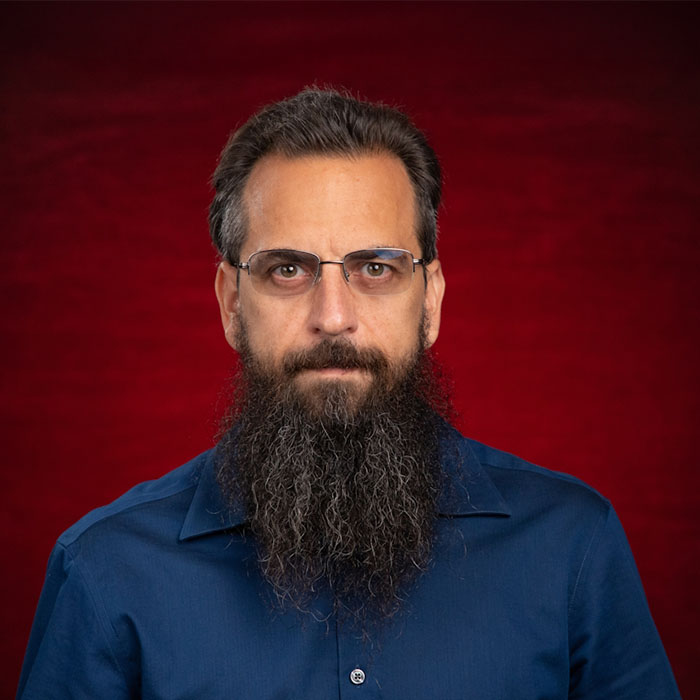
Professor Roman V. Yampolskiy
Roman V. Yampolskiy, PhD is a Computer Scientist, AI Safety Pioneer, and Tenured Associate Professor at the University of Louisville with over 15 years of experience in artificial intelligence safety, cybersecurity, and behavioral biometrics. He is the Founder and Director of the CyberSecurity Lab in the Department of Computer Engineering and Computer Science at the Speed School of Engineering of the University of Louisville.
Roman coined the term “AI safety” in a 2011 publication titled Artificial Intelligence Safety Engineering: Why Machine Ethics Is a Wrong Approach, presented at the Philosophy and Theory of Artificial Intelligence conference in Thessaloniki, Greece, and is recognized as a founding researcher in the field. He is known for his groundbreaking work on AI containment, AI safety engineering, and the theoretical limits of artificial intelligence controllability. His research has been cited by over 10,000 scientists and featured in more than 1,000 media reports across 30 languages. Read Artificial Intelligence Safety and Cybersecurity: A Timeline of AI Failures.
Roman has authored over 200 publications, including multiple journal articles and influential books on artificial intelligence. His most recent book, AI: Unexplainable, Unpredictable, Uncontrollable, published in 2024, explores fundamental questions about the limits of artificial intelligence safety. Read Q&A: UofL AI safety expert says artificial superintelligence could harm humanity.
In 2015, Roman launched “intellectology” in his paper, The Space of Possible Mind Designs. This new field of study was founded to analyze the forms and limits of intelligence, with AI being considered a subfield of this discipline. He has developed foundational theories on AI-completeness, proposing the Turing Test as a defining example.
Roman has advocated for research into “boxing” artificial intelligence and, with collaborator Michaël Trazzi, proposed in 2018 to introduce “Achilles’ heels” into potentially dangerous AI systems. Read Guidelines for Artificial Intelligence Containment, Building Safer AGI by introducing Artificial Stupidity, and Artificial Stupidity could help save humanity from an AI takeover. Watch Intellectology and Other Ideas: A Review of Artificial Superintelligence.
He joined AI researchers, including Yoshua Bengio and Stuart Russell, in signing Pause Giant AI Experiments: An Open Letter. In November 2025, Roman appeared on CNN to discuss the future of the workforce amid AI advancement. In 2024, Roman was featured on the Lex Fridman Podcast discussing the dangers of superintelligent AI, predicting a 99.9% chance that AI could lead to human extinction within the next hundred years.
In September 2025, he appeared on The Diary of a CEO with Steven Bartlett, warning that 99% of jobs could be automated by 2030 with over 11 million views on YouTube alone. He was also a guest on Joe Rogan’s podcast in July 2025. Watch If no job is safe from AI, what happens next?, Roman Yampolskiy: Dangers of Superintelligent AI, and The AI Safety Expert: These Are The Only 5 Jobs That Will Remain In 2030! Read AI expert says it’s ‘not a question’ that AI will take over all jobs and Why Uncontrollable AI Looks More Likely Than Ever.
Roman has been a Research Advisor for the Machine Intelligence Research Institute (MIRI) and an AI Safety Fellow at the Foresight Institute. He is a Research Associate at the Global Catastrophic Risk Institute (GCRI) and a Senior Member of the Institute of Electrical and Electronics Engineers (IEEE). Roman is an alumnus of Singularity University (GSP2012), where he received a $24,000 scholarship.
He edited Artifical Intelligence Safety and Security and is the author of several influential books, including Artificial Superintelligence: A Futuristic Approach (2015), Artificial Intelligence Safety and Security (2018), and coeditor of The Technological Singularity: Managing the Journey (2017). His earlier books include Feature Extraction Approaches for Optical Character Recognition (2007), Computer Security: from Passwords to Behavioral Biometrics (2008), and Game Strategy: a Novel Behavioral Biometric (2009).
Roman earned his PhD in Computer Science and Engineering from the University at Buffalo in 2008, with a dissertation on Behavioral Biometrics for Computer Security, titled Intrusion Detection Using Spatial Information and Behavioral Biometrics, under the supervision of Dr. Venu Govindaraju. During his doctoral studies, he was a recipient of a four-year NSF IGERT (Integrative Graduate Education and Research Traineeship) fellowship.
He earned his combined Bachelor’s and Master’s Degree of Science in Computer Science, with concentrations in Mathematics, Artificial Intelligence, and Psychology, from Rochester Institute of Technology in 2004, with a thesis titled Feature Extraction Methods for Character Recognition. He also earned his Associate’s Degree in Computer Science from Monroe Community College in 2000, graduating with Distinction.
After completing his PhD, Roman held the position of Affiliate Academic at the Center for Advanced Spatial Analysis at University College London. He previously conducted research at the Laboratory for Applied Computing at Rochester Institute of Technology and at the Center for Unified Biometrics and Sensors at the University at Buffalo.
In 2008, Roman joined the University of Louisville as an Assistant Professor and was promoted to Associate Professor in July 2014. During his tenure at the University of Louisville, Roman has received numerous honors and distinctions including: Distinguished Teaching Professor (2015), CECS Professor of the Year (2012), Faculty Favorite (multiple years), Leader in Engineering Education from the American Society for Engineering Education (2014), Top 10 Online College Professor of the Year, Outstanding Early Career in Post-Secondary Education Award from the Kentucky Academy of Science (2013), and the Excellence in Science Education and Outreach Award (2019).
In 2016, he was named to the Business First 40 Under 40 list of leaders on the edge of their careers. He was also commissioned as a Kentucky Colonel in 2016, the highest title of honor the Governor of Kentucky can bestow.
Roman has been recognized as “#1 AI Mind” by Forbes (2017), named to the 100 Leaders in Artificial Intelligence by Hub Culture (2018 and 2020), listed among IBM’s Top 30 AI Influencers (2017), and included in Oracle Corporation’s AI Influencer list (2019). In 2018, he received the Lifetime Achievement Award from Marquis Who’s Who. He has been listed among the world’s top 2% of scientists by Stanford University in the Scopus/Elsevier ranking (2023) and has been recognized as one of the Top 25 Researchers by publication count on existential risk.
Roman’s research has been profiled in major publications and media outlets, including New Scientist, BBC, MSNBC, Yahoo! News, German National Radio, and Swedish National Radio. His work has been translated into numerous languages, including Czech, Danish, Dutch, French, German, Hungarian, Italian, Polish, Romanian, and Spanish. Roman was born on August 13, 1979, in Riga, Latvia, and currently resides in Prospect, Kentucky.
Watch The Uncanny Mind That Built AI Safety and Roman Yampolskiy on AI Safety Engineering. Listen to Roman Yampolskiy on the Uncontrollability, Incomprehensibility, and Unexplainability of AI.
Roman also authored Artificial Superintelligence: A Futuristic Approach, Computer Security: from Passwords to Behavioral Biometrics, Game Strategy: A Novel Behavioral Biometric, Feature Extraction Approaches for Optical Character Recognition, The Gift of Sudoku, Computer Generated Sudoku Puzzles, and Jokes about Computers and Programmers (Russian).
His papers include Application of bio-inspired algorithm to the problem of integer factorization, Strategy-Based Behavioral Biometric: a Novel Approach to Automated Identification, Action-based user authentication, Traffic Analysis Based Identification of Attacks, Behavioral biometrics: a survey and classification, Embedded Noninteractive Continuous Bot Detection, and Behavioral Modeling: an Overview.
Visit his LinkedIn profile, Personal Homepage, Wikipedia page, Google Scholar page, AI for Good page, Medium page, and ResearchGate profile. Follow him on Facebook, Instagram, dblp, and X.