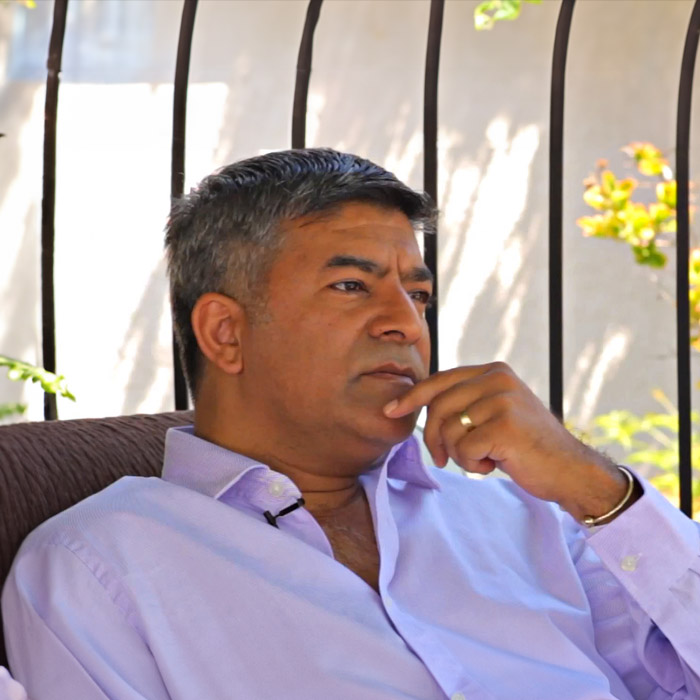
Reza Rassool
Reza Rassool is the Chair and CEO of Kwaai, a nonprofit artificial intelligence research and development lab, a Fellow at RealNetworks, and the Founder of Oak Venture Studio.
A serial technology entrepreneur and inventor with 27 granted US patents, he has spent nearly four decades building award-winning products across digital video, content security, biomedical devices, and artificial intelligence, including founding roles at two startups that were later acquired by Google.
He earned a BSc in Physics from King’s College London and has served as an Affiliate Professor of Computer Science and Physics at the University of Washington since 2022.
Reza founded Kwaai in July 2023, issuing a public call to action and publishing the Kwaai Manifesto out of concern that the exponential growth and monopolization of artificial intelligence was steering the technology onto an unsafe trajectory. Structured as a volunteer-driven, open-source 501(c)(3) nonprofit, Kwaai works to democratize AI by empowering individuals to own and operate self-sovereign, Personal AI on their own data and devices—an undertaking Reza frames as building the “Linux of AI.”
Under his leadership the lab has grown to roughly a thousand volunteers and developed pAI-OS (πOS™), a Personal AI operating system that entered beta in academic institutions in 2024. Its work proceeds along three streams — open-source tools, fundamental research into smarter, faster, and greener neural networks (including homomorphic encryption), and AI policy such as drafting model “nutrition facts” to bring greater transparency to AI systems.
Before founding Kwaai, Reza was Chief Technology Officer of RealNetworks from 2016 to 2023, where he led the company’s pivot from its streaming-media roots toward artificial intelligence. He continues to serve the company as a Fellow. He was the executive sponsor of SAFR, a computer-vision and facial-recognition platform that NIST testing rated among the most accurate and lowest in demographic bias, achieving 99.8% accuracy on the Labeled Faces in the Wild benchmark. SAFR has been offered free to more than 100,000 K–12 schools across the United States and Canada, was built on a privacy-by-design philosophy, and runs at the edge through SAFR Inside on Axis cameras.
A vocal advocate for engineering fairness into facial recognition, Reza has argued that a model deliberately trained for low bias also delivers higher overall performance. He additionally oversaw Kontxt, a natural-language message-classification platform for anti-spam, anti-smishing, and robocall blocking, and the RealMediaHD codec, a proprietary China OEM video technology capable of decoding 4K video on a mobile processor.
Since 2008, Reza has run Oak Venture Studio (formerly Kwaai Oak), a Los Angeles technology consultancy offering “CTO-as-a-Service” that has supplied the engineering behind more than twenty startups and projects, including work for DIRECTV, CBS, and Panasonic.
Earlier in his career, Reza was CTO of Zya (formerly Music Mastermind), the company behind the Ditty app, which—like Widevine before it—was acquired by Google. From 2000 to 2008, he was Chief Engineer and VP of Product Development at Widevine Technologies, a pioneer of software-based digital rights management that Google acquired in 2010. There, he architected the “Cypher” conditional-access and DRM system, directed the “Mensor” forensic watermarker, and ran an anti-piracy operation whose data was used in the landmark MGM v. Grokster litigation.
As Director of Software at Second Sight Medical Products, he developed the visual processing unit for the Argus retinal prosthesis—a “bionic eye” whose maker went public in 2014—building on earlier cochlear-implant work at Advanced Bionics.
As Technical Manager at Lightworks Editing Systems from 1991 to 1993, he managed the development of the non-linear film editor that earned a Scientific and Technical Academy Award and an Emmy and was later sold to Tektronix. The system has since been used to cut films, including Pulp Fiction and The King’s Speech. Earlier still, he led a pioneering video-on-demand server at Micropolis and built a digital scanner and the MAMBA color paint system at Crosfield Electronics.
Reza is the author of numerous technical papers and a continuing contributor to open-source code. His publications include VMAF reproducibility: Validating a perceptual practical video quality metric, presented at the IEEE International Symposium on Broadband Multimedia Systems and Broadcasting, along with a guest editorial for IEEE Transactions on Broadcasting and several papers on demographic bias in facial recognition.
A frequent keynote speaker, he gave the How AI Will Change the Nature of Employment keynote at Data Con LA 2023, presented How to Engineer Ethics into AI: Combating Bias in Facial Recognition at SMPTE, and has hosted the Kwaai Personal AI Summit at the Southern California Linux Expo. He is a longtime member of SMPTE and a member of COV-IRT, the COVID-19 International Research Team.
Born and raised in Cape Town during apartheid-era South Africa before his family relocated to London, Reza has credited that upbringing with shaping his commitment to fairness. He also contributed to the family cookbook Love Letter to Lallie: A Family’s Culinary Journey.
Visit his LinkedIn profile, his ResearchGate profile, and the Kwaai homepage. Follow him on Facebook and X.