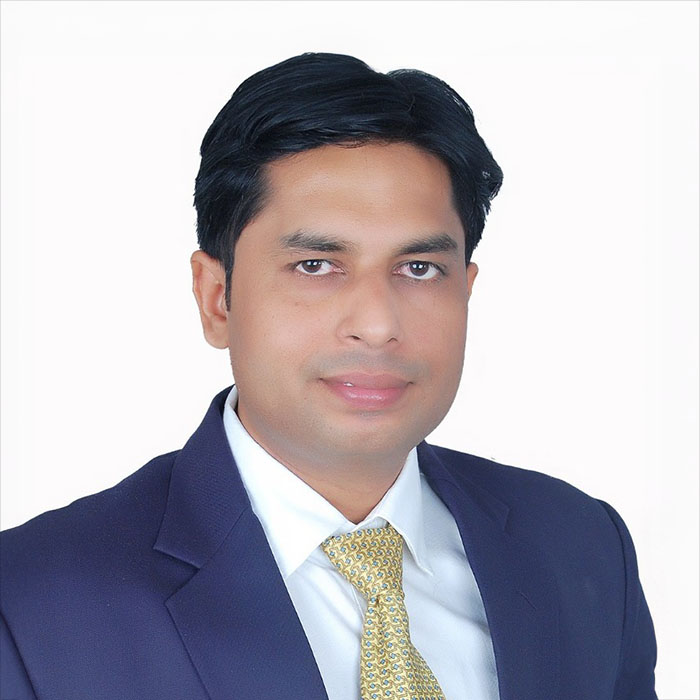
Dr. Ravi Kumar Chaudhary
Ravi Kumar Chaudhary, PhD is a Senior Scientist at the Government Institute of Medical Sciences (GIMS), India, and Founder of Longevity Blueprint, with over 12 years of experience in biomedical research, nanomolecular diagnostics, regenerative medicine, and longevity science.
He is a Medical Biotechnologist and Translational Researcher working at the interface of laboratory innovation and clinical application, integrating nanomolecular diagnostics, regenerative medicine, and artificial intelligence to solve clinically meaningful problems through rigorous experimental design and validation.
His research interests span three interconnected domains: nanomolecular diagnostics, regenerative medicine and aging biology, and artificial intelligence applications in healthcare. Ravi develops and validates real-time probes and nanoprobes to strengthen diagnostic performance and clinical utility, with a focus on workflows that can be realistically implemented in routine clinical settings.
His work in regenerative medicine includes in-vivo direct cellular reprogramming and aging biology, with a translational lens on safety, delivery strategies, and functional endpoints that align with patient-relevant outcomes and future early-phase clinical development. He applies AI for data integration, pattern recognition, and predictive modeling to support disease risk assessment and clinical decision-making.
As a Senior Scientist at GIMS, Ravi’s contributions to clinical research have been instrumental in advancing biomedical sciences. His work on innovative research methodologies and his leadership in scientific research make him a crucial part of clinical research study and trial design and development with advanced research techniques. At GIMS, he works in the Clinical Trial Unit, contributing to the advancement of clinical research infrastructure in India.
Ravi is the Founder of Longevity Blueprint, an initiative dedicated to advancing healthy aging through personalized medicine, integrative therapies, and public engagement. Through this initiative, he promotes innovation in precision health and healthy longevity on the global stage.
Between December 2022 and November 2023, Ravi was a Postdoctoral Associate at the Human Genetics Program at Sanford Burnham Prebys Medical Discovery Institute in San Diego, California. During this period, he conducted research on induced in vivo transdifferentiation of skeletal muscle into early endoderm-like cells and cardiomyocytes in zebrafish (Danio rerio) models, exploring the potential to reprogram terminally differentiated vertebrate cells directly for therapeutic applications.
Between June 2020 and November 2022, Ravi served in multiple capacities at GIMS, including as a Non-Medical Scientist in the Viral Research & Diagnostic Laboratory (ICMR-DHR-VRDL) and as Scientist-D in the Molecular Diagnostics & Research Laboratory (MDRL). In these roles, he worked on viral epidemiology, SARS-CoV-2 research, whole genome sequencing using Illumina platforms, and BSL-2+ and BSL-3 laboratory operations. He handled multiple viruses, including SARS-CoV-2, Zika, Dengue, Chikungunya, and respiratory pathogens.
Between August 2019 and September 2020, Ravi was an Assistant Professor at IAMR Group of Institutions, where he taught Cell & Molecular Biology, Recombinant DNA Technology, and Genetics. As a Department of Science & Technology research fellow from December 2012 to August 2015, Ravi worked on the development of novel adsorbents for the pre-concentration of pathogens and on Molecular Beacon-based PCR arrays to enable culture-free detection of food- and waterborne pathogens.
During this project, he handled over 15 pathogenic organisms, including Pseudomonas aeruginosa, Salmonella, Shigella flexneri, Staphylococcus aureus, Bacillus cereus, Listeria monocytogenes, Shiga toxin-producing Escherichia coli, Vibrio cholerae, and Campylobacter spp.
Ravi has published over 14 peer-reviewed publications, with his work accumulating over 450 citations. His notable publications include The Applications of Biosensors and Biochips for Prognosis and Diagnosis of Diseases published in Springer’s Biomaterials-Based Sensors in 2023, and Polyvinylidene Fluoride-Added Ceramic Powder Composite Near-Field Electrospinned Piezoelectric Fiber-Based Low-Frequency Dynamic Sensors, published in ACS Omega in 2020. Read Structural and functional in-silico analysis of toxin antitoxin proteins in persister cells of Pseudomonas aeruginosa.
Ravi earned his Doctor of Philosophy (PhD) in Biotechnology from Gautam Buddha University in 2019, with his dissertation focusing on persister formation in pathogenic bacteria and the development of novel adsorbents for pre-concentration of pathogens and a molecular beacon-based PCR-array for culture-free detection of food and waterborne pathogens.
He earned his Master’s Degree of Technology (M.Tech.) in Biotechnology with specialization in Genetic Engineering from Gautam Buddha University in 2012, with his major project on identification, cloning, and expression of toxin-antitoxin homologs from the genome of Xenorhabdus nematophila. He earned his Postgraduate Certificate (PgC) in Biosciences with a focus on Cell and Molecular Biology and Biomedical Lab Technology from Sheffield Hallam University in the United Kingdom in 2012, graduating with First Class honors.
Ravi holds certifications in Good Clinical Practices from NIDA Clinical Trial Networks, Medical Laboratories Quality Systems (ISO 15189) from the Indian Council of Medical Research (ICMR), Whole Genome Sequencing and Data Analysis from the National Institute of Virology – India, Project Management and Six Sigma Green Belt from MSME-Technology Development Centre, and Flow Cytometry from BD Biosciences. He also holds Cambridge ESOL and Scottish Qualifications certificates.
Ravi has received multiple awards and honors, including two CCP4 Travel Grant Awards from the Science & Technology Facilities Council (UKRI STFC) in 2017 and 2020 for CCP4 Workshops at the University of Nottingham. He is an active member of several global scientific societies, including the Cancer Epigenetics Society (CES) since 2017 and the International Society of Infectious Diseases (ISID) since 2014. He volunteers with the National Service Scheme and Rovers Rangers for social services.
Ravi is an internationally recognized speaker in the longevity and regenerative medicine space. He was a panelist at the Global Longevity Summit in Geneva, Switzerland, in October 2025, participating in discussions on Stem Cells, Regenerative Medicine & Apheresis. He has also been featured as a speaker at the Global Longevity Federation conferences, presenting on Epigenetic Reprogramming Without Dedifferentiation: In-Vivo Lineage Conversion and Rejuvenation Across the Lifespan.
Visit his LinkedIn profile, ResearchGate profile, Google Scholar page, and Loop profile.