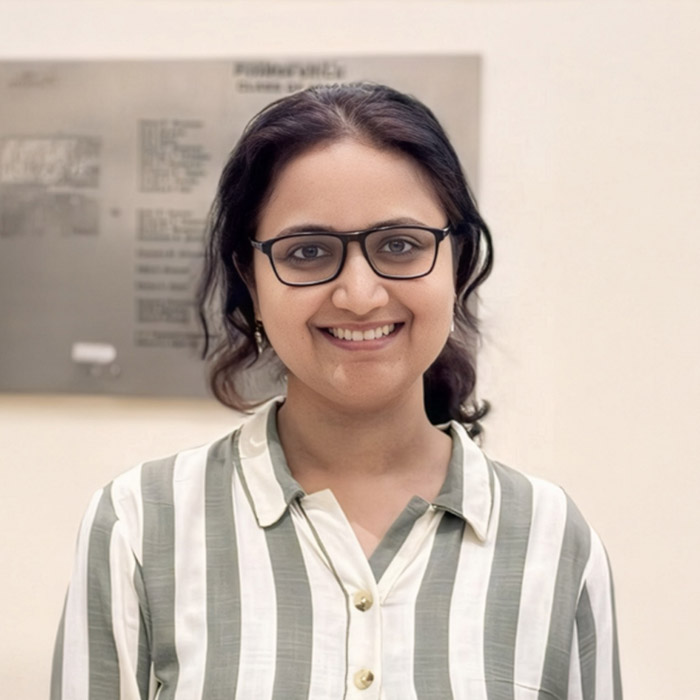
Dr. Paramita Dasgupta
Paramita Dasgupta, PhD is an Experimental Astroparticle Physicist and CCAPP Fellow at the Center for Cosmology and AstroParticle Physics (CCAPP) at The Ohio State University, where she works on NSF- and NASA-sponsored astrophysics missions.
Her research focuses on ultra-high energy cosmic ray and neutrino experiments, and she is an active member of several major international collaborations, including the Askaryan Radio Array (ARA), the Antarctic Impulsive Transient Antenna (ANITA), the Radio Neutrino Observatory in Greenland (RNO-G), and the NASA mission Payload for Ultrahigh Energy Observations (PUEO).
Paramita has over 15 years of experience in scientific computing, data analysis, and simulation. Her work has been cited over 660 times across more than 60 publications spanning astrophysics, cosmology, and high energy physics. As a CCAPP Fellow since 2024, Paramita conducts research in experimental particle astrophysics, simulation and data analysis, neutrino astronomy, and cosmic rays at the Department of Physics at Ohio State.
She was one of the lead organizers of the CCAPP Fellows Symposium 2025 and presented her research on searching for ultra-high energy neutrinos with the in-ice Askaryan Radio Array at the South Pole at the CCAPP Fellows Symposium 2024. In her current work with the ARA collaboration, Paramita is leading the first ultra-high energy neutrino search utilizing ARA’s fifth station hybrid detection capability, combining phased array and traditional detector components.
Read First Ultra High Energy Neutrino Search with a Hybrid Phased and Traditional Detector in the Askaryan Radio Array and A search for the ultra high energy neutrinos with the low threshold phased array trigger system of the Askaryan Radio Array.
This analysis approach represents the paradigmatic framework for future neutrino searches with next-generation in-ice neutrino experiments. She has also recently begun collaborating with the GRAPES-3 experiment (Gamma Ray Astronomy PeV EnergieS Phase-3) in Ooty, India, contributing to pioneering work in air shower modeling and radio detection, which represents the first effort of its kind in India.
Paramita’s PhD work at IIT Kanpur centered on the ANITA experiment, where she developed the first rigorous, first-principles-based model of radio signals produced by high energy cosmic rays and reflected off the Antarctic ice, validated using ANITA calibration data. Working with Professor Pankaj Jain, she developed a general formalism for treating the reflection of spherical electromagnetic waves from a spherical surface, providing critical insights into the anomalous polarity events detected by ANITA that had puzzled the physics community.
She also coauthored key experimental papers with the ANITA collaboration, including work on Antarctic surface reflectivity measurements. Read Antarctic Surface Reflectivity Calculations and Measurements from the ANITA-4 and HiCal-2 Experiments and Experimental tests of sub-surface reflectors as an explanation for the ANITA anomalous events.
Between 2020 and 2023, Paramita was an FRS-FNRS Post Doctoral Research Fellow at the Université libre de Bruxelles (ULB) and the Inter-University Institute for High Energies (IIHE) in Brussels, Belgium. There, she worked extensively on digitizer and detector calibration projects, contributed to in-ice radio signal simulations and studies of ice properties for experiments like ARA, and contributed to the RNO-G collaboration.
In Summer 2022, she was deployed to Summit Station, Greenland, with the RNO-G team, where she led surveying efforts and helped install radio antennas at depths of 150 to 200 meters in the Greenland ice sheet. Read Design and Sensitivity of the Radio Neutrino Observatory in Greenland (RNO-G).
Between September 2019 and October 2020, Paramita was a Visiting Researcher at The University of Kansas, where she worked with the KU Astroparticle Physics group and Professor Dave Besson to develop software packages for data analysis applicable to NASA-sponsored ANITA, ARA, and ARIANNA experiments located at the South Pole. In March 2020, she was a Scientific Visitor at the P.N. Lebedev Physical Institute in Moscow, where she was one of the speakers at the Moscow International School of Physics 2020 and received the Diploma for the Best Presentation.
Paramita earned her Doctor of Philosophy in Physics, with specializations in Astrophysics, Cosmology, and High Energy Physics, from the Indian Institute of Technology, Kanpur in 2020. She earned her Master’s Degree in Physics and Astronomy from the University of Nebraska-Lincoln, where she worked with Professor Stephen Ducharme on ferroelectric thin film research. She earned her Bachelor’s Degree in Physics from the University of Calcutta.
Visit her LinkedIn profile, CCAPP profile, ResearchGate profile, and Google Scholar page. Follow her on Facebook.