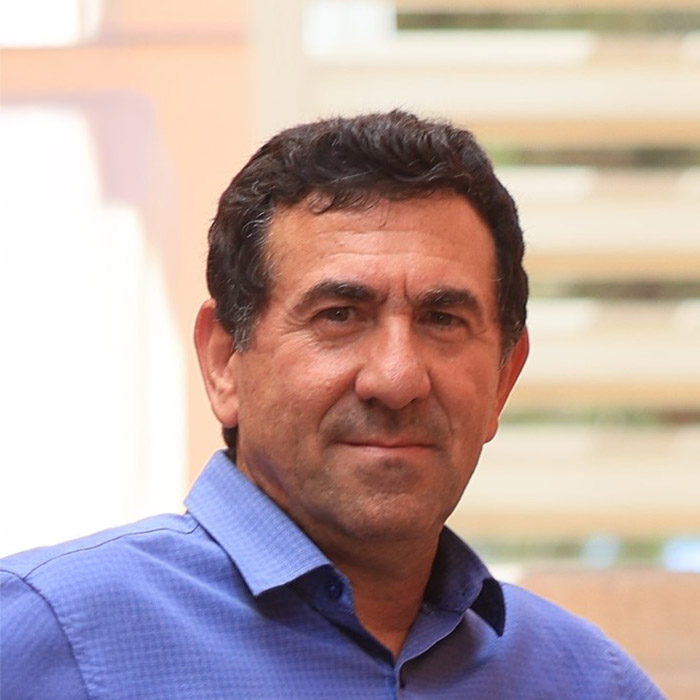
Dr. Col. (Res.) Ori Nissim Levy
Col. (Res.) Ori Nissim Levy, PhD, is Chairman of the World Nuclear Forum 193 (WNF-193), University Lecturer at Afeka Tel Aviv Academic College of Engineering and at Ariel University, and developer of the Operational Nuclear Defense Model (ONDM), a framework for preparing states and cities for the full life cycle of a nuclear incident, from preparation to rehabilitation.
Ori chairs WNF-193, an independent international forum established in 2017 that brings together more than 150 senior nuclear and radiological scientists from dozens of countries to promote public safety through clear and unbiased information on dirty bombs, electromagnetic pulse, reactor safety, and incident assessments.
Its flagship projects are a global ranking of countries by readiness for nuclear and radiological failure events and the promotion of nuclear-related legislation. At the NP1 Nuclear Power Conference in November 2020, Ori unveiled the N&R-SR1 standard of readiness index, which scores countries on public information, nuclear study programs, and emergency exercises, with rankings intended for the governments of all 193 countries. Read Extending Nuclear Cooperation to the Middle East and Dirty Bomb is Ultimate Tool to Get Budget Allocation, Nuclear Forum 193 Argues.
Since 2014, Ori has applied ONDM as an expert in nuclear defense preparation, emergency operations, and rehabilitation. The model grew out of three and a half years of research, including field visits to Chernobyl and Fukushima and comparison of preparedness models across the United States, Canada, Germany, Switzerland, Finland, and France. Read “Those Who Do Not Prepare For Nuclear Disaster – Will Not Recover From One”.
He holds the rank of Colonel (Reserves) and commands the reserve formation of Israel's National Emergency Management Authority (NEMA), serving roughly 200 days of reserve duty since October 2023. Earlier, with the Home Front Command, he built large-scale exercises for extreme scenarios and chaired the Nuclear Forum. Read Can Israel survive a nuclear strike?
Since August 2023, Ori has lectured at Afeka, where he teaches Engineering from Principle to Practical and the senior course Nuclear History Brief: From Atomic Bomb to Green Nuclear Energy in the 21st Century. In 2026, Afeka and WNF-193 cohosted a global webinar with Harvard's Francesca Giovannini. Read Afeka and WNF-193 Host Harvard Expert to Discuss the Global Nuclear Future. Since July 2020, he has also lectured in the Faculty of Engineering at Ariel University, and he is a listed expert of the National Knowledge and Research Center for Emergency Readiness at the University of Haifa.
Ori's peer-reviewed work applies cost-effectiveness analysis to nuclear emergency policy. He coauthored a 2020 study in the International Journal of Radiation Biology concluding that evacuation costs more lives than radiation when the population-averaged first-year dose is 500 mSv or less, about five times the IAEA action level. Read Consequences of a large-scale nuclear accident and guidelines for evacuation: a cost-effectiveness analysis.
A 2022 follow-up in INQUIRY quantified a threshold of about 140% of GDP per capita per quality-adjusted life year. Read Cost-Effectiveness Threshold for Healthcare: Justification and Quantification. His doctoral research produced Failure of the Superpowers (U.S.A., Russia, Japan) to Handle Large Nuclear Events in the On-line Journal Modelling the New Europe in 2018 and the 2016 Nomos book chapter A New Model for Governmental Policy Dealing with Nuclear Threats.
Ori is a frequent commentator on nuclear risk. In a 2019 Begin-Sadat Center for Strategic Studies paper, also published by The Algemeiner, he argued that public education could reduce the casualties of a nuclear strike ten to twentyfold. Read The Day After an Iranian Nuclear Strike. After Iran's March 2026 missile strike on Dimona, he told The Times of Israel that radiological damage from a hit on Israel's small research reactor would be very localized. Read Fallout from Iranian strike on Dimona plant would be symbolic, not radioactive, Israeli experts assess conflict with Iran and nuclear threat, and The next big thing: Floating nuclear power plants.
Watch Dr Col (Res.) Ori Nissim Levy 12 News: Nuclear energy safety, “Weak” Iranian Nuclear agreement fails to impress, and The Potential Power of Education in Minimizing Nuclear Damage.
His keynotes include State, district, or city preparations for a nuclear incident at Israel's 6th National Emergency Conference in 2018 and The responsibility of the academic sector in reducing the damage caused by nuclear incidents at the 6th International Conference on Education, Reflection, Development at Babeș-Bolyai University in 2018.
In 2017, he presented Cooperation between friendly, hostile, European Union and non-European Union countries during very severe nuclear crises at the Disintegration and Integration in East-Central Europe conference. He is a member of the Academic Forum for Nuclear Awareness (AFNA).
Ori earned his BSc in Electrical and Electronics Engineering in 1994 from Hofstra University in New York, his MBA with a specialization in Economics in 1998 from the University of Bradford, and his PhD in Nuclear Defense in 2018 from the Faculty of European Studies at Babeș-Bolyai University in Cluj-Napoca with the thesis Consolidated Policy to Manage Nuclear Risks: Preplanning, Coping with an Event and Rehabilitation of a State under Professor Nicolae Păun.
Before turning to nuclear defense, he worked in Israeli high-tech firms, trained organizations in ISO 9000 quality standards, and founded a startup focused on decision-making processes.
Ori lives in Modi'in with his wife and three children. In January 2021, he climbed Mount Kilimanjaro to Uhuru Peak at 5,895 meters.
Read his Contributions at the Begin-Sadat Center and Contributions in The Algemeiner.
Visit his LinkedIn profile, Afeka faculty page, ResearchGate profile, Academia.edu page, and Google Scholar page. Follow him on Facebook, Instagram, and X.