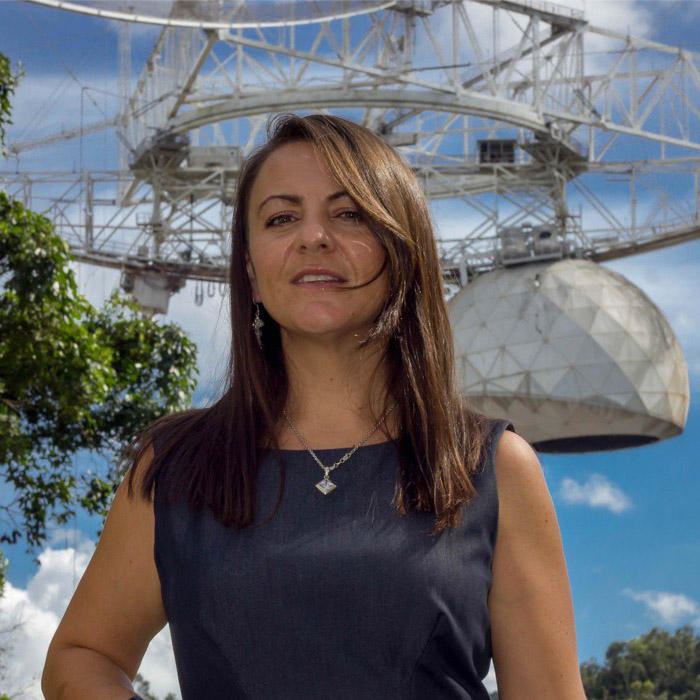
Professor Luisa Fernanda Zambrano-Marin
Luisa Fernanda Zambrano-Marin, PhD is a Planetary Radar Researcher and Professor at the Florida Space Institute at the University of Central Florida, and a Space Advocate at the Space Frontier Foundation with over two decades of experience in space science, planetary defense, and STEM education.
She is a space scientist, educator, and communicator specializing in radar observations of near-Earth asteroids, planetary defense research, and science outreach. Originally from Colombia and raised in Puerto Rico, Luisa has dedicated her career to advancing scientific understanding of asteroids while making space accessible to underrepresented communities.
As a Planetary Radar Researcher at the Florida Space Institute, Luisa specializes in near-Earth asteroids using the Arecibo Planetary Radar System, focusing on fast-rotating objects, binary systems, and asteroid shape modeling. She curates a comprehensive Arecibo Planetary Radar observation repository spanning four decades of data, ensuring community access to this invaluable resource. Her expertise encompasses academia-industry relations, teacher and K-12 student engagement, and curriculum development. Read Arecibo Observatory Scientists Help Unravel Surprise Asteroid Mystery.
In 2022, Luisa led the characterization of asteroid 2019 OK, a near-Earth asteroid that appeared barreling toward Earth from its blind spot on July 25, 2019. Her team had only 30 minutes to capture radar readings as the fast-moving asteroid passed through Arecibo’s observation window. Her findings, published in the Planetary Science Journal, revealed that 2019 OK is one of a growing number of fast-rotating near-Earth asteroids requiring internal strength to prevent breakup.
She has published more than 20 peer-reviewed articles and scientific presentations on planetary radar observations, asteroid characterization, and space education. Read Radar and Optical Characterization of Near-Earth Asteroid 2019 OK.
Luisa is a coauthor on the comprehensive study documenting 191 near-Earth asteroids observed by Arecibo Planetary Radar between December 2017 and December 2019. This collaborative work identified four binary asteroids and ten contact-binary asteroids among the observed targets. Read Arecibo Planetary Radar Observations of Near-Earth Asteroids: 2017 December–2019 December.
She has also contributed to research on the potentially hazardous binary asteroid 2020 BX12, the last binary asteroid discovered by the Arecibo Observatory before its collapse. Following the collapse of the Arecibo Observatory’s iconic 305-meter telescope in December 2020, Luisa served as Co-Chair of the Salvaging Survey Committee, demonstrating resilience and leadership during a challenging period for the planetary radar community. She continues to advance planetary defense research by analyzing Arecibo’s extensive data archive and comparing historical observations with new data from other observatories.
Luisa founded and directed the Arecibo Observatory Space Academy (AOSA) from August 2013 to June 2017 through USRA (Universities Space Research Association). AOSA is an intensive 18-week pre-college research program for highly qualified students in Puerto Rico, focusing on human space settlement studies and STEM education.
Under her leadership, the program guided over 350 local students through hands-on research experiences, maintaining nearly equal male-to-female ratios and achieving a 100 percent college enrollment rate among graduates. Students trained through the program have presented their research at the International Space Development Conference and were coached in science communication through NASA’s FameLab partnership. Read Arecibo Observatory Space Academy Addresses the Need for Diversity in STEM.
Since 2013, Luisa has been a Space Advocate at the Space Frontier Foundation, an American space advocacy nonprofit organization dedicated to opening the space frontier to human settlement through free enterprise. The foundation, founded in 1988, promotes increased private sector involvement in space exploration and development through conferences, policy papers, and nationally recognized projects.
In June 2009, Luisa founded the National Space Society-Puerto Rico Chapter, serving as its Founder and leader until June 2017. Through this initiative, she organized events to integrate Puerto Rico into the space industry, including hosting the 35th Annual International Space Development Conference and coordinating World Space Week activities at the Arecibo Observatory.
Between July 2022 and April 2024, Luisa served as an Education Committee Member for the Puerto Aerospace Technology Consortium, contributing to aerospace education initiatives throughout Puerto Rico. Between March 2018 and April 2024, she was a Planetary Radar Junior Scientist at the Arecibo Observatory, conducting research on surface characterization of asteroids and comets using radar measurements.
Earlier in her career, Luisa managed the development of the Cristina Torres-Memorial Astronomical Observatory while serving as an Instructor and Researcher at the University of Texas at Brownsville from January 2008 to September 2012. She taught Introduction to Astronomy and Physical Science for Educators laboratories, coordinated World Space Week and Yuri’s Night events attracting approximately 800 participants annually, and was licensed to use NASA’s Meteorite collection for educational projects.
Between June 2011 and August 2012, she served as Assistant Director for Teacher Quality Grants in Astrobiology at the University of Texas at Brownsville, coordinating lectures on physics, astronomy, and space sciences with a focus on astrobiology for high school teacher professional development.
From May 2004 to August 2005, Luisa was a Visiting Astronomer at the Vatican Observatory Group, gathering data with the Vatican Advanced Technology Telescope in Mount Graham, Arizona, over two summers. Her research aided in the selection of G-type candidate stars for NASA’s Kepler Mission, which launched in 2009 and discovered over 2,600 exoplanets. She focused on the Cygnus area using Strömvil filters and tested “The Command Log,” a UNIX-based code developed to improve photometry calibration.
From May to August 2007, Luisa was a Graduate Intern at NASA Goddard Space Flight Center, where she built inductors for the boom magnetometer test bed for the Juno Mission, which launched in 2011 and continues to study Jupiter. She also worked on research related to the Voyager 1 and 2 missions and explored the application of space technologies for heritage site preservation during her time at the International Space University.
Luisa earned her PhD in Physics and Space Sciences from the Universidad de Granada in 2025, with her research focused on surface characterization of asteroids and comets using radar measurements conducted at the Arecibo Observatory. She earned her MSc in Space Studies from the International Space University in Strasbourg, France in 2007, where her research project “Space Technologies for Archeology and Research Tools-START” was mentored by Dr. Isabelle Scholl, and she served as Class Social Coordinator and Panel Speaker at the Born After Apollo panel during the New Space Conference 2007 in Washington, D.C.
Between 2008 and 2012, she pursued additional studies in Physics, Education, and Astronomy at the University of Texas at Brownsville while working as an Instructor and Researcher. She earned her BSc. in Applied Physics with studies in Astronomy, Environmental Sciences, and Education from Universidad Metropolitana (Ana G. Méndez University System) in 2005, graduating with a perfect 100% grade.
During her undergraduate years, she was recognized as a Model Institution for Excellence Scholar (NSF), a Ronald McNair Scholar, a Junior Member of the American Astronomical Society, a member of the National Society of Hispanic Physicists, and a 2004 Fellow of the Enhancing Science and Technology Project Fellow.
Luisa is a frequent speaker and presenter at conferences worldwide, including presentations at the International Space Development Conference (ISDC), Division for Planetary Science (DPS) meetings, Europlanet Science Congress, and Asteroids, Comets, and Meteors conferences. Her presentations have addressed topics including fast-rotating near-Earth asteroids, binary asteroid systems, and the Arecibo Observatory’s legacy in planetary radar observations. She has collaborated with NASA, the Vatican Observatory, and the Arecibo Observatory throughout her career.
Luisa is fluent in English and Spanish with native or bilingual proficiency, has limited working proficiency in Catalan, and speaks additional languages.
Watch Asteroid Day Q&A (2024) | The Florida Space Institute.
Visit her LinkedIn profile, Google Scholar page, ResearchGate profile, and Florida Space Institute biography.