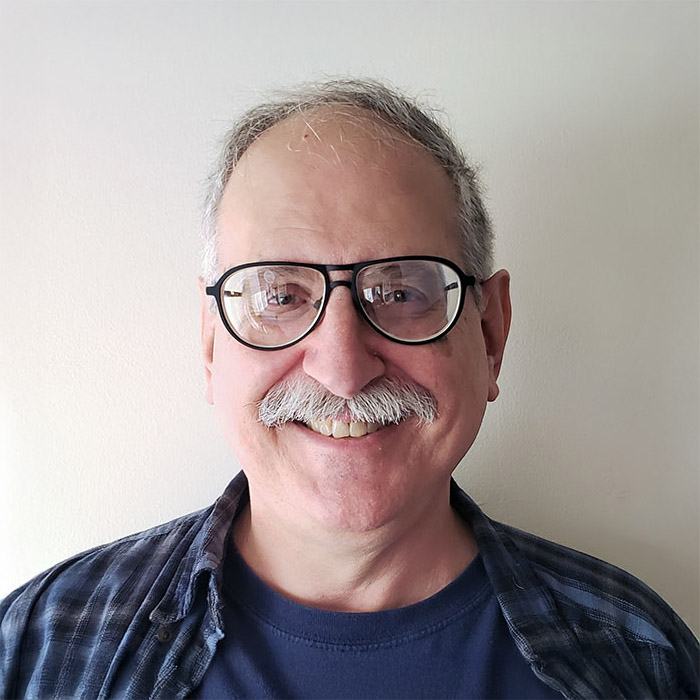
Larry Bartoszek, P.E.
Larry Bartoszek, P.E. is the Owner of Bartoszek Engineering and Vice President of the International Space Elevator Consortium (ISEC). He is a mechanical engineer with more than three decades of experience designing apparatus for the global nuclear and high-energy physics research community, and he is recognized within the space-elevator field as a leading designer of climbers — the electric vehicles intended to ascend the elevator’s tether.
Larry founded Bartoszek Engineering in 1990 and has run it as Owner from his base in Aurora, Illinois, ever since. The firm specializes in mechanical and electromechanical design for the nuclear and high-energy physics community worldwide, and it operates as a virtual network company drawing on engineers, scientists, and designers globally. Its work has spanned the full scale of laboratory apparatus, from tabletop devices to a 120-ton, three-story-tall Cartesian robot, and its clients have included Fermi National Accelerator Laboratory, Los Alamos National Laboratory, and many universities and governments. A chronological history of the firm’s projects is available on its Downloads page.
Through Bartoszek Engineering, Larry designed the magnetic horn used at Fermilab’s MiniBooNE experiment, a Cherenkov detector built to test the LSND neutrino-oscillation result. The horn is operated at a 170 kA pulsed current — generating the strong magnetic field used to focus the secondary mesons that produce the muon-neutrino beam — and has survived more than 400 million pulses in service, an endurance milestone for that class of device.
Larry is a coauthor of the foundational instrumentation paper The MiniBooNE Detector in Nuclear Instruments and Methods in Physics Research A. He has also contributed to the magnetic-horn system for the T2K (Tokai-to-Kamioka) long-baseline neutrino-oscillation experiment in Japan, whose horns operated at 320 kA peak current and enabled T2K’s 2013 observation of electron-neutrino appearance in a muon-neutrino beam.
Larry is a coauthor of the IsoDAR@KamLAND: A Conceptual Design Report for the Technical Facility (2015) and the follow-on IsoDAR@KamLAND: A Conceptual Design Report for the Conventional Facilities (2017), describing a cyclotron-driven electron-antineutrino source proposed for the Kamioka site. He is also a coauthor of the 2006 Astronomical Journal paper The 2.5m Telescope of the Sloan Digital Sky Survey, reporting on the design, construction, and performance of the Sloan Digital Sky Survey telescope at Apache Point Observatory.
Earlier in his career, Larry served as Chief Mechanical Engineer for the Solenoidal Detector Collaboration (SDC) at Fermilab from 1990 to 1993, working on a planned detector for the Superconducting Super Collider before the project was canceled by Congress in 1993. He has consulted for the Canadian government on a review of the SNO+ neutrino experiment and continues to take on detector and beamline design work for laboratories and universities around the world.
Larry’s involvement with the Space Elevator began in 2004 as a hobby — developing conceptual designs for climbers along the lines outlined in The Space Elevator: A Revolutionary Earth-to-Space Transportation System. He has presented at multiple Space Elevator Conferences, including Washington, DC (2004), Seattle (2013), and the ISEC Annual Conferences in Chicago (2023 and 2024). His original climber concepts include a roughly 900 kg first-construction climber, a 20-tonne first commercial climber, and a 200-tonne climber based on the 20-tonne technology, and have been published in two ISEC annual study reports.
In 2021, Larry was invited to join the ISEC Board of Directors as Chair for Design, and in 2024, he was elected Vice President of the consortium. Larry is a coauthor of the 2023 Acta Astronautica paper Conditions at the interface between the space elevator tether and its climber, which set out the constraints — friction, lifting torque, tensile, compressive, and shear strength, interface temperature, and radiative cooling — that govern climber and tether design. Read the ISEC 2023–1 Study.
At ISEC’s 2024 conference and at the National Space Society’s ISDC 2024, Larry presented two talks on Delivering Power to the Space Elevator Climber (with Dennis Wright and Martin Lades), examining laser power-beaming and conductive-tether approaches to delivering the megawatts a climber needs to begin its ascent. Larry has also carried the space-elevator concept to a broad public audience. Watch his ISEC webinar The Space Elevator Climber: From Basic Principles to Detailed Design.
Larry is a National Space Society Space Ambassador, a frequent speaker at events such as the Lake County Astronomical Society, Capricon (the Chicago science-fiction convention), and the NSS Space Forum. As ISEC Vice President, he is leading the consortium’s new Speakers Bureau, which connects volunteer speakers with science clubs, astronomy groups, civic organizations, and lifelong-learning audiences interested in the space elevator. Read Space Forum October 17: Delivering Power to Space Elevator Climbers.
Larry earned his Bachelor of Science in Physics and his Bachelor of Science in Mechanical Engineering (BSME) at the University of Illinois Urbana-Champaign between 1977 and 1983. He has been a Licensed Professional Engineer in Illinois since 1989 and is a member of the American Society of Mechanical Engineers, the American Welding Society, ASM International, the Chicago Society for Space Studies, the National Space Society, and the International Space Elevator Consortium.
Visit his LinkedIn profile, Bartoszek Engineering homepage, Google Scholar page, ResearchGate profile, SDC Featured Speaker page, and his NSS Space Ambassador profile. Follow him on Facebook and X.