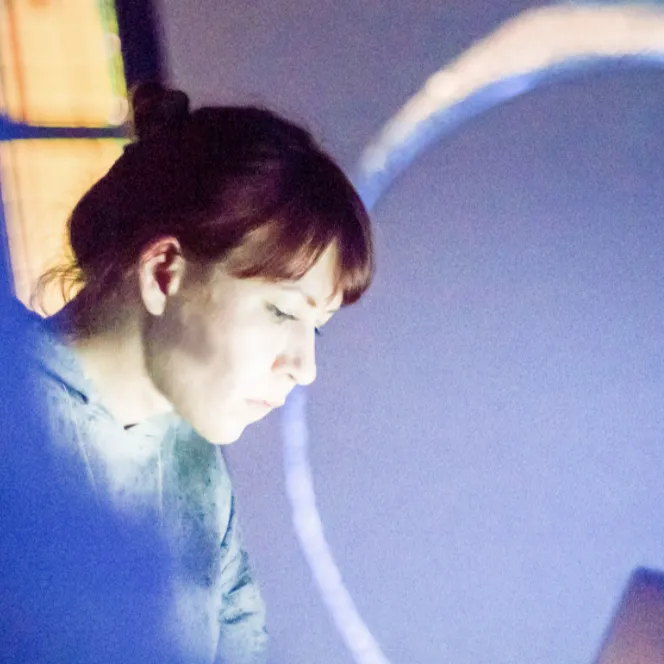
Kasia Molga, M.A.
Kasia Molga, M.A. is Founder and Creative Director of Studio Molga, an award-winning experiential artist, transdisciplinary innovation consultant, and creative technologist whose practice sits at the intersection of art, AI, ecology, and human perception of the natural world.
A self-described “design fusionist”, Kasia investigates the interconnections between humans and “non-human makers” — the organisms and entities that constitute life on Earth — and the ways technology reshapes our perception of those connections. Her work is commissioned, exhibited, and published internationally, with a sustained focus on ocean literacy and the evolving human relationship with marine environments.
Since 2018, she has led Studio Molga, where she heads a team of creative technologists and architects delivering commissioned installations, socially engaged artworks, and educational projects for brands, cultural institutions, and research programs. Through Studio Molga, she directs original authored works while advising brands, universities, and laboratories on transdisciplinary innovation strategies that merge design, data, sustainability, and imagination.
Between 2013 and 2015, she was Cofounder and Creative Director of World Wilder Lab, a Rotterdam- and London-based transdisciplinary platform that explored the intersection of art, science, design, and technology, positioning living organisms — plants, microbes, corals — as active participants in design and storytelling.
Her signature recent work, How to Find the Soul of a Sailor. was the winning 2023–2024 commission from The New Real’s “Uncanny Machines” AI Art Programme, supported by the Scottish AI Alliance, with partners including the Alan Turing Institute and the British Library.
Using a dataset built from her late father Tadeusz Molga’s handwritten diaries, merchant-navy ship logs, and climate data, Kasia used generative AI to reimagine his voice 50 years into the future, probing the ethical and emotional implications of “resurrecting” deceased loved ones through machine learning. The work was exhibited at Inspace Gallery at the University of Edinburgh and profiled by the University of Edinburgh News. Read Art and AI explores love, loss and the future of the seas.
Her earlier multi-part installation, How to Make an Ocean. developed through a 2020 EMAP/EMARE residency at Ars Electronica, investigates whether human tears can sustain basic marine life. The work combines a collection of mini-oceans grown from the artist’s own tears and North Sea algae, a “Moirologist Bot” AI trained on tens of thousands of environmental news headlines, and a meditative participatory performance. It received an Ars Electronica 2022 Honorary Mention in Interactive Arts and a 2022 COAL Award nomination, and premiered at Werkleitz Festival in 2021 before traveling to the Ars Electronica Festival, ISEA 2022 in Barcelona, and the Onassis Foundation’s “Radical Intimacy” exhibition.
Watch Kasia Molga: How to Make an Ocean. Read Turning human tears into a mini marine ecosystem and Tears for the Sea.
Kasia is perhaps best known internationally for Human Sensor. a performance of wearable costumes that light up in response to air pollution. Commissioned and produced by Invisible Dust in partnership with Manchester, European City of Science, and supported by the Wellcome Trust’s Sustaining Excellence Award and Arts Council England, the work debuted on the streets of Manchester in July 2016 and was later reconfigured as Human Sensor LDN for London.
She developed the costumes with media artist Ricardo O’Nascimento and creative technologist Erik Overmeire, advised by Professor Frank Kelly of King’s College London. The project received international coverage in The Guardian, The Washington Post, Nature, BBC, and Raspberry Pi, and won the 2016 Les Respirations Special Prize.
Earlier, Kasia was a core team member of the open-hardware community Protei (later Scoutbots), the oil-spill-cleaning sailing-robot project initiated by Cesar Harada, and co-developed the interactive installation Oil Compass with V2_, the Lab for the Unstable Media in Rotterdam. Together with Harada and collaborators, she received a 2012 Prix Ars Electronica Honorary Mention in Hybrid Arts for Protei and Oil Compass.
Between 2017 and 2019, Kasia undertook a STARTS Residency under the European Commission’s VERTIGO program, working with the Horizon 2020 GROW Observatory citizen-science project. With sound artist Robin Rimbaud (Scanner), she created By the Code of Soil and (de)Compositions, audio-visual works generated from soil-moisture data collected across Europe and timed to overhead transits of the Sentinel-1 satellite. The project was presented at the Centre Pompidou during the STARTS Residencies Days in 2018 and produced by FutureEverything.
Earlier, as Cofounder of World Wilder Lab, Kasia led PLANeT. an open-source hardware interface that captured electrical signals from plants and translated them into data streams, reframing smart cities around plants as environmental sensors. Research from PLANeT was presented at the European Parliament and won the 2015 N.I.C.E. Award (Network for Innovations in Culture and Creativity in Europe) from ECCE, as well as the Creativeworks London Creative Entrepreneur in Residence Award.
Alongside her studio practice, Kasia has held academic appointments across the UK and the Netherlands. Between 2009 and 2014, she was Head of the Faculty of Design Innovation at Limkokwing University London, Senior Guest Lecturer at Brunel University London, and Module Leader at the University of Wales / British Institute of Technology & E-Commerce, where she designed and taught courses on speculative design, creative coding, and 3D modeling.
From 2018 to 2022, she was Visiting Senior Lecturer at the Willem de Kooning Academy in Rotterdam, and has served as external examiner at WdKA and external adviser to the Interactive Architecture Lab at The Bartlett, UCL. She has delivered masterclasses at Goldsmiths, University of London, and regularly runs ecological-technology workshops for girls from underprivileged backgrounds.
Kasia began her career as a Graphic and New Media Designer at The Independent from 1999 to 2000, building the newspaper’s online edition, before joining the BBC from 2000 to 2001 as Lead Designer for the newly consolidated BBC Music department. From 2002 to 2009, she ran the independent cross-media studio Key to Alef, collaborating with agencies and broadcasters including BBC, Channel 4, Publicis, Digitas, LBi, Wunderman, VCCP, M.I.A., and Cartoon Network.
Kasia earned her Master’s Degree in Interdisciplinary Design Studies from the University of the Arts London in 2005, and her Bachelor of Arts in Film and Video, also from the University of the Arts London, in 2000. Between 2008 and 2011, she pursued doctoral research in UX Design in Digital Networked Forms at the University of East London.
She is a licensed PADI scuba diver and an avid aerial photographer, and spent her childhood sailing on merchant-navy vessels with her late father — an experience that continues to inform her artistic focus on the oceans.
Her work has been exhibited at Centre Pompidou, Tate Modern, the V&A Museum, Ars Electronica, Meta.Morf in Trondheim, FACT Liverpool, Dutch Design Week, NEMO Amsterdam, MIS São Paulo, Taipei Art Festival, and the Translife Media Arts Triennial in Beijing. She has received Arts Council England DYCP and Arts for Grants awards (2019, 2022, 2024), a 2018 Creative Industries NL grant for the Wide Wood Web residency at Wageningen University & Research, and a 2022 Paszport Polityki longlist nomination in Digital Arts.
In 2025, her work was featured at MAC Lyon in the exhibition L’art en mémoire de la nature. Listen to BBC Radio’s Art of Now — Filth. Read her journal article By the Code of Soil in the Journal of Virtual Creativity.
Visit her LinkedIn profile, her studio homepage, and her profiles at the Onassis Foundation, V2_ Lab for the Unstable Media, Invisible Dust, FACT Liverpool, and the ISEA Symposium Archives. Follow her on Facebook and Instagram.