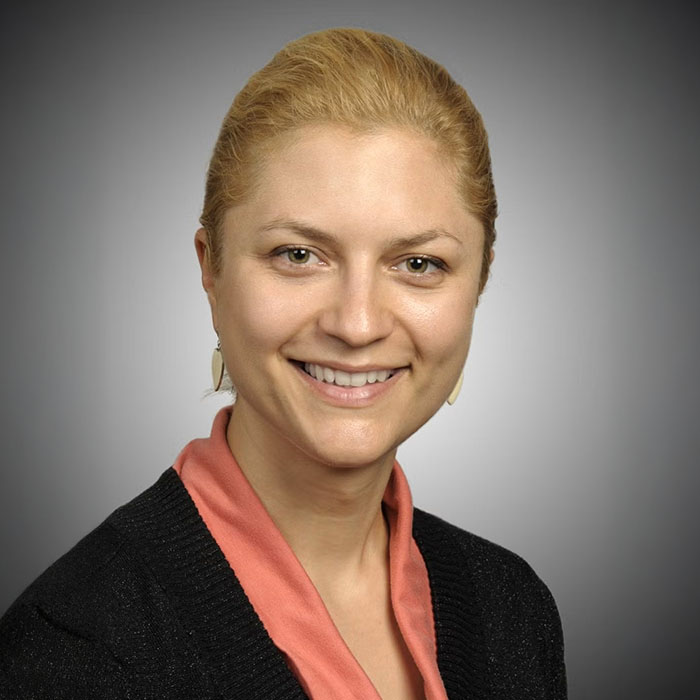
Dr. Julie Brisset
Julie Brisset, PhD is the Interim Director of the Florida Space Institute (FSI) at the University of Central Florida (UCF) and a Physicist specializing in experimental microgravity research. She is an accomplished researcher with extensive experience in aerospace engineering and planetary science, focusing on the behavior of dust and ice grains in microgravity conditions, with applications to planet formation and small-body surface science.
Julie is known for her experimental physics research investigating the earliest stages of planet formation and the structure and surfaces of small bodies in the Solar System. Her work combines microgravity experiments with practical applications for space exploration, including asteroid surface characterization and lunar regolith dynamics.
As Interim Director of FSI, Julie oversees a team of 80 staff from diverse disciplines and backgrounds, ensuring effective collaboration and progress on research initiatives that support NASA’s exploration objectives. In her role as Interim Director, Julie has demonstrated extraordinary leadership capabilities, most notably during the complex closure of the Arecibo Observatory following the catastrophic collapse of its 305-meter telescope in December 2020. As Principal Investigator of the Arecibo Observatory Management and Operations agreement with the U.S. National Science Foundation, she led the transition of research programs and staff following this historic loss. Read As famed Arecibo Observatory shuts down, its scientists face an uncertain future.
Under her leadership, portions of the Arecibo science programs continue to operate, including the Caribbean Climate Open Research and Education (CCORE) program on Culebra Island. Read The Idyllic Spot to Study the Sky.
Julie serves on the Editorial Board of Icarus, the premier planetary science journal endorsed by the Division for Planetary Sciences of the American Astronomical Society. She was appointed to this position in 2022 in recognition of her expertise in dust behavior under microgravity conditions for the study of planet formation and regolith. Read FSI Researcher Appointed to Icarus’ Editorial Board.
Julie is a Co-Investigator on the CubeSat Particle Aggregation and Collision Experiment (Q-PACE), a NASA-funded 3U CubeSat mission selected through NASA’s Small Innovative Missions for Planetary Exploration (SIMPLEx) program. The satellite, which launched in January 2021 aboard Virgin Orbit’s LauncherOne, was designed to study how small particles collide and aggregate in microgravity, providing insights into the earliest stages of planet formation. Read A Small Satellite With Planetary Ambitions.
She developed and flew the NanoRocks experiment, a 1.5U payload that operated on the International Space Station (ISS) in the NanoRacks NanoLab facility from September 2014 to March 2016. During its 18 months in orbit, NanoRocks recorded 158 videos of particle collisions at velocities below 1 cm/s, providing unprecedented data on the transition between bouncing and sticking collisions relevant to planetesimal formation. Read Multi-particle collisions in microgravity: Coefficient of restitution and sticking threshold for systems of mm-sized particles.
Julie was awarded a $250,000 NASA grant in 2018 to study levitating dust clouds in microgravity using the Dust In-situ Manipulation System (DIMS) in collaboration with Blue Origin. This project represents a significant advancement in understanding how dust particles interact with light in undisturbed environments, with applications ranging from astrophysics to atmospheric science.
The DIMS payload is scheduled to launch aboard Blue Origin’s New Shepard vehicle to test dust cloud creation and manipulation in microgravity. Read UCF Researcher Launching into Microgravity with Blue Origin. Watch UCF-Developed Testing Tech to Launch on Blue Origin Mission.
NASA’s Flight Opportunities Program selected Julie’s Suborbital Particle Aggregation and Collision Experiment-2 (SPACE-2) for reduced gravity flights in 2015, demonstrating her continued contributions to advancing space technology through commercial flight opportunities. Read NASA Selects New Technologies for Parabolic Flights and Suborbital Launches.
Julie’s research is affiliated with the Center for Lunar and Asteroid Surface Science (CLASS), a NASA-funded node of the Solar System Exploration Research Virtual Institute (SSERVI). The center facilitates NASA’s exploration of deep space by focusing on surface science and surface exploration of rocky, atmosphereless bodies, supporting missions to the Moon, near-Earth asteroids, and the moons of Mars.
She works closely with the Exolith Lab, a space hardware testing and regolith research facility managed by FSI that produces high-fidelity lunar, Martian, and asteroid regolith simulants. Her research using these simulants supports NASA’s Artemis program and commercial space exploration efforts. Read UCF Experimental Space Dirt Used by NASA, Private Companies to Advance Space Exploration.
Julie earned her PhD in Physics in 2014 from Technische Universität Braunschweig in Germany, with her dissertation titled A Microgravity Sounding-Rocket Experiment on Protoplanetary Dust Aggregation. Her doctoral research involved designing, building, and operating the Suborbital Particle Aggregation and Collision Experiment (SPACE) on the REXUS 12 suborbital rocket in March 2012. Read Submillimetre-sized dust aggregate collision and growth properties.
She earned her Master of Science in Aeronautics and Space Engineering in 2005 from both ISAE-SUPAERO in Toulouse, France, and Technische Universität München in Germany. She earned a Graduate Certificate in Space Studies in 2004 from the International Space University and a Graduate Certificate in Applied Sciences (Space Studies) in 2004 from the University of South Australia. She earned her Bachelor of Science in Mechanical Engineering in 2001 from Lycée Louis-le-Grand in Paris.
Before joining UCF, Julie worked as a Payload Operations Engineer for the German Aerospace Center (DLR), Germany’s national aeronautics and space research center, for several years. At DLR, she gained practical experience in satellite operations and space mission support.
She has published extensively in peer-reviewed journals and has contributed to more than a dozen research publications in experimental physics, astrophysics, and observational astronomy. Her work has been featured in major media outlets, including Science, MIT Technology Review, Scientific American, and Sky & Telescope.
Julie is a featured presenter at the Space Settlement Summit organized by the National Space Society, where she shared her vision for growing FSI’s research and technology development portfolio while providing exceptional training opportunities for students.
Watch the Interview with Julie Brisset, Director of the Florida Space Institute.
Visit her LinkedIn profile, Florida Space Institute profile, UCF Planetary Sciences Group page, Florida ExpertNet profile, ResearchGate profile, and Google Scholar page.