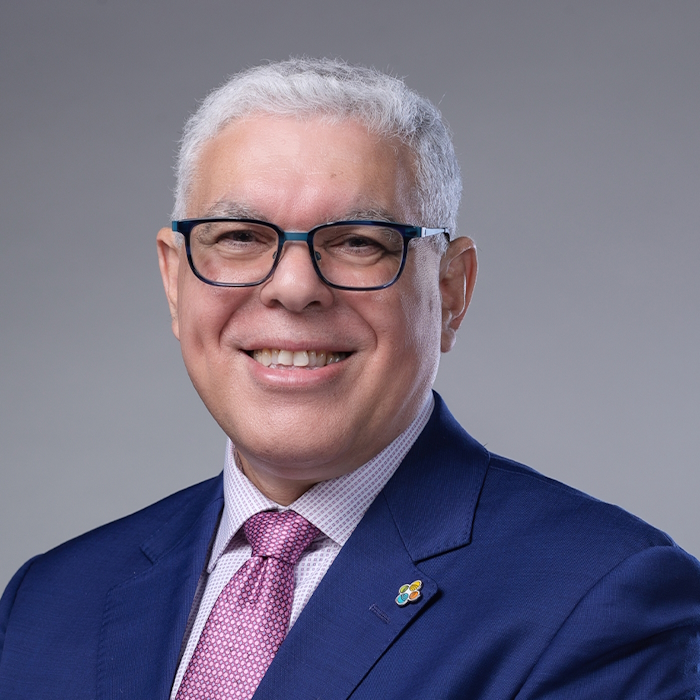
Professor Imed Gallouzi
Imed Gallouzi, PhD is the founding Chair (Director) of the KAUST Center of Excellence for Smart Health (KCSH), Professor of Bioscience in the Biological and Environmental Science and Engineering (BESE) Division at King Abdullah University of Science and Technology (KAUST), and Professor Emeritus at McGill University. He is a Scientific Advisor to the Kerry Health and Nutrition Institute (KHNI).
Imed is a leading expert in RNA biology with over 25 years of experience, known for uncovering key molecular mechanisms driving muscle wasting, aging, and cellular stress responses. His pioneering work on RNA-binding proteins, such as HuR and G3BP1, has opened new avenues for RNA-based therapeutics targeting cancer-induced cachexia, neurodegeneration, and regenerative medicine.
A recognized authority in post-transcriptional regulation, Imed has helped position RNA metabolism at the forefront of precision medicine. Read An HuR mutant, HuR-V225I, identified in adult T-cell Leukemia/Lymphoma, alters the pro-apoptotic function of HuR, G3BP1 controls the senescence-associated secretome and its impact on cancer progression, and The senescence-associated secretory phenotype as a driver of tumor growth: does G3BP1 hold the key?
Imed was a codiscoverer of the cytoplasmic RNA granules known as stress granules and their importance in cell stress response and in some pathologies. His research at Yale and McGill established the role of these RNA granules in cellular protection during stress conditions. His work on mRNA binding proteins (RBPs) has led to the discovery that RBPs play an important role in muscle fiber formation and the onset of pathological conditions such as muscle wasting, cancer, and aging-related diseases.
His group has identified several factors and pathways and the mode of action by which they promote cancer-induced muscle wasting, opening the door to consider novel therapeutic avenues to treat this deadly syndrome. Read HuR binding to cytoplasmic mRNA is perturbed by heat shock and Depletion of HuR in murine skeletal muscle enhances exercise endurance and prevents cancer-induced muscle atrophy.
As founding Chair of the KAUST Center of Excellence for Smart Health, Imed leads a multidisciplinary initiative that develops innovative smart-health technologies and works to integrate these technologies into the Saudi Arabian healthcare system. The Center has assembled experts in biological sciences, computer science (including AI and machine learning), materials science, engineering, and statistics to address health and wellness priorities in alignment with Saudi Arabia’s Vision 2030 strategy.
Imed played a central role in establishing the first M.D.-Ph.D. program in Saudi Arabia in collaboration with Alfaisal University in Riyadh. This program, which accepted its first cohort in 2022, aims to train the next generation of physician-scientists capable of integrating AI and machine learning into their practices to pioneer the paradigm shift to precision medicine. Read KAUST Insights for health education: Collaborations on smart health deliver benefits for KSA.
Between June 2022 and June 2024, Imed served as Chief Operating Officer (COO) of the KAUST Smart Health Initiative (KSHI), where he played a crucial role in the expansion and impact of KSHI both nationally and internationally. The initiative focuses on building cutting-edge tools and platforms that improve healthcare delivery in Saudi Arabia and globally.
Imed’s current research explores how posttranscriptional regulatory mechanisms, particularly those involving RNA-binding proteins, stress granules, and microRNAs, govern muscle regeneration, aging, and disease progression. His team is pioneering strategies to harness iPSCs, mRNA decay pathways, and RNA-based technologies to address muscle wasting, aging-associated disorders, and the impact of gravity on RBP-mediated muscle and brain functions through interdisciplinary approaches.
Read The formation of HuR/YB1 complex is required for the stabilization of target mRNA to promote myogenesis, Stress granules counteract senescence by sequestration of PAI‐1, HuR counteracts miR-330 to promote STAT3 translation during inflammation-induced muscle wasting, and eIF4A inhibition prevents the onset of cytokine-induced muscle wasting by blocking the STAT3 and iNOS pathways.
Prior to KAUST, Imed spent over 20 years at McGill University, where he was Professor of Molecular and Cellular Biology in the Department of Biochemistry and at the Rosalind and Morris Goodman Cancer Institute, Faculty of Medicine and Health Sciences. During this time, he also served as Associate Chair (Education) of the Department of Biochemistry.
Between August 2001 and March 2022, Imed was a full Professor at McGill. From 2002 to 2012, he held a Tier II Canada Research Chair in Cellular Information Systems, one of Canada’s most prestigious research appointments. He received the FRSQ (Fonds de Recherche en Santé du Québec) award from 2002 to 2006. Read Promising tool to combat cachexia-induced muscle wasting discovered.
He played a central role in launching graduate biomedical programs and advancing health and life science research at Hamad Bin Khalifa University (HBKU) in Qatar through the College of Health and Life Sciences, where he contributed to establishing programs in biological and biomedical sciences.
Imed earned his PhD in Molecular Biology from Université Montpellier II in France in 1998. He completed his postdoctoral training at Yale University from 1998 to 2001, where he worked with renowned RNA biologist Dr. Joan Steitz on mRNA export pathways and the characterization of RNA-binding proteins. His landmark publication with Dr. Steitz in Science, Delineation of mRNA Export Pathways by the Use of Cell permeable Peptides, established foundational knowledge about mRNA nuclear-cytoplasmic trafficking.
He earned his DEA (Advanced Studies Diploma) from Université Montpellier II in 1993 and his Maîtrise in Physiology and Pharmacology from Université Montpellier II in 1992.
Imed is a member of several national and international funding agencies, including CIHR (Canadian Institutes of Health Research), CCSRI (Canadian Cancer Society Research Institute), FRSQ, and NIH (National Institutes of Health). His research has been cited over 6,400 times, and he has published numerous papers in leading journals including Nature Communications, Science, PNAS, Cell, Nucleic Acids Research, and Journal of Biological Chemistry.
Imed has co-chaired international scientific conferences, including the 8th RNA Stability Conference alongside Dr. Jeff Wilusz. He is involved in the Saudi Space Agency’s BioGravity program, which embodies Saudi Arabia’s vision to establish itself as a global destination for science and innovation in space research, examining the impact of gravity on RNA-binding protein-mediated muscle and brain functions.
Read Pateamine A, a natural inhibitor of general translation, prevents the onset of cachexia-induced muscle wasting and HuR counteracts miR-330 to promote STAT3 translation during inflammation-induced muscle wasting.
Visit his LinkedIn profile, KAUST Faculty page, KAUST Research Portal, McGill School of Biomedical Sciences page, ResearchGate profile, and Google Scholar page. Follow him on Facebook.