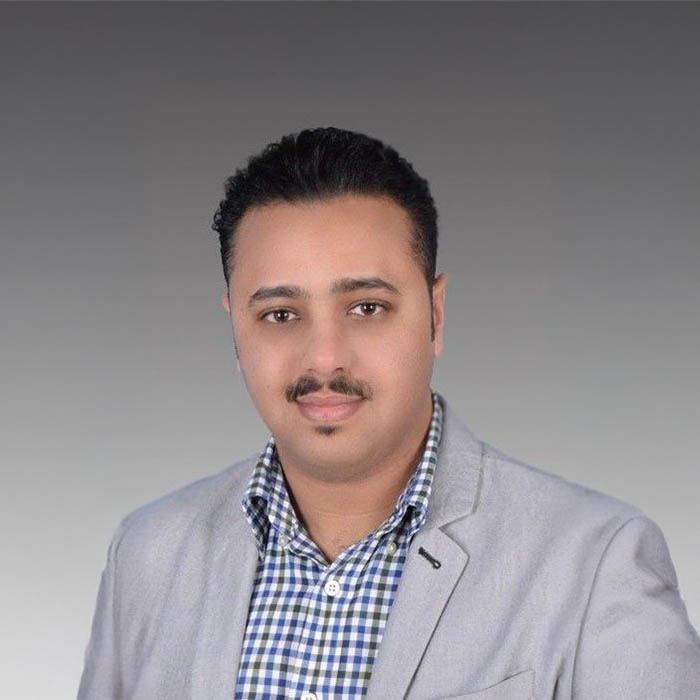
Ghanim Alotaibi, MSc
Ghanim Alotaibi, MSc is a Mechanical Engineer, Doctoral Researcher in Space-Based Solar Power at the University of Strathclyde, Cofounder of the Advance Space Civilization Initiative (ASCI) in Kuwait, and Project Manager of the Moon Village Association’s Participation of Emerging Space Countries (MV-PESC) project.
He is considered the first person in Kuwait to hold a full-time space-related job, having proposed and led the scientific objective for KuwaitSat-1, the first satellite ever built by Kuwaitis.
Ghanim’s doctoral research at the Department of Mechanical and Aerospace Engineering in Glasgow, supervised by Professor Massimiliano Vasile, focuses on thermal management for a Solar Power Satellite based on the SPS-ALPHA concept — a hypermodular, biomimetic architecture for space-based solar power developed under NASA’s Innovative Advanced Concepts (NIAC) program by John C. Mankins. The aim is to advance the Technology Readiness Level for gigawatt-scale orbital power generation by addressing the challenge of rejecting heat from arbitrarily large phased arrays using passive thermal techniques.
Read Thermal model and radiator design for the SPS-ALPHA concept, presented at the IAF Space Power Symposium during the 76th International Astronautical Congress (IAC 2025) in Sydney, and Temperature prediction first results of a solar power generator based on the SPS-ALPHA concept, presented at the IAF Space Power Symposium in Paris in 2024.
As Cofounder of Advance Space Civilization Initiative, Ghanim communicates the urgency of expanding humanity into outer space to public audiences in Kuwait through Overview Effect workshops, virtual reality experiences, astronomy courses, and analog mission programmes. The initiative is inspired by the work of our space philosopher Frank White, author of The Overview Effect and the Cosma Hypothesis, with whom Ghanim has collaborated on a project examining the relationships between Islamic spirituality and the cognitive shift astronauts experience when viewing Earth from space.
Ghanim is a Member of the Board of Directors of Space Renaissance International (SRI), an international nonprofit think tank based in Italy that promotes astronautical humanism and the civilian development of space. He has served on the SRI Board since April 2022 and co-chairs the Space Renaissance Academy Target Young Generations Committee, where he has chaired sessions of the upcoming Space Renaissance Congress 2026.
In June 2025, ASCI partnered with SRI and other organizations to launch rocks from Kuwait’s Failaka Island into low Earth orbit aboard The Exploration Company’s Nyx capsule on a SpaceX Falcon 9 from Vandenberg Space Force Base, as part of the Space for All Gallery — Mission Possible cultural payload. Read From Failaka to the final frontier in the Kuwait Times.
Since January 2020, Ghanim has been Project Manager of the Moon Village Association’s MV-PESC initiative, mentoring local teams from twelve countries to draft national roadmaps for participation in lunar exploration and the broader space economy. The project — documented in a UNOOSA case study — has produced roadmaps from Jordan, Egypt, Kenya, Colombia, Mexico, Chile, Nepal, Mongolia, Thailand, and Kuwait, creating a network of emerging space nations working to make the Moon an internationally accessible destination.
Between 2019 and 2022, Ghanim was the Engineer for KuwaitSat-1 at Kuwait University. He proposed the CubeSat project for national space capacity building, led the scientific objective of using the onboard camera as a gyroscope, lectured undergraduate students on orbital mechanics and space mission design, and coordinated with commercial providers.
KuwaitSat-1, a 2U CubeSat with a multi-color camera payload, was launched on January 3, 2023, aboard SpaceX Falcon 9 Transporter-6 from Cape Canaveral — Kuwait’s first national satellite. Between June and September 2022, Ghanim served as an Academic Assistant at the International Space University Space Studies Program (SSP22) in Lisbon, Portugal.
From 2018 to 2021, Ghanim was the Middle East Regional Coordinator and a member of the executive committee of the Space Generation Advisory Council (SGAC), where he organized the first Middle East Space Generation Workshop and mentored National Points of Contact across the region. Read SGAC Member of the Month — March 2019. He previously founded the Kuwait Chapter of the Students for the Exploration and Development of Space (SEDS) and served as Kuwait’s National Point of Contact for SGAC between 2008 and 2010.
Ghanim is one of the first analog astronauts from a Gulf Cooperation Council country. He performed three analog missions: as Crew Astronomer with the International Emerging Space Leaders Crew at the Mars Desert Research Station Crew 205 in Utah in 2019 (read the Final Mission Summary), a second MDRS rotation in 2020, and a third mission as communication officer at the Analog Astronaut Training Center in Poland in 2021. In 2022, he organized the first all-Kuwaiti analog mission and the first analog mission worldwide focused on arts as a primary objective.
Ghanim began his career as a Well Surveillance Engineer at Kuwait Oil Company between 2009 and 2015, working on surface well testing, slickline operations inspection, and briefly on the Umm Gudair solar power plant project.
Ghanim earned his Bachelor’s Degree in Mechanical Engineering from Kuwait University in 2008. He earned his Master’s Degree of Science in Solar Energy Systems (Photovoltaics) from the University of Freiburg in Germany in 2017, with research conducted at Fraunhofer ISE on the analysis and optimization of a six-source sun simulator for large-area multi-junction solar cells.
He completed a Diploma in Space Sciences at the International Space University Space Studies Program 2010 in Strasbourg, a Diploma in Astronomy and Astrophysics from Swinburne University of Technology between 2011 and 2013, and a Graduate Certificate in Space Sciences from the Kepler Space Institute between 2020 and 2021.
Ghanim is a published author in space philosophy and policy. Read Regulations for Space Based Solar Power as a Key for Innovation in the Journal of Space Philosophy, in which he argues for an international UN-administered regulatory entity to facilitate disruptive adoption of space solar power, drawing parallels with Germany’s Renewable Energy Act (EEG) and its catalytic role in terrestrial photovoltaic deployment. He also coauthored Space renaissance event: Expanding Humanity to Outer Space (EHTOS), presented at the IAF Space Education and Outreach Symposium during IAC 2025. His Curriculum Vitae is hosted by the Space Renaissance Academy.
Ghanim has presented at the Science Summit at the United Nations General Assembly (UNGA78), the International Astronautical Congress, and the Global Space Exploration Conference.
Visit his LinkedIn profile, IAF biography, and his University of Strathclyde research profile. Follow him on Facebook and Instagram.