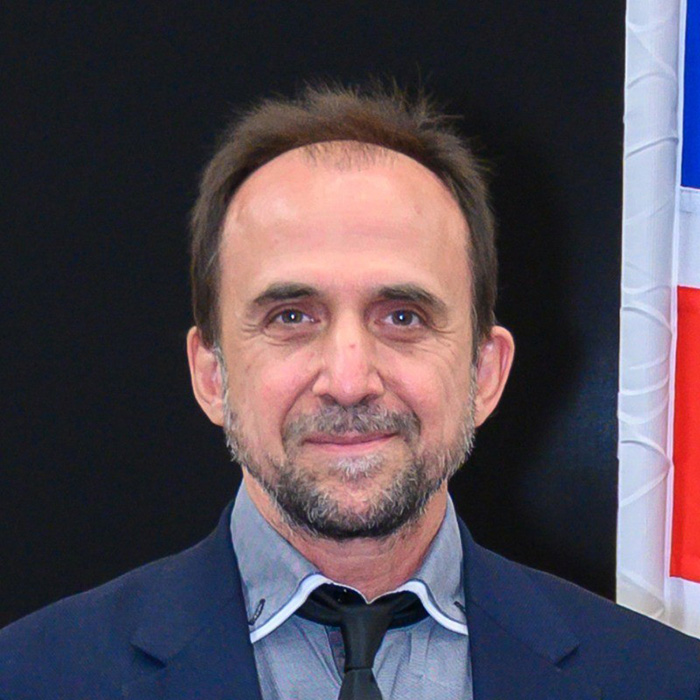
Professor Daniel Muñoz-Espín
Daniel Muñoz-Espín, PhD is a Spanish Cancer Biologist and Professor of Research at the University of Cambridge, where he serves as a Research Group Leader at the Early Cancer Institute and Co-Director of the CRUK Cambridge Centre Thoracic Cancer Programme. He is also Cofounder of Senesys Bio, a biotechnology startup developing next-generation senolytic delivery technologies to combat age-related diseases.
Daniel is an internationally recognized expert in cellular senescence, cancer biology, and aging, whose pioneering research has redefined the understanding of how senescent cells contribute to disease and development.
Daniel’s laboratory at the Department of Oncology, University of Cambridge, works at the interface between cellular senescence, plasticity, and the fundamental processes and mechanisms that lie at the origin of cancer. His group uses this knowledge to design, develop, and validate novel pharmacologically active drugs and nanodevices to promote rejuvenation, extend lifespan, and convert incurable diseases like aggressive lung cancer and pulmonary fibrosis into treatable conditions.
Read Programmed cell senescence during mammalian embryonic development and Cellular senescence: from physiology to pathology.
His seminal 2013 paper published in Cell was the first to describe the phenomenon of developmental senescence, demonstrating that programmed senescence plays a key role in tissue remodeling during embryonic development. This groundbreaking discovery was highlighted in Nature, Nature Reviews Molecular Cell Biology, and The EMBO Journal, and has accumulated over 860 citations. His highly cited 2014 review in Nature Reviews Molecular Cell Biology has garnered over 1,600 citations.
Since establishing his independent research group at Cambridge in 2016, Daniel has secured multiple competitive funding awards, including an MRC New Investigator Research Grant from 2017 to 2021, a Royal Society Research Grant, a CRUK Early Detection OHSU Project Grant from 2018 to 2021, and a CRUK Programme Foundation Award from 2020 to 2026.
As principal investigator and corresponding author, he has published research in high-impact journals including EMBO Molecular Medicine (2018), Aging Cell (2020), European Respiratory Journal (2022), Cancer Cell (2023), Angewandte Chemie (2024), Cell Death & Disease (2024), and Nature Aging (2025).
Read Treatment resistance to platinum-based chemotherapy in lung and ovarian cancer is driven by a targetable TGFβ senescent secretome and Clearance of senescent macrophages ameliorates tumorigenesis in KRAS-driven lung cancer.
Daniel’s laboratory has developed a suite of novel tools targeting senescence for both diagnostic and therapeutic purposes, resulting in several filed patents. His pioneering work on senolytic nanocarriers demonstrated that encapsulating drugs within galactose-coated mesoporous silica nanoparticles enables selective delivery to senescent cells, improving drug safety profiles and efficacy. Read A versatile drug delivery system targeting senescent cells and Galacto-conjugation of Navitoclax as an efficient strategy to increase senolytic specificity and reduce platelet toxicity.
As Cofounder of Senesys Bio, Daniel, together with Professor Ljiljana Fruk from the Department of Chemical Engineering and Biotechnology at the University of Cambridge, is developing NanoJAGGs, a groundbreaking nanostructure-based delivery system designed to accurately detect and deliver senolytic drugs to senescent cells for the treatment of age-related diseases. Read Improved Therapeutic Efficiency of Senescent Cell-specific, Galactose-Functionalized Micelle Nanocarriers.
Daniel coauthored the book Cellular Senescence in Disease with Professor Manuel Serrano, Principal Investigator at Altos Labs, published by Elsevier in 2021. The book won the 2023 PROSE Award in Biomedicine and Neuroscience from the Association of American Publishers, selected from more than 560 entries by a panel of 24 judges. Read Daniel Muñoz Espín wins 2022 PROSE award.
Daniel earned his PhD in Molecular Biology in 2006 from the Autonomous University of Madrid with cum laude honors, working within the Viral DNA Replication Group at the Centre of Molecular Biology Severo Ochoa (CMBSO) under the supervision of Professor Margarita Salas. During his PhD, he was also a visiting student at the Sir William Dunn School of Pathology at the University of Oxford, working in Professor Jeff Errington’s group.
He earned his Bachelor’s Degree in Biology and Molecular Biology from the Autonomous University of Madrid. Following his doctoral work, Daniel was awarded an I3P Fellowship followed by a Spanish National Research Council (CSIC) Fellowship to conduct postdoctoral research on DNA replication at the Centre of Molecular Biology Severo Ochoa in Madrid from 2007 to 2010, resulting in several first- and corresponding-authored papers in journals including Proceedings of the National Academy of Sciences (PNAS), The EMBO Journal, and Journal of Biological Chemistry.
Based on this research, a patent was filed on a novel gene delivery system to Sygnis AG Pharma in 2013. Between 2011 and 2015, he joined the laboratory of Professor Manuel Serrano at the Spanish National Cancer Research Centre (CNIO), where he specialized in cellular senescence and in vivo models of cancer and aging. His work at CNIO was recognized with two major research awards: the Ramón y Cajal Programme Senior Grant and a National Programme Grant for Research Aimed at H2020 Societal Challenges.
In 2016, Daniel joined the University of Cambridge as a Senior Research Associate and Principal Investigator within the Early Detection Programme of the Cancer Research UK Cambridge Centre. He was appointed Associate Professor in September 2016 and promoted to Professor of Research in October 2023.
Read Activatable senoprobes and senolytics: Novel strategies to detect and target senescent cells and Cellular senescence in cancer: from mechanisms to detection.
Daniel has authored over 70 research publications, accumulating more than 7,000 citations. Watch Targeting Cellular Senescence in Cancer and Ageing at the Cambridge Philosophical Society.
Visit his LinkedIn profile, Lab Homepage, ResearchGate profile, ORCiD page, Publication list, and University of Cambridge profile. Follow him on Facebook, private X, and Lab X.