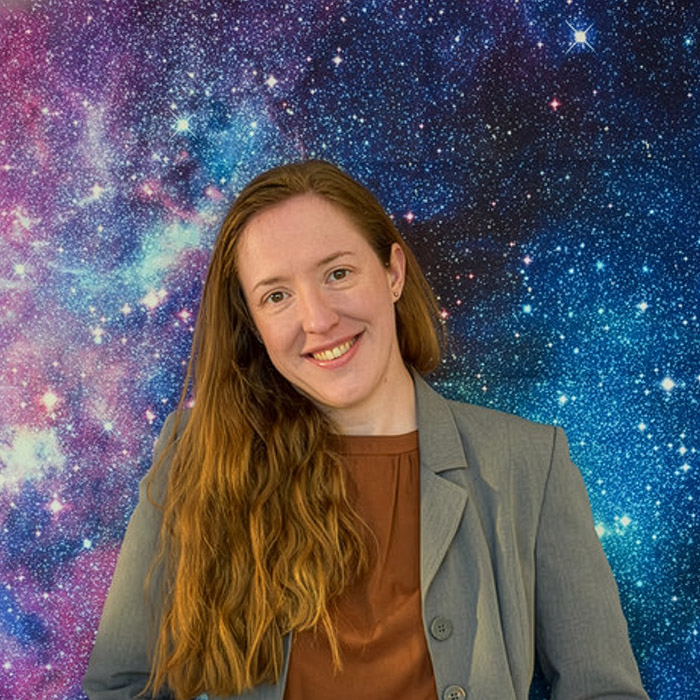
Dr. Caitlin Ahrens
Caitlin Ahrens, PhD is an Assistant Research Scientist with the University of Maryland, College Park Department of Astronomy, embedded with the Center for Research and Exploration in Space Science and Technology II (CRESST II) at NASA’s Goddard Space Flight Center in Greenbelt, Maryland.
A planetary scientist focused on icy worlds, cryovolcanism, and the thermodynamics of planetary surfaces, she serves on the science team of NASA’s Lunar Reconnaissance Orbiter (LRO) Diviner instrument and leads a NASA-funded lunar sustainability research initiative. Watch NASA Expert Talk: Dr. Caitlin Ahrens, Planetary Scientist.
Caitlin’s research couples remote sensing of icy surfaces with laboratory and theoretical modeling of volatile interactions, with particular emphasis on permanently shadowed regions at the lunar poles where water and other volatiles are cold-trapped. She applies LRO Diviner thermal data — in combination with other remote sensing datasets — to determine the stability and phase behavior of ices at the lunar poles.
Beyond the Moon, she works on planetary volcanism — lava flow morphology, caldera formation, and rheology — across Mars, Ceres, Titan, and Pluto. She is advised by Dr. Noah Petro, Project Scientist of LRO.
Caitlin is the Principal Investigator of A RAD Framework for the Moon: Applying Resist-Accept-Direct Decision-Making, one of five university-led projects selected by NASA’s Office of Technology, Policy and Strategy in 2024 to share a combined $550,000 in space sustainability research funding.
The work develops a decision-making framework for lunar surface activities — covering lunar architecture and civil engineering, mining operations, resource management, and the protection of human heritage sites — that can inform Artemis and Commercial Lunar Payload Services operations under deep uncertainty. Read Highlighting Explore Alliance Ambassador Caitlin Ahrens: Pioneering Space Sustainability.
Caitlin is concurrently Lunar Science Lead within the Goddard Center for Astrobiology, investigating how permanently shadowed regions may preserve volatile-organic compounds at extremely low temperatures and how returned lunar samples should be classified, contained, and curated for astrobiological study.
She is a member of the American Society of Civil Engineers Aerospace Division’s Space Engineering & Construction Technical Committee and Regolith Operations, Mobility, and Robotics Technical Committee, and she serves as an environmental technical research assistant for the NASA Extravehicular Activity and Human Surface Mobility Program supporting Artemis surface activities.
Caitlin is a prolific author and editor in the planetary sciences. She is first author of Geocryology of Pluto and the icy moons of Uranus and Neptune (Chapter 11, with Carey M. Lisse, Jean-Pierre Williams, and Richard J. Soare) and a co-editor of the Elsevier volume Ices in the Solar-System: A Volatile-Driven Journey from the Inner Solar System to its Far Reaches.
She coauthored Sverdrup-Henson crater: A candidate location for the first lunar South Pole settlement, which proposes a flat-floored polar site rich in water ice and accessible to communications and solar power as a candidate for a first lunar base, and contributed multiple chapters to Mars: A Volcanic World as well as a chapter to Triton and Pluto: The Long Lost Twins of Active Worlds. She was Associate Editor and Section Editor of the Springer Encyclopedia of Lunar Science between 2021 and 2023.
Caitlin earned her PhD in Space and Planetary Sciences from the University of Arkansas Center for Space and Planetary Sciences in 2020. Her dissertation, Understanding Ice Mixtures under Pluto Simulated Conditions and their Implications for Geophysical Processes, characterized binary and ternary mixtures of methane, nitrogen, carbon monoxide, and water ice using Fourier-transform infrared spectroscopy in a custom-built Pluto Simulation Chamber capable of reaching 10–50 K and 14–25 µbar — conditions relevant to Pluto’s surface. She designed and helped build the chamber itself and was widely known on campus as “the Pluto Manager”. She earned her Bachelor of Science degrees in Geology and in Physics with an emphasis in Astrophysics from West Virginia University in 2015.
Following her PhD, Caitlin held a NASA Postdoctoral Program Fellowship at Goddard between 2020 and 2023 and a CRESST II Postdoctoral Research Scientist appointment between 2023 and 2025, before assuming her current Assistant Research Scientist position in July 2025. She also holds U.S. Patent 7,593,907 — an earthquake forecasting method based on P-ring junctions and tectonic plate edges, invented by her late father Steven E. Ahrens and assigned to her in 2009.
Caitlin’s professional service spans the major planetary science societies. She is a member of the American Geophysical Union, where she served on the Natural Hazards Program Committee from 2018 to 2025, the Lunar Exploration and Analysis Group and its Extraterrestrial Materials Analysis Group Specific Action Team on volatile samples and cold curation, and the Outer Planets Assessment Group. She has been a NASA/JPL Solar System Ambassador since 2016, a U.S. Team Member of the International Astronomical Union National Astronomy Education Coordinator network, and a science team member of the Apollo Next Generation Sample Analysis Program.
She has reviewed for The Planetary Science Journal, ACS Earth and Space Chemistry, Nature, and Nature Communications, and has served as primary reviewer and executive secretary on multiple NASA ROSES proposal panels. In 2018, the U.S. Junior Chamber selected Caitlin as one of its Ten Outstanding Young Americans, recognizing her promotion of science, advocacy for women in STEM, accessible-format outreach for blind and deaf audiences, and free educational resources for rural communities. She had been named an Outstanding Young West Virginian by the West Virginia Junior Chamber earlier that same year. Read U of A Graduate Student Selected as Outstanding Young American.
Other recognitions include the West Virginia University Eberly College Rising Star Award in 2019, the GSFC Sciences and Exploration Directorate Excellence in Mentoring Award in 2024, and a NASA Group Achievement Award the same year for her work on the Extravehicular Activity and Human Surface Mobility Program Systems Requirements Review Team.
Caitlin is an active and decorated science communicator. From 2017 to 2020, she wrote and hosted Scratching the Surface, a weekly solar-system science segment on the NPR-affiliated KUAF 91.3 FM at the University of Arkansas. Read Community Spotlight: the KUAF Pluto Manager moves to NASA!
She serves as an Explore Alliance Ambassador for Explore Scientific, where she has hosted the seven-part series 7 Months of Science with Dr. Caitlin Ahrens. She has presented at venues including the Smithsonian National Air and Space Museum Center for Earth and Planetary Studies, the American Geophysical Union Fall Meeting, and the Lunar Surface Innovation Consortium Cross-Cutting Capabilities monthly seminar, and was invited by the Ministry of Education and Culture of Finland to deliver a keynote on improving STEM access through different communities.
Recent talks include lectures on lunar architecture and risk-managed engineering at the National Capital Area Skeptics, a Bang, Boom, Pop, Fizz: Space Volcanoes! segment at Astronomy on Tap DC, a Space Volcanos lecture at the Westchester Amateur Astronomers in October 2023, and an October 2025 Mysterious, Marvelous Cryogeology talk in the WVUniverse series at her undergraduate alma mater.
She was a featured speaker at the International Space Development Conference of the National Space Society on the Moon and Space Settlement tracks.
Visit Caitlin’s University of Maryland faculty page, NASA Goddard biography, Early Career Scientist Spotlight, Google Scholar page, ResearchGate profile, and ORCID record. Follow her on Facebook and X.