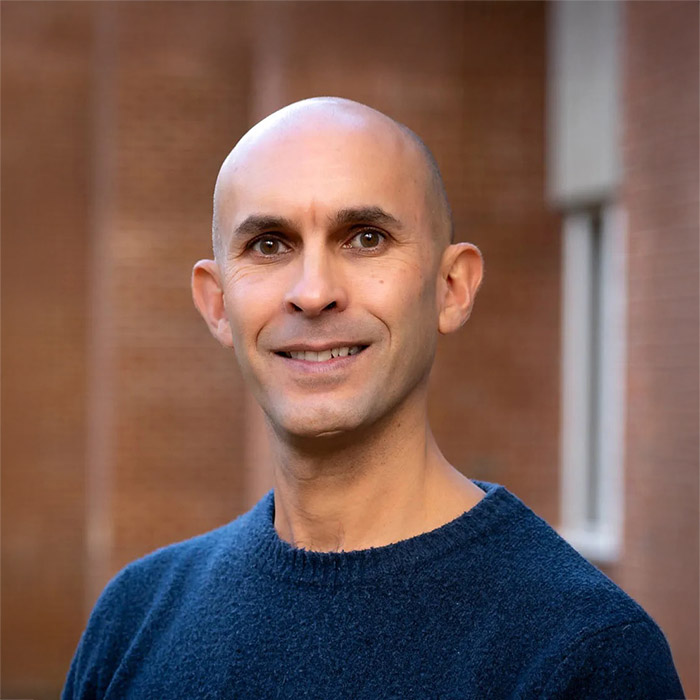
Professor Anil Seth
Anil Seth, D.Phil., is Professor of Cognitive and Computational Neuroscience and Director of the Sussex Centre for Consciousness Science at the University of Sussex, Co-Director of the Canadian Institute for Advanced Research (CIFAR) Program on Brain, Mind, and Consciousness, and a European Research Council Advanced Investigator.
A neuroscientist, author, and keynote speaker, he has pioneered research into the brain basis of consciousness for more than twenty-five years, publishing more than 200 research papers and earning recognition from Web of Science, over several years, being in the top 0.1% of researchers worldwide.
Anil’s research brings together neuroscience, mathematics, artificial intelligence, computer science, psychology, philosophy, and psychiatry to explain how conscious experiences depend on the brain. His central proposal is that the brain is an embodied “prediction machine” and that conscious experiences, including the experience of being a self, are best understood as forms of “controlled hallucination” — perceptual predictions shaped by the imperative to keep the body alive.
His lab develops mathematical tools for measuring levels of consciousness and emergence in neurophysiological data, studies the brain basis of specific perceptual experiences, and applies these findings to psychiatric and neurological conditions.
Read Interoceptive inference, emotion, and the embodied self, Theories of consciousness, Activity in perceptual classification networks as a basis for human subjective time perception, and Dynamical independence: Discovering macroscopic emergent processes in complex dynamical systems. With Lionel Barnett, he developed the widely used MVGC multivariate Granger causality toolbox for inferring directed connectivity from neural time series.
Since 2021, Anil has led CONSCIOUS, a five-year project funded by a €2.43 million European Research Council Advanced Investigator Grant, which combines cognitive neuroscience, statistical physics, machine learning, and philosophy to move from correlating brain activity with consciousness to explaining it. Read Sussex neuroscientist wins €2.43 million grant to probe mystery of human consciousness. In 2025, with our Axel Cleeremans and Liad Mudrik, he set out the state of the field in Consciousness science: where are we, where are we going, and what if we get there?
Anil has become a leading voice on whether artificial intelligence could ever be conscious, arguing that consciousness is more likely a property of life than of computation and that “simulation is not instantiation.” His target article Conscious artificial intelligence and biological naturalism appeared in Behavioral and Brain Sciences in 2025, and his essay The Mythology of Conscious AI in Noema won the 2025 Berggruen Institute Prize Essay Competition, selected from roughly 3,000 submissions from more than 120 countries. Read Professor Anil Seth wins prestigious Berggruen Prize Essay Competition.
In April 2026, he returned to the main TED stage in Vancouver to make the case against conscious AI. Watch Why AI isn’t going to become conscious. He also advises Conscium on the science of consciousness.
Anil is lead scientist on the Dreamachine, an award-winning immersive light-and-sound experience, commissioned as part of UNBOXED: Creativity in the UK, in which participants generate vivid visual worlds behind closed eyes. Alongside it, he directed the Perception Census, described as the largest ever scientific study into perceptual diversity, which drew more than 33,000 participants from over 100 countries. Read Public invited to take part in largest ever scientific study into perception.
Anil’s book Being You: A New Science of Consciousness (2021) was an instant Sunday Times bestseller and a 2021 Book of the Year for The Economist, The New Statesman, Bloomberg, The Guardian, and the Financial Times. He edited and coauthored 30-Second Brain (2014), coedited Modelling Natural Action Selection (2011) with Tony J. Prescott and Joanna J. Bryson, and was consultant neuroscientist on Clive Gifford’s Eye Benders, winner of the 2014 Royal Society Young People’s Book Prize.
Anil joined the University of Sussex faculty in 2008 as Senior Lecturer in Informatics and has held the Chair in Cognitive and Computational Neuroscience since 2012. In 2010, he cofounded the Sackler Centre for Consciousness Science with Hugo Critchley, serving as Co-Director until 2021 before becoming Director of its successor, the Sussex Centre for Consciousness Science, one of the University’s Centres of Excellence. Read A decade of consciousness science at Sussex.
From 2001 to 2006, he was a Postdoctoral Fellow and then Associate Fellow at The Neurosciences Institute in San Diego, working with Nobel laureate Gerald Edelman on theoretical neurobiology.
Anil earned his D.Phil. in Computer Science and Artificial Intelligence from the University of Sussex in 2001 with the thesis On the relations between behaviour, mechanism, and environment: explorations in artificial evolution, following an MSc in Knowledge Based Systems from Sussex in 1996 and an M.A. in Natural Sciences from the University of Cambridge in 1994.
From 2014 to 2024, Anil was founding Editor-in-Chief, with Jakob Hohwy, of Neuroscience of Consciousness. He chaired the 16th meeting of the Association for the Scientific Study of Consciousness in Brighton in 2012. He was a Wellcome Trust Engagement Fellow from 2016 to 2020, President of the Psychology Section of the British Science Association in 2017, and has been a CIFAR fellow since 2016 before becoming Co-Director of the Program on Brain, Mind, and Consciousness alongside Adrian Owen. He is a Patron of Humanists UK.
In 2023, Anil was awarded the Royal Society’s Michael Faraday Prize and Lecture for excellence in communicating science to the public, joining previous recipients including Sir David Attenborough and Brian Cox, he delivered the prize lecture, Consciousness in humans and in other things in London in March 2024. Read University of Sussex’s Professor Anil Seth awarded Royal Society Michael Faraday Prize and Lecture Award.
He delivered the 2025 Voltaire Lecture and received the inaugural Rationalist Press Lecture Medal from Humanists UK, gave the 2023 Segerfalk Lecture at Lund University, and has repeatedly been named a Clarivate Highly Cited Researcher, including for the fifth consecutive year in 2024. Read Five Sussex academics among world’s most highly cited. Prospect listed him among its Top 25 global thinkers for 2024.
Anil’s 2017 TED Talk, Your brain hallucinates your conscious reality, has been viewed more than 15 million times, and his two TED Talks together exceed 16 million views. He appeared in the Netflix documentary The Most Unknown (2018) and in the BBC and Netflix special Cunk on Life (2024), and collaborated with rapper Baba Brinkman on the Rap Guide to Consciousness (2017). He was interviewed by Nature in Marvelling at the mystery of consciousness through a scientific lens. He has written for Aeon, The Guardian, Granta, New Scientist, and Scientific American. Read his Contributions in The Guardian.
Anil grew up in South Oxfordshire, England, and lives in the Brighton area. He speaks Italian and Spanish.
Visit his homepage, LinkedIn profile, Wikipedia page, University of Sussex profile, Google Scholar page, PhilPeople profile, and Open MIND contributor page. Follow him on Facebook, Instagram, and X.